Charles Moore

Charles Moore

Charles Moore is The Spectator’s chairman.

He is a former editor of the magazine, as well as the Sunday Telegraph and the Daily Telegraph. He became a non-affiliated peer in July 2020.

The unpleasant truth about shale gas: it’s in my back yard

One great advance for the environment is shale gas, though for some reason Greens do not see it that way. It will make us — and has already made America — far less dependent on high carbon-emitting sources of energy. It is lucky for those trying to extract it in this country that it is in places like Ellesmere Port and Blackpool where there are not many spoilt, rich people to complain about damage to the landscape. The problem is that successful extraction requires quite a lot of ‘frack pads’ each covering an area larger than a football pitch. These attract little attention in enormous, dull, empty areas of the United States, and will probably be accepted in our impoverished north-west.

Why not marry your dog?

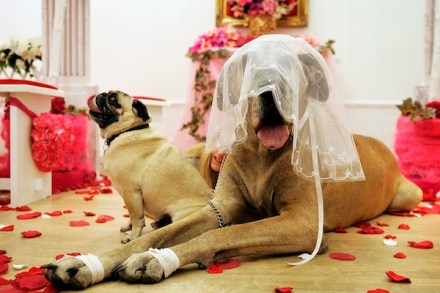
Looking forward, as one always must, I wonder if the law will eventually be changed to allow one to marry one’s dog. Until now, this would have been considered disgusting, since marriage has been a law revolving around sexual behaviour, and sexual acts with animals are still, I believe, illegal. But, as this column has pointed out, the unintended consequence of the same-sex marriage legislation has been to take sex out of marriage law. Civil servants, unable to define same-sex consummation, omitted it. So marriage, from now on, can mean no more than the legally registered decision of two people to live together while not being married to anyone else. The justification for this is ‘equality’, buttressed by the idea that love must carry all before it.

The system for MPs’ pay is an undemocratic absurdity

MPs are incomparable. This may seem an odd thing to say in the current climate of opinion, but I mean it exactly: they cannot be compared with others. Now that a big rise is being suggested by Ipsa, the ‘independent’ body which sets their pay, people say they should be compared with local authority chief executives or head teachers, or that they are a profession. They cannot, and they aren’t. They are our elected representatives. We elect them to make our laws and to vote ‘supply’, i.e. to decide how much of our money government may spend. They therefore constitutionally must decide, in public, on their own pay (if any) and vote on it.

Charles Moore: Why not marry a dog?

MPs are incomparable. This may seem an odd thing to say in the current climate of opinion, but I mean it exactly: they cannot be compared with others. Now that a big rise is being suggested by Ipsa, the ‘independent’ body which sets their pay, people say they should be compared with local authority chief executives or head teachers, or that they are a profession. They cannot, and they aren’t. They are our elected representatives. We elect them to make our laws and to vote ‘supply’, i.e. to decide how much of our money government may spend. They therefore constitutionally must decide, in public, on their own pay (if any) and vote on it. Anything else is an evasion, and Ipsa or anything like it is a power above Parliament, and therefore unanswerable to voters.

Why do we assume that ‘whistleblowers’ like Edward Snowden are always in the right?

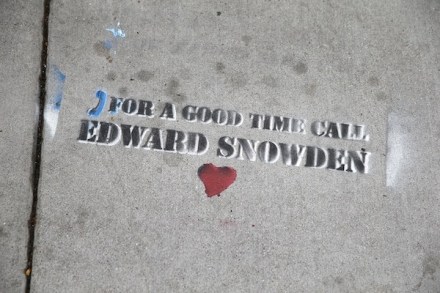
Although virtually everyone, including me, is against the dreadful people who ran the Care Quality Commission, I do notice that something ridiculous has crept into all reporting of such rows. This is the unquestioned assumption that the ‘whistleblower’ is in the right. Other recent examples include the mysterious anti-CIA and anti-GCHQ man, Edward Snowden, the police who appear to have invented what Andrew Mitchell told them at the Downing Street gates, and anyone who ever accuses anyone in any position of authority of having performed acts of paedophilia. We know that many people in big organisations have base motives for covering things up, and we excoriate them for doing so.

Gay divorce

It has already been announced that there will be no provision for adultery as grounds for single-sex divorce, for the obvious reason (though it was only belatedly obvious to the legislators) that same-sex intercourse, having no procreative purpose, cannot have any definition of consummation, and therefore cannot be adulterated. Now it turns out, however, that if someone in a single-sex marriage has intercourse with a member of the opposite sex, this will be grounds for divorce. Since such intercourse will presumably be unwelcome to most homosexuals, and yet useful in divorce proceedings, one can foresee a return to the pre-war system, satirised by A.P. Herbert in Holy Deadlock.

The Spectator’s Notes | 27 June 2013

Jane Austen is a ‘contingency character’, we have just learnt. In his last appearance as Governor of the Bank of England before the Treasury Select Committee of the House of Commons, Sir Mervyn King explained that the great novelist rather slightingly so described stands in reserve to feature on any of our bank notes if too many people succeed in counterfeiting the current occupants. She is also in the running for the ten-pound note when Charles Darwin relinquishes it. This is a hot issue, because the notes do not feature enough women, we are told — despite the fact that since 1952, 100 per cent of them have featured a woman (the Queen).

If they want another woman to depict on bank notes, how about Margaret Thatcher?

Jane Austen is a ‘contingency character’, we have just learnt. In his last appearance as Governor of the Bank of England before the Treasury Select Committee of the House of Commons, Sir Mervyn King explained that the great novelist rather slightingly so described stands in reserve to feature on any of our bank notes if too many people succeed in counterfeiting the current occupants. She is also in the running for the ten-pound note when Charles Darwin relinquishes it. This is a hot issue, because the notes do not feature enough women, we are told — despite the fact that since 1952, 100 per cent of them have featured a woman (the Queen).

The future of Christianity in Britain? Christian first, denominational second

What is the future of Christianity in Britain, Mr Moore?’ I was asked as I rushed down the stairs to catch a train. I wished I had the gift of concision of the late William Douglas-Home, who, when asked in an exam paper ‘What is the future of coal?’, wrote ‘Smoke’. I had just been addressing a meeting of the Friends of the Ordinariate, the body set up by Pope Benedict to enable Anglicans to be in communion with the Catholic Church without abandoning the liturgical and spiritual traditions of their Anglicanism. It tries to bring reality to Jesus’ own statement: ‘In my Father’s house are many mansions.

So where is the ‘ecosystem collapse’ that Prince Charles warned us about?

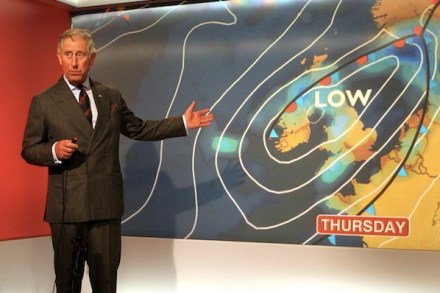
It is traditional for me, at this season, to remind readers of the Prince of Wales’s prophecy, spoken in Brazil in March 2009. His Royal Highness warned that the world had ‘only 100 months to avert irretrievable climate and ecosystem collapse’. So only four years now remain. But as I write, the Met Office is meeting in Exeter for an unprecedented summit to work out why it has predicted for the past 13 years that the British climate will get warmer only to find, in 12 out of the 13, that it has got colder. No one is admitting, of course, that the end of the world is not nigh, but one does notice much self-exculpatory talk of how weather is affected by ‘a host of other factors’.

The Spectator’s notes | 20 June 2013

When he arrived for the G8 in Co. Fermanagh, President Obama told the people of Northern Ireland that those living with conflict in far-flung places are ‘studying what you’re doing’ and that ‘You’re the blueprint to follow’. If they really were studying it, they would be less confident of the blueprint status. It is not true that the Belfast Agreement meant that, as the President put it, ‘clenched fists gave way to outstretched hands’. What happened was that the roughest major grouping on each side — the Paisleyites and Sinn Fein — saw that they could crowd out their more moderate rivals and divide the spoils of office between them. If hands are outstretched, it is more for public money than for peace.

Opposing gay marriage now is as brave as being openly gay was in 1970

Since one’s attitude to homosexual acts is now considered the main way of judging whether a person is civilised, one must salute those in public life who defy this. To oppose gay ‘equality’ today is roughly as brave as it was to be publicly homosexual in, say, 1970: your position is not absolutely illegal, but it is perilous. Given how wobbly many Anglicans are on the issue, the Archbishop of Canterbury and the Bishop of London should be commended for their courage in the House of Lords debate. The Chief Rabbi, Lords Sacks, should be reproved. Orthodox Judaism is absolutely clear on this issue, but Lord Sacks absented himself. Perhaps he feels that Jews should not intervene in secular society.

The Spectator’s Notes | 13 June 2013

Few things in history can be more worth thinking about than the first world war, so in a way one welcomes the government’s plan for extensive centenary commemorations. And I do not agree with the critics that part of the purpose should be to blame the Germans: such blame is not a task for government. The bigger worry is surely twofold. One is that, over the planned four years, the commemorations will dissipate their energies in cultural trench warfare and get muddled up with the normal (and excellent) patterns of Remembrance. The other is that they will resemble those semi-apologies about any violent death in our history which have become a cheap way for political leaders to show themselves more enlightened than their predecessors.

First Mercer, now Yeo – isn’t it time politicians tried to entrap journalists?

Now that it has become commonplace for the press to entrap MPs and peers, why don’t our legislators try to turn the tables? I suggest that ministers sidle up to journalists (secretly filming them the while) and offer them honours. They should hint that the honour is conditional on favourable coverage, and agree to meet again in six months. In between, they should track what the journalists write, and then, when they have trapped their victims, expose the pattern. Another trick would be for politicians to get friends to pretend to be businessmen offering journalists money or freebies to place products in their stories and features. These tactics would get interesting results. The latest Sunday Times sting can be read here (£).

The Spectator’s Notes | 6 June 2013

What a strange country this is. On the same day that we celebrated the 60th anniversary of the coronation, a mystical rite founded for the ancient kings of Israel and continuous here for a thousand years, our almost equally venerable House of Lords voted to undermine the basis of the oldest of all human relationships recognised in law. The new Archbishop of Canterbury spoke very well on both subjects. In Westminster Abbey, he praised the Queen’s ‘servant leadership’, and reminded the congregation that Jesus ‘did not count equality with God a thing to be grasped, but humbled Himself and took the form of a slave’. But in Parliament, equality was greedily grasped.

How Equality will do for the Right in the end

As the Same Sex Marriage result shows, the doctrine of Equality now carries all — family, religion, tradition, freedom — before it. Lots of Conservatives prate in favour of it without realising that Equality is the most essentially left-wing of all doctrines and will do for them in the end. Watching the Derby on television on Saturday, I found myself treated to ten minutes of how wonderful Emily Davison was for throwing herself under the King’s horse at Epsom 100 years ago. Dr Helen Pankhurst, of the suffragette dynasty, was interviewed at the racecourse by Clare Balding.

The Spectator’s Notes | 30 May 2013

The website of the Security Service (MI5) says that since the end of the Cold War, the threat of subversion is ‘now considered to be negligible’. Isn’t this a mistake? It seems likely that many Muslim organisations — university Islamic societies, for example — are subverted by jihadists. The infiltrators whip up hatred against the West and create networks, rudimentary but often powerful, of the like-minded. When they have done their work well, they do not need to give direct orders to people like the Woolwich murderers to kill: they have primed their human device, and left it to explode. Such subversion may not be backed by foreign state power, but it still resembles communism in its ability to infiltrate minds and organisations at the same time.

MI5 is wrong: subversion is still a threat

The website of the Security Service (MI5) says that since the end of the Cold War, the threat of subversion is ‘now considered to be negligible’. Isn’t this a mistake? It seems likely that many Muslim organisations — university Islamic societies, for example — are subverted by jihadists. The infiltrators whip up hatred against the West and create networks, rudimentary but often powerful, of the like-minded. When they have done their work well, they do not need to give direct orders to people like the Woolwich murderers to kill: they have primed their human device, and left it to explode. Such subversion may not be backed by foreign state power, but it still resembles communism in its ability to infiltrate minds and organisations at the same time.

The Spectator’s Notes | 16 May 2013

The BBC loves nothing better than a narrative in which Tory anti-European eccentrics split their party, and a bewildered public votes Labour. It is certainly the case that some of the Tory sceptics are half-crazed by dislike of David Cameron. But the reason the subject keeps coming up is because it matters, and it remains unresolved. The Tory rebels understand this in straightforward electoral terms: the rise of Ukip threatens their seats, so they must do something about it. What is maddening is not so much Mr Cameron’s actual policy on Europe, but his patent longing to avoid the subject. His refusal to ‘bang on’ about Europe has brought about more banging on than ever.

Refusing to bang on about Europe has brought about even more banging on than before

The BBC loves nothing better than a narrative in which Tory anti-European eccentrics split their party, and a bewildered public votes Labour. It is certainly the case that some of the Tory sceptics are half-crazed by dislike of David Cameron. But the reason the subject keeps coming up is because it matters, and it remains unresolved. The Tory rebels understand this in straightforward electoral terms: the rise of Ukip threatens their seats, so they must do something about it. What is maddening is not so much Mr Cameron’s actual policy on Europe, but his patent longing to avoid the subject. His refusal to ‘bang on’ about Europe has brought about more banging on than ever. This is an extract from Charles Moore's Spectator's Notes in this week's magazine.