Charles Moore

Charles Moore

Charles Moore is The Spectator’s chairman.

He is a former editor of the magazine, as well as the Sunday Telegraph and the Daily Telegraph. He became a non-affiliated peer in July 2020.

The Spectator’s Notes | 6 April 2017

Cadbury and the National Trust stand accused of taking the Easter out of Easter eggs. The Trust’s ‘Easter Egg Trail’ is now renamed the ‘Cadbury Egg Hunt’. My little theory about the National Trust is that all its current woes result from the tyranny of success: it has become so attached to ever-growing membership (now more than four million) that everything is skewed to this and the original purposes are neglected. No doubt the substitution of the word ‘Easter’ by the word ‘Cadbury’ seemed a small price to pay for big sponsorship. This decision is a symptom of the Trust’s problem. But for the fate of Easter itself, one need not worry.

The National Trust is compromised by its own success

Cadbury and the National Trust stand accused of taking the Easter out of Easter eggs. The Trust’s ‘Easter Egg Trail’ is now renamed the ‘Cadbury Egg Hunt’. My little theory about the National Trust is that all its current woes result from the tyranny of success: it has become so attached to ever-growing membership (now more than four million) that everything is skewed to this and the original purposes are neglected. No doubt the substitution of the word ‘Easter’ by the word ‘Cadbury’ seemed a small price to pay for big sponsorship. This decision is a symptom of the Trust’s problem. But for the fate of Easter itself, one need not worry.

Battersea Dogs’ Home’s political advocacy is a step too far

Battersea Dogs and Cats Home is running a poster campaign to increase sentences for cruelty to animals. The current maximum is six months. It is probably popular — almost all campaigns for higher prison sentences are. But I doubt if the public interest would be served by locking up offenders for five years, as Battersea demands. The prisons are already full to bursting, increasingly by elderly people accused (in some cases, falsely) of ‘historic’ child abuse. Each prisoner costs the taxpayer more than £30,000 a year. One should be prepared to listen to the arguments, however. My real point is different: why should a dogs’ home campaign on public policy?

When our armed police open fire have we got their backs?

I walked past Parliament, five days after Khalid Masood’s fatal attack. I looked at all the armed policemen on all the gates visible to the public. All were talking to one another rather than surveying the scene in front of them. As I write, the only person, so far as we know, being actively investigated by the authorities for his part in the events of last week is Sir Michael Fallon’s close protection officer, who shot Masood dead. Under our rules, it is automatic that the Independent Police Complaints Commission investigates any officer who shoots anyone. It is hard to know whether to admire this as a mark of civilisation or gasp in exasperation.

Let’s compare Sturgeon and May’s sure-footedness – not their legs

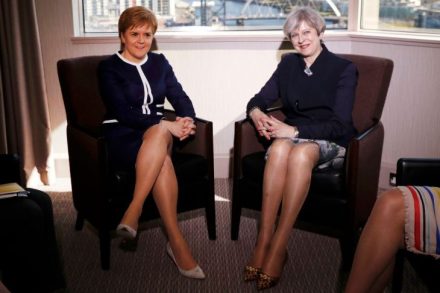
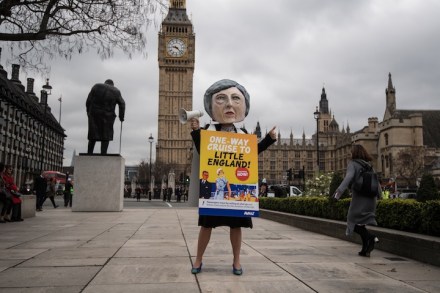
One must not make odious comparisons between Mrs May’s legs and those of Ms Sturgeon, but it is not sexist to ask which is the more sure-footed. So far, Ms Sturgeon has run much the faster, and by doing so has gained attention far in excess of the numbers she can command. Mrs May might look the more plodding. But as Ms Sturgeon charges forward yet again with a call for another referendum, I wonder if she is becoming like Bonnie Prince Charlie, who reached Derby, and then slipped.

The Spectator’s Notes | 30 March 2017

An email from the high-minded Carnegie Endowment, marking the triggering of Article 50 and the 60th anniversary of the Treaty of Rome, speaks of ‘The Closing of the European Mind’. ‘The cult of the protective sovereign nation-state,’ it goes on, ‘will not provide convincing solutions to 21st-century challenges, which are inherently transnational.’ This is true, in a way. Lots of modern challenges cannot be solved by the nation-state alone. But is there anyone — even including the ‘Anywheres’ defined recently by David Goodhart — who would be happy to inhabit a space completely unprotected by a sovereign state?

Could Health and Safety kill off home cooking?

If Health and Safety is (are?) your thing, you must always be dreaming, like Alexander the Great, of new worlds to conquer. The next one, I predict, will be cooking at home. Recently I have noticed talk about the bad effect of ‘particles’ produced by hot food cooked in or on ovens. The sequence will go thus: a study will prove that people who cook at home inhale more particles than others, reducing their life expectancy. A woman seeking divorce will win a higher settlement because, she says, she was forced to spend hours of each day in such dangerous culinary conditions, suffering various ‘harms’. Then it will be shown that children are the innocent victims of passive cooking. Ovens, except for microwaves, will be forbidden in new-build homes.

The Spectator’s notes | 23 March 2017

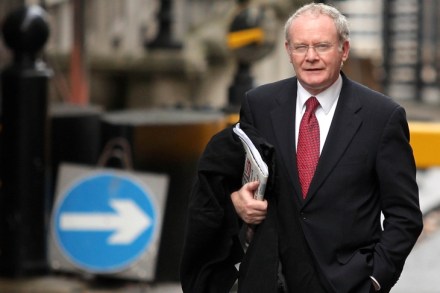
We keep being incited to find it heartwarming that Martin McGuinness and Ian Paisley were known as the Chuckle Brothers. But what were they chuckling about? Their shared success at outwitting the British state. Both, though for opposite reasons, had made their careers out of harassing Britain, and both, in their later years, had acquired money, power and status by doing so. In the case of McGuinness and his gang, Britain greatly underplayed its hand. Having militarily beaten the IRA, successive British governments could have marginalised them, but instead they accepted them as authentic representatives of the Irish people who had to be included in any settlement. The process for doing this systematically disadvantaged the moderates and bigged up the thugs.

Martin McGuinness changed his ways – but he never changed his mind

We keep being incited to find it heartwarming that Martin McGuinness and Ian Paisley were known as the Chuckle Brothers. But what were they chuckling about? Their shared success at outwitting the British state. Both, though for opposite reasons, had made their careers out of harassing Britain, and both, in their later years, had acquired money, power and status by doing so. In the case of McGuinness and his gang, Britain greatly underplayed its hand. Having militarily beaten the IRA, successive British governments could have marginalised them, but instead they accepted them as authentic representatives of the Irish people who had to be included in any settlement. The process for doing this systematically disadvantaged the moderates and bigged up the thugs.

Too many Hoggs spoil it for Charlotte

Charlotte Hogg forgot to tell the Bank of England, of which she had been appointed deputy governor, that her brother Quintin is director of strategy at Barclays bank. She has had to resign. There is something strange about this story. After all, if the Bank of England did not know already that her brother held this position, its knowledge of the banking world it is supposed to supervise must be thin indeed. You can see why Miss Hogg might have assumed that those appointing her knew already, and so have given it no thought, rather as Tony Blair and David Cameron probably never thought to put in the Register of Interests as lawmakers that their brothers are QCs.

The Spectator’s Notes | 16 March 2017

The great achievement of the Scottish Nationalists is to persuade people outside the borders of their own nation — including the London-based media — to equate them with the Scottish people. Obviously, they are their chief elected representatives just now, but the result of the referendum on Scottish independence quite clearly showed that the equation is false. So when Nicola Sturgeon says there has to be another referendum because of Brexit, the equation should be much more firmly challenged. There is no moral reason why the result of a declaredly UK-wide referendum should require another vote in part of the kingdom (next, UDI for London?). Nor is there a constitutional right.

Sturgeon’s great trick has been to convince us the SNP represent all Scots

The great achievement of the Scottish Nationalists is to persuade people outside the borders of their own nation — including the London-based media — to equate them with the Scottish people. Obviously, they are their chief elected representatives just now, but the result of the referendum on Scottish independence quite clearly showed that the equation is false. So when Nicola Sturgeon says there has to be another referendum because of Brexit, the equation should be much more firmly challenged. There is no moral reason why the result of a declaredly UK-wide referendum should require another vote in part of the kingdom (next, UDI for London?). Nor is there a constitutional right.

Remembering Tristan Voorspuy, who was recently killed in Kenya

After he left the Blues and Royals in 1981, the young Tristan Voorspuy drove a motorbike from London to Cape Town. Thus began his love of Africa. He also learnt to fly, and arranged to travel alone to Kenya from England in a single-engine aeroplane, using only a schoolboy atlas. Luckily, his brother Morvern, a professional pilot, heard of this plan and prevented it. But Tristan reached Kenya by other means, and became a Kenyan citizen. For 30 years, he was a leading conservationist there and set up and ran the accurately named firm Offbeat Safaris, which allows guests to ride among the great beasts of Africa.

The Spectator’s Notes | 9 March 2017

After he left the Blues and Royals in 1981, the young Tristan Voorspuy drove a motorbike from London to Cape Town. Thus began his love of Africa. He also learnt to fly, and arranged to travel alone to Kenya from England in a single-engine aeroplane, using only a schoolboy atlas. Luckily, his brother Morvern, a professional pilot, heard of this plan and prevented it. But Tristan reached Kenya by other means, and became a Kenyan citizen. For 30 years, he was a leading conservationist there and set up and ran the accurately named firm Offbeat Safaris, which allows guests to ride among the great beasts of Africa.

In defence of Lord Heseltine

Lord Heseltine has been denounced because he says he will vote against the government over Brexit in the House of Lords. It seems terrifically unfair. Has there ever been an occasion, in his long political career, when he has not been in favour of British membership of the EU (or EEC)? Why should he change now, aged 83, from that honourably held, spiritedly asserted, if wrong, position? Can’t a few Europhiles, in the mirror-image of John Major’s Eurosceptic ‘bastards’, be bastards too? The only inconsistency in Hezza’s last stand is that this is the one time in his half-century stance on Europe when he has asserted the right of Parliament to decide anything.

Excusing a huge group of paedophiles isn’t the answer to tackling child abuse

Chief Constable Simon Bailey, who heads Operation Hydrant, the police investigation of ‘non-recent’ child abuse cases, now says that paedophiles who view images of child abuse should not be prosecuted, because police cannot cope with the numbers involved. Mr Bailey is wedded to the doctrine that someone who says he is an abuse victim must automatically be believed. The result, said Sir Richard Henriques in his scathing report on Operation Midland, is that the criminal justice system totters: ‘Chief Constable Bailey’s argument ignores the consequences of false terminology.’ Another consequence is that the child abuse statistics, unchecked, explode.

The Spectator’s Notes | 2 March 2017

Chief Constable Simon Bailey, who heads Operation Hydrant, the police investigation of ‘non-recent’ child abuse cases, now says that paedophiles who view images of child abuse should not be prosecuted, because police cannot cope with the numbers involved. Mr Bailey is wedded to the doctrine that someone who says he is an abuse victim must automatically be believed. The result, said Sir Richard Henriques in his scathing report on Operation Midland, is that the criminal justice system totters: ‘Chief Constable Bailey’s argument ignores the consequences of false terminology.’ Another consequence is that the child abuse statistics, unchecked, explode.

There’s a simple way of dealing with the BBC’s TV licence bullies

Congratulations to the Daily Mail for exposing the unpleasant methods by which TV Licensing’s staff make people pay their television licence fees. Capita, the company that does the dirty work for the BBC, encourages its employees to use ‘ruthless and underhand tactics’ to collect the money, says the Mail. The paper offers painful examples of the victims — ‘RAF man with dementia, mum in a women’s refuge’. It could have added ‘veteran Spectator columnist’, since these activities were first exposed on this page in 2006, when I got fed up with being pursued by Capita to buy a TV licence for a flat without a television. The Mail correctly identifies the unpleasant incentive system, but it doesn’t get to the heart of the issue.

Is Michael Gove angling for a cabinet return?

I never expected to be writing the following, since Michael Gove is, to me, one of the few heroic figures in modern politics. But he did write a very strange column in the Times last week, inciting the government to ‘Put VAT on school fees and soak the rich’. He seems to be outraged that what he calls ‘the education of the children of plutocrats and oligarchs’ is a charitable activity. Private schools get rate rebates, VAT exemptions and free uniforms, weapons etc for their cadet forces, he says. This is ‘egregious state support’. He also mocks the many bursaries provided by public schools, on the grounds that these have ‘left behind’ all those who do not receive them.

Saying sorry to Liverpool is a politician’s rite of passage

As Paul Nuttall, the Ukip leader, has recently discovered, there usually comes a point in a British political career when you have to apologise to Liverpool. The origins of this custom are obscure, rather like the rule that the Cap of Maintenance must accompany the Sovereign to the State Opening of Parliament, but it must not be questioned. It is no good asking why Liverpool should receive more apologies than, for instance, Runcorn or Milton Keynes: you must just say sorry. Rather than having to stammer an inconvenient ‘mea culpa’ at a by- election it would be more sensible to get your apology in first.