Bruce Anderson

Bruce Anderson is The Spectator's drink critic, and was the magazine's political editor

South Africa and a toast to democracy

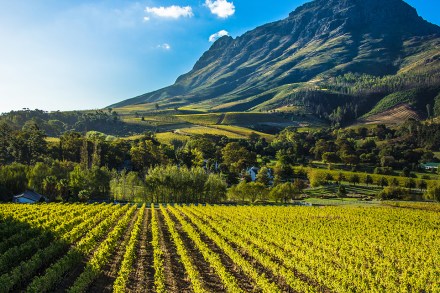
Not everything in the entire world is going to hell in a half-track. A few days ago, I tasted some South African wines. Although there are many reasons for a gloomy appraisal of South Africa’s prospects, wine is not among them. The industry is benefitting from new investment, encouraged by easier export markets made possible by political change. Even under the previous dispensation, there were excellent vine-yards in the Cape, the product of a fruitful racial compact. When the Huguenot refugees arrived at Table Bay, they brought their oenophile lore and rapidly assimilated with the Dutch settlers who were already establishing themselves. The name Franschhoek survives, as do many French surnames, although the language largely disappeared.

My Advent vinousness

Some simpering bishops are urging their clergy to make sure that carol services do not interfere with the ship of football. That leads to an obvious conclusion: Christmas is too important to be left to the Church of England. The vulgarities of commercialisation are distressing, but survivable. Last year, one friend became fed up with his brats’ lust for presents and upbraided them: ‘If this goes on, you’ll be given nothing but bibles and prayer books.’ He remembered his father saying the same to him. No doubt his grandparents delivered similar thunderbolts in their day. Thus life rolls on.

The overlooked brilliance of Branaire-Ducru 

At the end of last century, when there were grounds for optimism about Russia’s future, an increasingly popular word expressed this: stabilnost – stability. Russians would roll it round their mouths as a Texan would use ‘goddam’, or an English after-dinner drinker of an earlier vintage might evoke his enjoyment of the beverage by letting the word ‘port’ linger across his palate. I do not suppose that there is much talk of stabilnost in Moscow these days, and we could do with some of it here. Still, there are ways of banishing dull care, if only for a few hours, and drinking fine claret is one of them. The other evening, I was at a tasting of Branaire-Ducru and my first conclusion was that I had not drunk it nearly often enough. It is a St Julien.

The wartime roots of Italian Pinot Noir

Wine-making can have a tragic dimension, and rarely more so than with Italian Pinot Nero: that is, Pinot Noir. It is often made amid blood-soaked landscapes, where tragedy regularly arose out of pretensions to grandeur. If you wish to read an overview of modern Italian history in order to understand why, the place to start is David Gilmour’s The Pursuit of Italy. Despite the quality of the prose, mention Sir David’s book even to thoughtful Italians, and you might be surprised by the lack of enthusiasm. He applies a revisionist scalpel to national myths, without benefit of anaesthetic.

The Eton vs Winchester of the wine world

A few days ago, when everything looked black, a small group of us were consoling ourselves over a couple of good bottles. ‘In politics,’ said I, ‘things are never as bad as you fear, or as good as you hope.’ ‘I entirely agree,’ replied one friend. ‘At the moment, things are not as bad as I fear. They are worse.’ That was before Bojo lost his mojo. Has his curse now finally been lifted from the Conservative party? It would be foolish to offer a swift and complacent ‘yes’. Among the political figures Boris resembles, we must include not only Alcibiades, Silvio Berlusconi and Donald Trump. There is also Rasputin. Can we be certain that Mr Johnson has been given the full fatal dosage: icy Neva, silver bullet, poisoned cake, stake through the heart?

A wine company after Roger Scruton’s heart

‘Golden’ is often used to describe the hue of some wines in the glass. But there is another resemblance. Gold is a beautiful metal as well as a store of value. Wine, covetable for its taste, can also be a store of value, at least for many years. So it inevitably attracts the attention of investors, the best of whom want to deploy expertise partly in order to finance their drinking. The late Roger Scruton, no less, once wrote a piece explaining how it was possible to drink Château Lafite free. You estimate your future needs and then buy twice the quantity. Within a few years, you should be able to sell half your bottles for the cost of the whole. I never asked him whether he had tried this out. But there is a firm based in London which is run on Scrutonian lines.

Why the dry martini is the finest cocktail of all

We were discussing bourbon and whether American whiskey could ever rival Scotch. I recalled the first time I ever tried the transatlantic spirit. It was more than 50 years ago, in an undergraduate room in Oxford. The occupant was an ingenious fellow. At the beginning of one term, he wrote to Jim Beam, the whiskey makers. He informed them that he had discovered their wonderful product in the States, but it appeared to be impossible to come by in Oxford, which was a pity, because it deserved to be better known (in truth he had never tasted it and had never been to the US). A case shortly arrived, followed by another at the beginning of next term, and so on. He sent enthusiastic letters of thanks, assuring the Beam-ites that his friends were developing a lifelong taste for the stuff.

A toast to absent friends

There have been few more momentous weeks in British history, or indeed in world history. This commentator must plead guilty. To draw on George Bush Jr, I mis-underestimated Liz Truss and appear to have made the same mistake about Ukraine. That said, we should all be relieved when the war is over on favourable terms, and tactical nukes have remained an item in Russian military doctrine, without becoming part of military practice. Another mis-underestimation has now been corrected, one hopes permanently. Though I was never guilty, the former Prince of Wales had not received the respect that was his due. That is not true of King Charles III. Throughout the United Kingdom, his first coronation has already taken place, in his loyal subjects’ hearts. The Queen is dead.

A toast to the field marshals

August may not be the cruellest month but it is often the most dangerous one. Now that it is over, and rosé is giving way to grouse, we can console ourselves. There has not been a world war. We merely face a number of middle--ranking crises. Over fortifying bottles, I was chatting about such matters with friends who had known the late Peter Inge, a dominating figure even by field marshal standards. It was said that in his company, brigadiers’ coffee cups would rattle with tension. I once taxed him with the contrast between his reputation as a martinet’s martinet and his geniality in private life.

At least we still have wine

Even in recent heat, the English summer can be magical. As long as there is shade, a pool and a steady supply of cooling wine, there is so much to enjoy. Trees, flowers, songbirds, butterflies: dolce far niente works here too. But thinking can be the snake which insinuates itself into Eden. Susan Hill’s Simon Serrailler books are always excellent train reading and the latest was no exception, even if the principal character always puts one in mind of Turner’s supposed reply to someone who said that they had never seen a sunset like the one which he had painted. ‘But don’t you wish you could?’ It is hard to believe that there are many actual policemen like Simon Serrailler – more’s the pity. There are other reasons for pity.

Should you really pair Pimm’s with oysters?

Imagine a camel train, crossing the great desert. The remaining water is rancid; the beasts’ humps are shrunken. Death looms. Then suddenly, there is the sound of a fountain plashing and the scent of sherbet. Old Abdullah, who has done the journey often, as he has been reminding everyone for ten days and making his companions increasingly homicidal, is vindicated. The oasis is at hand. Although Londoners, afflicted by heat, may feel affinity with those sons of the desert, our conditions are not so dire. For a start, there are many more oases, in the form of bars or clubs. That brings us to Pimm’s, that admirable method of rehydration. According to the sources, Mr Pimm invented the drink to accompany oysters. Eh?

Think pink: there’s no shame in quaffing rosé in England

In the battle of ideas, it is sometimes necessary to make a tactical withdrawal. That is now the case over climate change. This should not be confused with a full retreat. But in the circumstances, those who insist on the need for lifestyle changes have a point, at least when it comes to wine. Some time ago, I propounded a dictum. Rosé should only be drunk south of Lyon. One could start quite early – 10.30 perhaps, opening the first bottle while brushing away the final crumbs of croissant. Apart from a very few serious wines, it would not matter if the stuff were cooled to ice-lolly temperature. But in this heat, there is no shame in quaffing rosé in England. Other wines can be problematic. Freedom and whisky gang thegither.

The ghost of Thatcher is haunting the Tory leadership race

At least one groundless anxiety has surfaced during the Tory leadership contest. It concerns Boris Johnson's future and the fear that he will try to undermine his successor, in the way Margaret Thatcher treated John Major. But that ought to be the least of the party’s anxieties. It is true that Boris will not display any loyalty to the new leader, or to the party – or indeed to the country. If he were to give an honest response, it would be a simple one: 'What's in it for me?’ He needs money. Freed from the constraints of Downing Street, he will want to have fun (watch him, Carrie). But this will all lead him, not towards serious political engagement, but to the light entertainment industry.

My memorable night at the Carlton Club

‘Club’ is a four-letter word. Whenever a club is mentioned in the press, it will inevitably be portrayed as a sinister meeting place where men gather in secret to plot against the common weal. If only. The main point about all clubs is that they are fun. That is true in St James’s. It is also true in the working-men’s clubs of the north and Midlands. That said, the Carlton Club could claim to be a special case, although anyone entering its portals in the hope of coming across louche behaviour would be disappointed (almost always). But it could be regarded as a trustee of the Conservative party. As such, it has provided the setting for crucial events, most notably in 1922.

A voyage through fine wine off Sardinia

One could get used to this. I come from seafaring stock, albeit distant. ‘Anderson’ suggests Viking antecedents, especially as my forebears came from the Shetland Islands. Yet there must have been something wrong with the first Anderson. Other Vikings reached Normandy, Sicily, even Byzantium. At the very least, they found the odd monastery to plunder. Later, their Norman descendants compensated for cultural destruction with cultural creation. But to endure the rigours of crossing from Norway and then disembark on Shetland? Was my remote ancestor seasick, or mutinous, or did he rape the cabin boy? We will never know. A millennium or so later, life at sea was rather different. We were on a yacht, cruising between Sardinia and Corsica.

A claret to toast the Queen – and forget the Prime Minister

It was an extraordinary weekend. The various spectacles had something for all tastes: pageantry on Horse Guards; solemnity in St Paul’s; the street party of all street parties on the Mall. And there was also food for thought. What does this tell us about the monarchy, and about Britain? I discussed it with a French friend, abetted by some moderately serious claret. We agreed that France was a monarchy masquerading as a republic; Spain, a republic pretending to be a monarchy. As for Britain, the monarchy is as secure as it has ever been. The evolution of British institutions regularly refutes Our Lord Himself. It is possible to put new wine into old bottles.

The perfect pairing of books and wine

In the West End of London there is an alley which insinuates its way between the Charing Cross Road and St Martin’s Lane. It is called Cecil Court, and the Salisbury pub is close at hand. Those are clues. The area around Cecil Court has been owned by the Salisbury branch of the Cecil family since the 17th century. For a long period, it was not a salubrious area. At least one local was hanged. Others were transported. There may have been a whorehouse or two. The ambience resembled a cross between Fagin’s kitchen and Mistress Quickly’s Boar’s Head, with Doll tearing the sheets. Then everything changed, thanks to Victorian morality and political pressure. The Third Marquess of Salisbury was a devout churchman as well as a prime minister.

The horror of gluten-free beer

I was reminded of the worst liquid that I have ever consumed. It was the last occasion on which I drank Coca-Cola, nearly 50 years ago. To be fair to Coke, this bottle was at room temperature, and the room was in the Anatolian peninsula, during the ferocity of high summer. A group of us were travelling in a battered old bus, still four hours by bad roads from Izmir, hot water and cold beer. Having run out of bottled water, we needed something to stave off dehydration. The village offered a choice: well water or parboiled Coke. An aristocratic French leftie was moved to a declamation: ‘Moi, j’ai un horreur de Coca-Cola.’ I concurred.

Do the Tories really want Boris to fight the next election?

In large part, these local elections were a referendum on a basic proposition. Do the government and the Prime Minister deserve a kick in the pants? As it was virtually impossible to argue against that verdict, Boris Johnson could claim to have done surprisingly well. Indeed, some of his Tory critics are disappointed with the outcome. It does not justify an immediate coup. That said, it seems certain that many of the Tory losses can be blamed on Boris. A lot of traditional Tories, who are used to seriousness in their own lives, will not accept lower standards in their prime minister. This appears to have been especially true in London. In local elections, London always attracts disproportionate attention. Keir Starmer will be grateful for that.

Tony Blair was a victim of his own success

Napoleon is said to have placed a high value on lucky generals, though no one has succeeded in identifying the source of the quote. Then again, he would hardly have been in favour of unlucky ones. Luck is equally important in politics. For ten years, Margaret Thatcher had it, and exploited it ruthlessly. Her successor, John Major, was less fortunate. Events, and his opponents, seemed determined to give him the doubt of every benefit. He hardly had any luck, and his enemies were also ruthless, in exploiting its absence. What a contrast with Tony Blair – who celebrates the 25th anniversary of his 1997 election win today. No British politician has ever enjoyed such a cornucopia of good fortune. In his political career, he had started out as Gordon Brown’s younger brother.