Bruce Anderson

Bruce Anderson is The Spectator's drink critic, and was the magazine's political editor

Felines and Figaro

I know little about human medicine: still less about the animal equivalent. So I had always assumed that vets were failed doctors, who had to make their living in muddy byres at 4 a.m., managing the cow through a difficult pregnancy while trying to avoid her hooves. The other evening, at a dinner party full of cat owners, I heard an entirely different version. Everyone had horror stories about the cost of cat medicine. The winner was a girl whose moggy’s treatment had cost over £1,000, including the price of three days in a cat hospital. There had been an uncovenanted benefit. When Daphne came home, she displayed gratitude, or at least catitude. If that became known in feline circles, she would be in trouble.

From Hegel to Riesling

John Stuart Mill did not describe the Conservatives as the stupid party. He merely said that although not all Tories were stupid, most stupid people voted for them (cf. Brexit). But at any level above automatic loyalty at the polling box — not to be deprecated — Conservatism is no creed for the intellectually limited. It requires hard thinking. The socialists have an easier life. First, they have a secular teleology: socialism. Second, assuming that history is on their side, many lefties feel entitled to lapse into a complacent assumption of moral superiority. That helps to explain why there has been no serious left-wing thinking in the UK since Tony Crosland in the 1950s. Though Tories may envy the complacency, they are condemned to stress.

A summer evening with Cameron

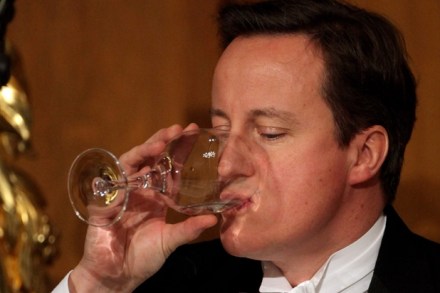
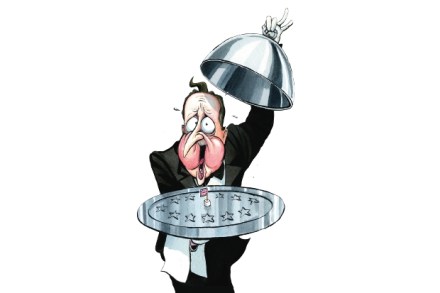
Journalists are chronic exaggerators. Strong words are always being thrown away on trivial events. ‘Whitehall was shocked last night as a bitter new row broke out…’ Translation into truth-speak: ‘There was a certain amount of interest in some quarters of Whitehall yesterday as an exchange of memoranda between the department of string and the ministry of candle-ends revealed…’ Now we truly are in shock and bitterness. Nation divided, party divided, Union in peril, City under threat, entire economy under threat. Europe weakened, the West weakened: Putin delighted, Trump delighted. A great nation has turned itself into a music-hall act for the gratification of domestic and global cretinism.

Gossip from the top table

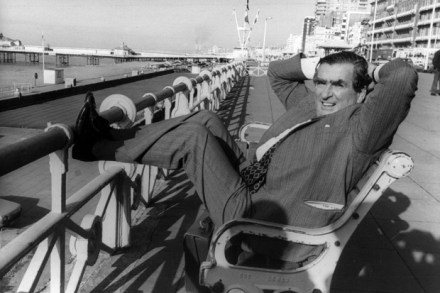
In the 1970s, when there were many fewer restaurants in London, Locket’s was much the best place to eat around Westminster. The IRA once paid it a compliment by -trying to bomb it. If a lobbyist -invited one to lunch there, it meant that a) his firm had a large budget, b) he was hoping for important information — or c) he was feeling like a good lunch. The food was a pre-nouvelle cuisine London version of sophisticated French food: dishes such as Tournedos Rossini or Steak Diane; you get the picture (the upper-middle-class version of prawn cocktail and Black Forest gateau). Locket’s catered for trenchermen’s appetites, and I remember a couple of proper sessions there with Denis -Healey.

A hell-cat in heaven

Over the weekend I officiated at a funeral. Earlier in the morning there had been lowering rain clouds, but by the time we dug the grave there were blue skies to salute Albert’s passing. He deserved them. It was also appropriate that he died just before the anniversary of Jutland, for this was a feline dreadnought. Black as the darkest night and a prodigious slaughterer of vermin, he also ranged well beyond his owners’ policies in search of tabby-cats on heat or toms up for a fight. No one knew exactly how old he was. He had arrived 20 years ago as a young stray, to a family who were not sure whether they liked cats — always an irresistible challenge to any self-respecting moggin — and set about earning his keep by massacring rats and mice.

Nicholas Soames’ Twitter account is a miracle (and so is his diet)

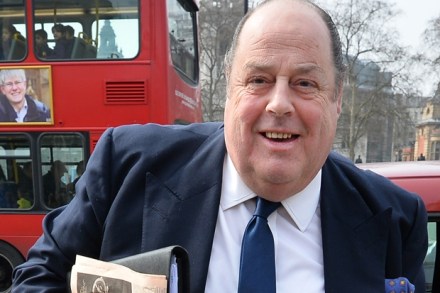
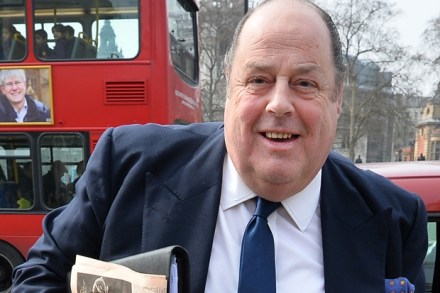
Miracles are not ceased. A few years ago, a kindly educational therapist took pity on John Prescott and set out to devise a way to reconcile the Mouth of the Humber and his native tongue. He came up with Twitter. That explains the restriction to 140 characters, barely room for Lord Prescott to commit more than three brutal assaults on the English language. A hundred and forty was too much. Twitter did not cure John Prescott. But it did gain pace among the young — and, the miracle, with Nicholas Soames. Nick is one of the funniest men of this age. With Falstaff, he could say (he could say a lot with Falstaff): ‘I am not only witty in myself but the cause that wit is in other men.’ Even so, he is not new-fashioned.

Nicholas the miraculous

Miracles are not ceased. A few years ago, a kindly educational therapist took pity on John Prescott and set out to devise a way to reconcile the Mouth of the Humber and his native tongue. He came up with Twitter. That explains the restriction to 140 characters, barely room for Lord Prescott to commit more than three brutal assaults on the English language. A hundred and forty was too much. Twitter did not cure John Prescott. But it did gain pace among the young — and, the miracle, with Nicholas Soames. Nick is one of the funniest men of this age. With Falstaff, he could say (he could say a lot with Falstaff): ‘I am not only witty in myself but the cause that wit is in other men.’ Even so, he is not new-fashioned.

White mischief | 5 May 2016

I promised a return to Burgundy and the 2014 vintage, which becomes no less impressive when recollected in tranquillity. We started at Marc Morey, where Sabine Mollard presented her Bourgogne Blanc. How did it compare with Pierre Bourée’s similar wine, often praised in this column? (We had sampled his ’15 the previous evening.) There is a simple answer: I would prefer the one I had tasted most recently. We are dealing with village wines, along the foothills of greatness. But in their delightful harmonies of butter, lemon, hay and spring flowers, there are hints of the grandeurs of Montrachet. Shall I compare thee to a summer’s day? Not quite, but a charming spring day, certainly.

Riders and diners

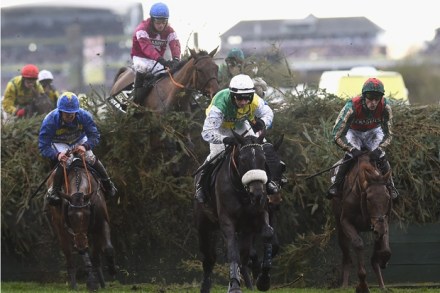
Not quite nil humanum a me alienum, but I have always been interested in other people’s trades and worlds. That was one reason why I enjoyed the late Woodrow Wyatt’s invitations to the annual Tote board lunch. I always found myself on a table with racehorse owners and trainers. When they realised that I barely knew the difference between a fetlock and a bridle, they became politely distant, until they discovered that I was a political journalist, which made them barely politely suspicious. Politicians they disdained. As for hacks, they only took notice of the ones that they could ride. That said, I am sure that they would have paid attention to Marcus Armytage, a delightful fellow who writes about equine matters in the Telegraph.

A gentleman of Bordeaux

There was a moment during the war when De Gaulle was being more than usually impossible. Roosevelt, furious, asked Churchill to convey his feelings. The PM summoned the Frenchman, who arrived, took off his kepi and sat down. Churchill launched into him. Unfortunately, the tirade was not recorded. By all accounts, few prosecution cases have been expounded more forcefully. It was a masterpiece of eloquence which lasted for 45 minutes. Throughout, de Gaulle was impassive: not a flicker of facial muscle, let alone emotion. Churchill came to a final flourish, then stopped and glared. In response, de Gaulle rose to his feet, put on his kepi, saluted, turned and left. Churchill’s comment: ‘Magnificent.

On the trail of a Holy Grail

It was a scene evoking the first movement of the Pastoral Symphony. The evening sunshine was caressing the verdant woods at the top of a hill. It was only a low hill; there seemed nothing especial about this sweet rural scene. But just below the woods, the upper slopes contain some of the most valuable agricultural land in the world, producing magnificent wine. We were looking up from Gevrey-Chambertin towards the domain of the grands crus. Not everything was as joyous in recent years, Dijon has expanded. France, with the same population, is two and a half times as large as the UK, so land is cheap. There is nothing to discourage the shapeless sprawl that disfigures the surroundings of many US cities: garages, car showrooms and — worst of all — fast-food outlets.

A thirst for Justice

Justice Oliver Wendell Holmes, a great common lawyer, was an adornment to the American Supreme Court. His wisdom is still cited in common-law jurisdictions throughout the world. Any English lawyer who would prefer to exchange Holmes’s incisive rulings — which usually amount to common sense elevated to a Platonic idea — for some European mush based on supposed human rights, reveals himself as a legal numbskull who so hates his own country that he cannot bear its successes, not least of which is the principle of freedom under the rule of law. Holmes’s long life was a chronicle of American evolution. He would have been entitled to call his memoirs ‘The history of the United States in my own times’.

The grim irony of Walsingham

As you came from the Holy land Of Walsingham Met you not with my true love By the way as you came? The Walsingham poem used to be attributed to Walter Raleigh, which must be an error. ‘True love’ had a different meaning in his gallantries, most famously when he pleasured a maid of honour against a tree. She began by pretending to resist, but within brief minutes ‘Nay, sweet Sir Walter’ turned into ‘swisser swasser, swisser swasser’. The carnal and the spiritual can co-exist: see Dr Donne. But in its structure of feeling, the Walsingham poem is a couple of generations earlier than Raleigh: either immediately pre-Reformation or at the very latest just before Henry VIII had unleashed the full malign rapacity of his robbers and iconoclasts.

Whatever the deal, it will never satisfy the Brexit bunch

In Thursday's Times, Tim Montgomerie announced that after 28 years, he was leaving the Conservative party. Such a momentous decision requires an equally momentous explanation. Tim has failed to provide one. The gravamen of his charge was that David Cameron is no Margaret Thatcher. Without in any way casting doubt on Lady Thatcher's achievements, or on her right to be regarded as our greatest peacetime Prime Minister, the reality is more complex than Tim's hagiographic version would have us believe. 'It wasn't just the colour of her politics, but the strength.' True, she was strong, on many occasions.

Game show

A few years ago, a distinguished cove in the diplomatic service was made High Commissioner to Australia. To prepare himself for the penal colony, he invited three predecessors to lunch, for advice. The first said that he should make contact with the Billabong institute in Sydney. They were experts on the transportees’ economy. The second advised him to befriend Ned Kelly, editor of the Convict Chronicle, who knew where the political bodies were buried, having often handled the shovel. Then it was Peter Carrington’s turn; Peter had held the post in the mid-1950s. ‘Watch out in late January,’ he warned. ‘When the shooting season ends, all your friends will try to invite themselves to stay.

Border spirit

There has been a gastronomic revolution in London. For some years, the Boisdale restaurants, often mentioned here, have featured Macsween’s haggis, made in Edinburgh. It is a good drop of haggis, and the various Boisdales were using around four-and-a-half tons a year. Ranald Macdonald decided that it was time to review the competition. There was a blind tasting, and Blackface haggis won easily. Made from Dumfriesshire Blackfaces, slightly less granular than Macsween’s but somewhat more sheepy and peppery, it excited the judges in a way that Macsween’s failed to do. With it, we drank various varieties of St Cosme. The most eccentric and indeed truculent winemakers in Gigondas, they may well also be the best. Their wines can stand up to haggis.

The Battle of Brussels

My friends divide into three groups. There are those who are determined to anticipate Lent. There is a larger number whose January diet barely made it until Twelfth Night. There is a third group, whose dietary plans are indeed based on Twelfth Night: the characters of Toby Belch and Andrew Aguecheek. To which set do I belong? That depends whom I am talking to, and whether they will believe me. Whether or not Christmas is the greatest Feast — the truth appears to be that there is no hierarchy in Feasts — we had a great feast down in Somerset. The centrepiece was goose. There is a family called Zebedee, famous for geese, whose headquarters is Lower Daggon farm. Shades of Tolkien’s Farmer Maggot: I bet they also harvest mushrooms.

Commanding vintages

As the bottles flowed, the talk ranged, to a serious vineyard, an awesome Field Marshal and a delightful restauranteur. For years, the late Tom Benham ran Monkeys as a club. He cooked game especially well and his game pudding, made of course with suet, was one of the best dishes that I have eaten. As Tom charged a fixed mark-up for wine, the better the bottle, the better the value. He always found space for his friends, although his way of doing so was often ruthless. One would telephone: ‘Completely full — but wait: there’s a name here I don’t recognise. You can have that table.’ I never actually saw him bar the door to the dispossessed, but I suppose I should have felt guilty. It was unfair. So is life.

Even great wine can’t quite give me hope for Lebanon

Housman had a point. If men could be drunk for ever, the human condition would be tolerable. But thought always forces its way on to the agenda. ‘And when men think, they fasten/ Their hands upon their hearts.’ This occurred to me in the context of Lebanon. That is a country designed to be a paradise where the nymphs dance to Pan’s pipes. An Arabic-French cultural coalition, modern Lebanon should be an entrancing amalgam of sophistication, religious influences and sensuous delights. Lapped by the Mediterranean, it could draw on 5,000 years of that great sea’s civilisation. There is also the landscape and the climate. For much of the year, you can ski in the morning and swim in the afternoon. All Lebanon needs is peace.

An overflow of bookshelves, a huge kitchen, a cellar, music, dogs, hens, donkeys children . . . all the ingredients for civilised life

In the later 1850s, Palmerston was Prime Minister: Gladstone, his Chancellor. It was a successful partnership between two very different characters. As Roy Jenkins used to say, Palmerston’s willingness to put up with Gladstone — never an easy subordinate — proves that he was more that a bombastic Regency rake. At different times, the pair made the two wisest comments ever to emerge from a Liberal (the only two wise comments?). Gladstone: ‘Money is best left to fructify in the pockets of the people.’ Palmerston: ‘Change, change, change: aren’t things bad enough already?’ If modern Liberals talked like that, their party might have some hope of survival.