Arabella Byrne

Arabella Byrne

Arabella Byrne is the co-author of In The Blood: On Mothers, Daughters and Addiction.

Wimbledon’s myth of elitism

Many were the jibes when Boris Johnson announced that he was ‘thrilled’ to be back on the tennis court in 2021 as lockdown restrictions eased. ‘Bloody posho poncing about on a tennis court’ or ‘how typical’ were probably some of them. Sir Keir, naturally, made sure that he was photographed on a football pitch on the same day. But here’s the thing: these days, playing tennis isn’t posh. Yes, chins love to watch it and play it – helped by tennis courts of their own – but the playing of tennis has become democratised. Reports of next-gen community tennis clubs springing up all over the country have become widespread, according to the Financial Times. And yet tennis has always had a class problem.

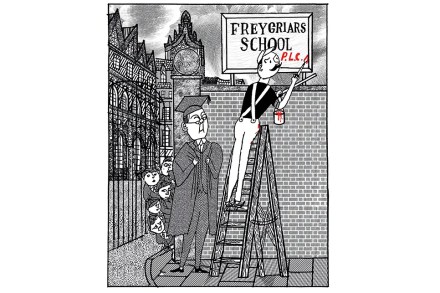
Is your private school dumbing down?

Bankruptcy, as Ernest Hemingway famously said, comes ‘gradually, then suddenly’. For Britain’s private schools floundering in the wake of the VAT rise on fees imposed in January this year, the gradual decline is well underway. Not only have an estimated 11,000 pupils left private schools so far in an unprecedented – and poorly forecast by Labour – mid-academic year exodus and smaller private schools have closed, but now Chinese whispers have begun about the lowering of academic standards.

War and peace, why restaurants are going halal & the great brown furniture transfer

45 min listen

This week: war and peace Despite initial concerns, the ‘Complete and Total CEASEFIRE’ – according to Donald Trump – appears to be holding. Tom Gross writes this week’s cover piece and argues that a weakened Iran offers hope for the whole Middle East. But how? He joined the podcast to discuss further, alongside Gregg Carlstrom, the Economist’s Middle East correspondent based in Dubai. (01:51) Next: why are so many restaurants offering halal meat? Angus Colwell writes about the growing popularity of halal meat in British restaurants. This isn’t confined to certain food groups or particular areas – halal is now being offered across restaurants serving all sorts of cuisine, from Chinese to Mexican. But why is it so popular?

Millennials don’t want brown furniture

For me, it was the sideboard that did it. Originally the centrepiece of my grandmother’s dining room, upon her death it was passed on to my mother, who kept it grudgingly in her cottage even though you couldn’t get to the kitchen without banging your hip against its bow front. At some stage it was passed on to my sister, who paid a considerable sum to store it because she had no room for it in her terraced house. Some years later, I was informed that I must house this precious mahogany albatross myself. After some handwringing and sadness, lack of space forced me to pass it on to someone in my village. She took one look and promptly vowed to ‘do an upcycle’.

Ascot has been ruined by the middle classes

Today, I go to Ascot. The last time I darkened the turf of the Royal Enclosure was in 2017, when I was heavily pregnant with my first daughter. In the photograph of my husband and me that day, I resemble a whale with a plate attached to its head, while my husband looks as if he might at any moment burst into flames from wearing tails and top hat in a heatwave. As you can imagine, we both look rather cross. Curiously, though, on the edge of the photo, there appears to be another couple posing for the camera who look to be having a brilliant time. The gentleman is wearing a cravat of some sort, no tails or topper, while his lady love sports a pink minidress.

Arabella Byrne, Sean Thomas, Mathew Lyons, Bryan Appleyard & Chas Newkey-Burden

28 min listen

On this week’s Spectator Out Loud: Arabella Byrne on the social minefield of private swimming pools (1:13); Sean Thomas says that not knowing where you are is one of the joys of travel (5:34); reviewing Helen Carr’s Sceptred Isle: A New History of the 14th Century, Mathew Lyons looks at the reality of a vivid century (11:34); reviewing Tim Gregory’s Going Nuclear: How the Atom Will Save the World, Bryan Appleyard analyses the three parties debating global warming (16:07); and, Chas Newkey-Burden looks back to the 1980s nuclear drama that paralysed his childhood, Threads (20:42).  Produced and presented by Patrick Gibbons.

End of the rainbow, rising illiteracy & swimming pool etiquette

50 min listen

End of the rainbow: Pride’s fall What ‘started half a century ago as an afternoon’s little march for lesbians and gay men’, argues Gareth Roberts, became ‘a jamboree not only of boring homosexuality’ but ‘anything else that its purveyors consider unconventional’. Yet now Reform-led councils are taking down Pride flags, Pride events are being cancelled due to lack of funds, and corporate sponsors are ‘withdrawing their cold tootsies from the rainbow sock’. Has Pride suffered from conflation with ‘genderism’? Gareth joined the podcast to discuss, alongside diversity consultant Simon Fanshawe, one of the six original co-founders of Stonewall.

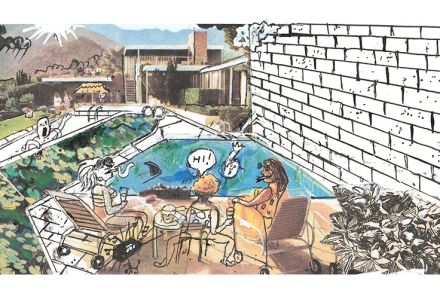
Is it ever acceptable to ask to swim in a friend’s pool?

I’ve always loved English swimming pools. I can’t help it – I am a pool-fancier. The lumpy feel of the blue lining beneath pale feet; the peculiar, chlorinated smell of the pool hut where you do the knicker trick; the scratchy pool towel, the near-collapsing deckchair by its side; the greying sky overhead. There’s the swimming, too, but that’s not what gets me. No, the English pool is a particular social idea, a knowing nod to vulgarity, a paradis artificiel in our rainy climes. Chips Channon, an early adopter, knew it when he insisted on putting in a pool at Kelvedon in 1937, as did Viscount Astor when he went against his mother Nancy’s wishes and did the same at Cliveden.

The private school exodus has begun

‘Why did Albert [not his real name] leave before sports day?’ As is increasingly the norm, I am driving my seven-year-old daughter home from school, and she has questions for me. As questions go, they are reasonable. ‘Albert left to go to a new school’ I say. ‘But he told me it was because of the bat’ comes the response from the back seat. We’ve been here before. The bat is not in fact a placental mammal but the VAT rise on school fees, in playgroundese. Bats and VAT rises are both alarming and linger in the dark of parents’ minds, so it makes sense. ‘Yes’ I reply, ‘you’re right; it’s because of the bat’.

Women don’t want to dress like Kate Middleton any more

Look, if you will, at Kate Middleton on the Isle of Mull for her wedding anniversary. There she was in skinny jeans, tucked-in blue shirt and tweed blazer, shod in what looked like sensible walking boots. It’s a look I like to call Royal Prep School Mummy, and she’s been at it for years: on school runs, at charity netball matches, and Anmer Hall photoshoots. It works, as it always has done, by combining registers. The tweed blazer nods to all sorts of Balmoral-ish, elitist accents – but we forget all about that because of the blue shirt and skinny jeans, items we might well own ourselves. Hilary Mantel may have famously called Kate a ‘shop window mannequin’, but I want to know which one. Joules, Boden or Cath Kidston? https://twitter.

Mothers need more than a mental health hub

New mothers everywhere, rejoice, for the NHS has your back. And your sanity, apparently. Data released last week shows that 64,000 women accessed specialist perinatal mental health services last year, a rise in demand of 10 per cent compared to 2023. Describing the newly provisioned services as ‘lifesaving’ to perinatal women – the period encompassing pregnancy and one year postpartum– the NHS went on to detail the importance of maternal mental health, adding that it was ‘vital that women did not suffer in silence’ or ‘feel stigmatised’.

Inside the Trump Ivy League college

Many years ago, long before Covid and when Donald Trump was still a property magnate-cum-reality TV star, I crossed the pond to study for my PhD at Penn. Not Penn State, which everyone seems to have heard of because of some obscure sex scandal; not Princeton, basking in its Michelle Obama afterglow; but Penn. It’s in the Ivy League, before you crinkle your nose: it has Gothic Revival buildings, frat houses, jocks, and Americans talk endlessly about how old it is. Some call it the Jewish Ivy, thanks to its high proportion of JAPs – Jewish American Princesses – who went there after a Gossip Girl existence at private school in New York. I wasn’t sure what to call it, but I was young, impressionable and ready to wear the Penn merch and Nikes at the drop of a baseball cap.

Why ladies love the Land Rover

It was when I nearly reversed into two brand new Land Rover Defenders in the car park at my daughter’s prep school that I realised something was going on. Of course, I had seen them before. I live in Oxfordshire where the A-roads are one long parade of Land Rover Discoveries, Range Rovers and Volvo SUVs from one junction to the next. But recently Defenders seem to be the ‘it’ car on the block. Land Rovers used to connote a certain kind of rarified upper-class masculinity – think Prince Philip, think chins hanging out of them on a shoot – but the new Defender, puffed-up and boxy like a fat peacock, unintentionally parodies what marketeers might pompously call its ‘brand heritage’.

Why I’m a pro-screen parent

Have you ever looked after a child that doesn’t nap from 5 a.m. to 7 p.m.? I have. Just to be clear, I’m talking about a 14-hour day with no relief whatsoever from grannies, nannies or DHs, the ghastly acronym that Mumsnet uses for fathers to signify ‘darling husband’. Next question: have you ever looked after a child for the standard 14-hour shift and not turned a screen on? Don’t lie, because no mother on this planet will ever believe you. Seasoned mothers know that the only way to make it to the business end of the day – 5 p.m., give or take – is to fill chunks of the never-ending day with screen time, sometimes quite large chunks since you’re asking.

Massacre of the innocents, saving endangered languages & Gen Z’s ‘Boom Boom’ aesthetic

37 min listen

This week: sectarian persecution returnsPaul Wood, Colin Freeman and Father Benedict Kiely write in the magazine this week about the religious persecution that minorities are facing across the world from Syria to the Congo. In Syria, there have been reports of massacres with hundreds of civilians from the Alawite Muslim minority targeted, in part because of their association with the fallen Assad regime. Reports suggest that the groups responsible are linked to the new Syrian president Ahmed al-Sharaa (formerly known as Abu Mohammed al-Jolani). For some, the true face of the country’s new masters has been revealed. Whether the guilty men are punished will tell us what kind of country Syria has become since the fall of Assad’s dictatorship.

Calloway

Caroline Calloway wants to give you some advice

From our US edition

Caroline Calloway — “It” girl, Instagram phenomenon, scammer, grifter — wants to give you some advice. Except, like most things in Calloway’s world, it’s not that simple. What she actually wants is for Elizabeth Wurtzel, author of Prozac Nation (1994), to give you some advice. But there’s just one problem: Wurtzel is dead. No matter: Calloway is stepping in, updating Wurtzel’s unpublished advice guide with some of her own insights and social-media savvy. If this unbidden collaboration from beyond the grave sounds farfetched, that’s because it is. Elizabeth Wurtzel and Caroline Calloway’s Guide to Life is about as mad as you would expect from the self-published author of Scammers and no less extraordinary for it. Of collaboration, Calloway knows a fair bit.

How ‘Boom Boom’ are you?

Do you Boom Boom? Or are you just Booming? Can Boomers Boom Boom or is it just for Zoomers? Can you Boom Doom? Hear me out: I’m getting to grips with the new vibe shift. In December, Sean Monahan, an American trend analyst, announced the arrival of the ‘Boom Boom’ aesthetic, which he described as a ‘pure expression of excess’ or ‘an Eighties archival look that is maximalist in its appetites’. He apparently came up with the term as he sat in London’s low-lit Decimo restaurant. Monahan is taken fairly seriously when it comes to predicting cultural trends. In 2013 he coined the term ‘normcore’, which is defined by a conspicuous, intentional blankness; it is the converse of Boom Boom. Think trainers at work and blanket athleisure wear.

The democratisation of cocaine

Love or loathe Danny Dyer, hard-man hooligan of Football Factory, EastEnders bod and breakout Rivals star, but he does talk sense. The kind of straight-up, geezer sense you can only get down the pub, a locale to which he is no stranger. In the promotional press for his latest film, Marching Powder, Dyer, when pressed on the not-so-euphemistic title of the film, had the following to say on cocaine: ‘I’ve got that social butterfly thing where I mix in both circles and believe me, everyone’s fucking at it [...] it’s classless actually, that drug.’ To some of us, this may seem obvious. In my decade of active addiction, I obtained and recreationally ‘enjoyed’ the drug with anyone from builders to baronets.

Is this the end of the White Van Man?

A third of van drivers under the age of 35 are privately educated – and nearly half hold foundation or university degrees, according to research published by Mercedes-Benz vans. These numbers not only suggest that the end is nigh for ‘White Van Man’, the apocryphal working-class, white-collar ‘tradie’, they also ask us to reconsider the labour market outcomes for those who attended fee-paying schools. I think we all know White Van Man but let me draw him just in case.

There’s something sinister about the Mustique mafia

It’s half-term and instead of the Baftas and Anmer Hall in Norfolk, the Prince and Princess of Wales have decamped en famille to Mustique. Old pictures of Kate and Wills walking along the Caribbean seafront hand in hand and a young Prince George in a green polo shirt are accompanied by newspaper commentary detailing how Kate deserves a rest in what is thought to be her favourite place. So far, so very lovely.   Mustique itself, though, has always struck me as a rather sinister place.