Alexander Kolyandr

Alexander Kolyandr is a researcher for the Centre for European Policy Analysis specialising in the Russian economy and politics. Previously he was a journalist for the Wall Street Journal and a banker for Credit Suisse. He was born in Kharkiv, Ukraine and lives in London.

Starmer’s Russia oil U-turn sends a clear message to Ukraine

From our UK edition

The government did two things at once on Tuesday evening. It legislated, for the first time in binding form, the long-promised ban on imports of refined petroleum products made in third countries from Russian crude. This was the 'refining loophole' that Chancellor Rachel Reeves had championed back in October. Simultaneously, it carved diesel and jet fuel out of the new ban under an indefinite trade licence. The government's framing has been a masterclass in misdirection Petrochemicals, naphtha, heating oil and fuel oil made using Russian crude oil in third countries are now prohibited in UK law. The two products that account for the overwhelming bulk of the refined petroleum trade are not. The government has said it is tightening sanctions against Russia.

What Putin’s Victory Day says about war-time Russia

For the first time in 18 years, Russia’s Victory Day parade will have no tanks. There will be no missile carriers and no armoured columns on Red Square. Several regions have cancelled their parades altogether. Muscovites had been told to expect no mobile internet on the day itself or this evening. The Ministry of Defence has declared a unilateral ceasefire for 8 and 9 May and warned, in the same breath, that any Ukrainian attack will be answered by 'a massive retaliatory missile strike on the centre of Kyiv'. The Russian Foreign Ministry has helpfully advised foreign embassies in the Ukrainian capital to consider evacuating their staff. The official explanation for the missing weaponry is the threat from Ukrainian FPV drones.

Russia is running out of workers

Vladimir Putin likes good statistics. At a government meeting on 15 April, even as he acknowledged that growth was slowing, he pointed proudly to Russia's unemployment rate: 2.1 per cent, a record low. Proof, he suggested, that the economy remains fundamentally sound despite everything the West has thrown at it. The Russian president would do better to worry. A record low unemployment rate is not, in normal circumstances, cause for alarm. In Russia's case it signals something closer to a slow-motion emergency. For the first time in its post-Soviet history, Russia has run out of workers.

Is Russia’s economy really on its last legs?

The head of Swedish military intelligence has dropped what he clearly regards as a bombshell. Thomas Nilsson told the Financial Times this week that Russia's economy is far weaker than it appears, that the Kremlin systematically manipulates its statistics to fool Ukraine's Western allies, and that the central bank is understating inflation, which he believes is closer to 15 per cent than the official 5.86 per cent. For good measure, he endorsed the German intelligence service BND's earlier estimate that Russia's budget deficit is understated by $30 billion (£22 billion). One need not be a Kremlin agent to find this less than convincing. That Russia's economy is struggling is not in dispute.

With Orbán’s loss, Russia has lost its European foothold

Péter Magyar’s landslide victory over Viktor Orbán is not just political earthquake for Hungary. It is Moscow’s worst result in the European Union since the war began. Orbán served Russia in a way no overt ally could. He was never Putin’s puppet – he was something far more useful: a democratically elected, Brussels-based veto-wielder who could slow sanctions, obstruct aid to Ukraine, and dress it all up as principled neutrality. A leaked call recorded him telling Putin that Hungary was like a mouse to Russia’s lion. Leaked tapes of his foreign minister, Péter Szijjártó, conversing with Sergey Lavrov revealed the same cringing loyalty.

Trump’s oil sanctions relief is a precious gift for Putin

From our UK edition

Apart from windfall revenues from higher oil and gas prices and the political leverage that comes from supplying the Global South with fertilisers, how much sanctions relief can Russia also expect amid the war in the Middle East? Some relief is already here. On 12 March, the United States amended its sanctions on Russian oil tankers already at sea. Under an updated general licence, Washington continued to allow the sale of Russian crude and petroleum products loaded onto vessels as of that date. It also globally extended a month-long Treasury department waiver, issued a week earlier, that had allowed India to buy Russian crude and petroleum products loaded between 12 March and 11 April.

Why Ukraine’s Russian oil strikes are backfiring

Every drone Ukraine fires at a Russian oil terminal is meant to defund Moscow's war in Ukraine. Right now, each one may be doing the opposite. Ukraine's strikes on Russian oil export infrastructure are intended to starve Moscow of the budget revenues that fund its war machine. The logic is straightforward: disrupt exports, reduce revenues, constrain the war effort. Kyiv has been explicit about this: Ukrainian officials consistently frame attacks on oil terminals as direct hits on Russia's war chest, treating every barrel that cannot be shipped as a rouble that cannot be spent on missiles or mobilisation. Reuters puts the scale of that disruption in stark terms – at least 40 per cent of Russia's crude export capacity, roughly 2 million barrels per day, is currently offline.

The Iran war is just what Putin’s depleted coffers need

Of all the parties watching the chaos in the Middle East unfold, one should be rubbing its hands together with particular satisfaction. Russia has not fired a shot in this conflict, lost no allies it cannot afford to lose, and has so far gained rather a lot, with more to come. A cynic might call it the perfect war for Vladimir Putin. Moscow's public reaction has been characteristically theatrical. The Foreign Ministry denounced American and Israeli actions as a 'reckless step' and a 'dangerous adventure'. Things have gone no further. There has been no announcement of political or military support for Iran from the Kremlin – nor is there likely to be: Russia needs its drones and missiles for Ukraine.

What Putin learned from Iran’s crackdown

From our UK edition

After losing his erstwhile allies and clients in Syria and Venezuela over the past 13 months, Vladimir Putin ought to be breathing a sigh of relief at the bloody suppression of the protests in Iran. Russia and Iran are natural bedfellows – a marriage of inconvenience, if you will. Both languish under Western sanctions, though Iran's are stricter and have endured longer. Both economies depend heavily on China hoovering up their sanctioned oil at a discount and Beijing flogging them technology. Both deploy shadow fleets to export their oil. Neither has access to global financial markets. The brutal suppression of Iran's protests ought to reinforce Putin's calculus that if dissent cannot be bought off, it must be crushed There are, naturally, crucial differences.

It’ll be anything but a happy new year in Putin’s Russia

From our UK edition

The next year will be challenging for Russia. Yes, we've heard this for almost four years. We've been told that the Russian economy is about to collapse under Western sanctions and the cost of war, yet it stumbles on. There may be no breadlines or toilet paper shortages, but the bill for the Kremlin's past political and economic decisions has finally landed, and it is ordinary Russians who will foot it. What a difference a year makes. Economic growth, fuelled by Vladimir Putin's profligate spending on the defence industry, has virtually evaporated. Oil revenues, which provide a fifth of the government's income, are down nearly a quarter owing to lower global prices and tighter sanctions.

Putin is mortgaging Russia’s future to pay for Ukraine

From our UK edition

We will wage the war in Ukraine for longer and make you pay more for it. That was the message the Kremlin sent its subjects following the Russian government's presentation of next year's budget and the accompanying economic outlook. The budget, which reached parliament for rubber-stamping on Monday, outlines the Kremlin's vision ahead of the war enterring its fifth year next February: the war will continue at the expense of the economy and people's incomes. Higher taxes are expected to keep the budget deficit at 1.6 per cent of GDP next year. For three years, rising fiscal spending stimulated both economic growth and climbing incomes. The downside of this amphetamine-fuelled growth was double-digit inflation, which the central bank tackled with prohibitively high interest rates.

Can Putin extract an economic victory from Trump?

From our UK edition

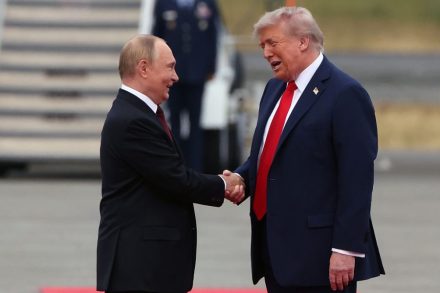
The Alaska summit taking place today isn't just about war – economics looms equally large. Vladimir Putin, with his forces pressing forward in Ukraine, faces neither military urgency nor economic desperation to halt the fighting. For him, this has never been a territorial grab but an existential struggle against Western hegemony. His challenge is to decouple the war from bilateral cooperation with America: the former proceeds too favourably to abandon, while the latter promises diplomatic triumph and relief from mounting economic pressures. Putin's delegation tells the story. Finance Minister Anton Siluanov and Kirill Dmitriev, Putin’s special envoy for international investment, signal that sanctions and economic cooperation will be discussed.

Putin’s economic alchemy can’t last forever

From our UK edition

The Kremlin's accountants are having a problem: Russia's state budget, once the engine of spectacular growth, is now flashing red. The mathematics are brutal. Russia's fiscal deficit has ballooned to 3.7 trillion rubles in June – roughly £34 billion – skating perilously close to this year's legal limit. As a share of GDP, the deficit threatens to breach the 1.7 per cent ceiling, a prospect that has Valentina Matviyenko, speaker of the Federation Council, preaching the gospel of 'strict savings' with all the enthusiasm of a Victorian governess. The transformation of a petro-state into a war economy was supposed to demonstrate Russian resilience The root of Moscow's monetary malaise lies in spectacular overoptimism.

Why Putin thinks Trump’s Russia tariffs are a bluff

From our UK edition

Moscow's response to the latest ultimatum issued by Donald Trump last week has been to deploy that most Russian of diplomatic weapons: contemptuous laughter. The US president's threat to impose draconian sanctions unless Putin ends his invasion of Ukraine within fifty days has been met with the kind of theatrical disdain that would make Chekhov proud. Foreign Minister Sergey Lavrov, never one to miss an opportunity for diplomatic sarcasm, openly sneered at Trump's intervention on Tuesday. 'We want to understand what exactly is behind this statement. Fifty days. It used to be 24 hours, and then it became 100 days. Russia has gone through all this and now wants to understand what the US president’s motives are,' he said.

Has Putin pushed the Russian economy to its limits?

From our UK edition

The remarkable resurgence the Russian economy has experienced since Vladimir Putin's invasion of Ukraine is losing momentum. Where once Putin could boast about 4.3 per cent growth rates for two years in a row – thumbing his nose at Western sanctions with all the aplomb of a man who'd discovered alchemy – the numbers now tell a somewhat different story. The party, as they say, is over – and the time to crank up sanctions against Moscow has come. For two years running, Putin's propagandists have crowed about Russia's economic vitality as proof that Western sanctions were about as effective as a chocolate teapot. The economy's steroid-fuelled growth, pumped up by hefty fiscal spending, facilitated the steepest rise in household incomes for nearly two decades.

Trump’s trade war is driving Russia further into China’s arms

From our UK edition

Trade between Russia and China is no longer booming as it was immediately after Moscow's full-scale invasion of Ukraine three years ago. In 2024, annual trade between the two was up 1.9 per cent from the previous year to $240 billion (£182 billion). But in the first four months of 2025, it fell 7.5 per cent from the past year to just $71.1 billion (£54 billion), according to Chinese customs data. Chinese exports to Russia are down 5.3 per cent ($30.8 billion or £23 billion), while Russian deliveries to China are down 9.1 per cent ($40.3 billion or £30.5 billion) between January and April.  The drop in Russian exports can only partly be explained by the decline in oil prices.

Russia can’t escape the fallout of Trump’s tariff war

From our UK edition

When Donald Trump unveiled his table of tariffs in Washington last week, there was one country that was conspicuously absent from his list: Russia. The White House's argument was that there was no point slapping tariffs on trade with Moscow because the existing sanctions in place against it meant there was negligible bilateral trade going on between the two countries. Despite this, the global trade war that has erupted will still impact Russia, threatening to undermine Moscow's economic stability, stifle its already slowing growth and amplify its strategic dependence on Beijing. Trump's trade realignments will further marginalise Russia as an energy supplier The White House's justification for excluding Russia from its tariffs list withers under scrutiny.

Why Putin needs sanctions lifted on Russia

From our UK edition

Just hours after the US announced last week that it had reached an agreement between Russia and Ukraine to stop the conflict in the Black Sea, Moscow presented its conditions for this partial truce. Moscow said it would comply with the truce only when these stipulations are met. This list of demands Russia presented to the US is a classic example of the delay tactics the Kremlin likes to use. But it also provides a helpful glimpse at Russian decision-making and Putin's world view. The agreement, as hashed out between the US and Russia, is pretty hollow. America insisted Russia agreed to ensure safe navigation in the Black Sea, eliminate the use of arms and stop using civil vessels for military purposes. There is no mention of protecting Ukrainian ports from Russian attacks.

Why won’t the West use frozen Russian assets to help Ukraine?

From our UK edition

Since Moscow launched its full-scale invasion of Ukraine three years ago, there has been a great deal of temptation to seize Russian sovereign assets frozen in the West. There is, after all, an urgent need and moral imperative to make the aggressor pay and use Russia’s money for Ukraine’s cause. But the reality is that unless European governments show urgent determination, Russian money is unlikely to be used to support Ukraine in its totality any time soon.  Amid the spat between Volodymyr Zelensky and Donald Trump last week, which resulted in the US stopping military aid to Ukraine, the issue of financial support for Kyiv has never been more critical. No wonder, then, that the plan to use Russian frozen assets to buy arms and time for Ukraine has resurfaced.

Could Russian sanctions soon be lifted?

From our UK edition

Markets are rife with rumours of impending talks between presidents Donald Trump and Vladimir Putin on a ceasefire for the war in Ukraine. Even before Trump told the New York Post last week that he had spoken with Putin over the telephone and that the Russian president wanted to end the war, stock market traders were rushing to buy stocks from the businesses associated with Ukraine. Ukrainian sovereign bonds, shares in the Austrian bank Raiffeisen, the Ukrainian mining company Ferrexpo and global steelmaker Arcelor Mittal have all posted record gains over the past week. The markets are betting on a prompt ceasefire and for sanctions against Russia to be eased. However, Moscow has refused to confirm the phone call between Putin and Trump and has warned against optimistic expectations.