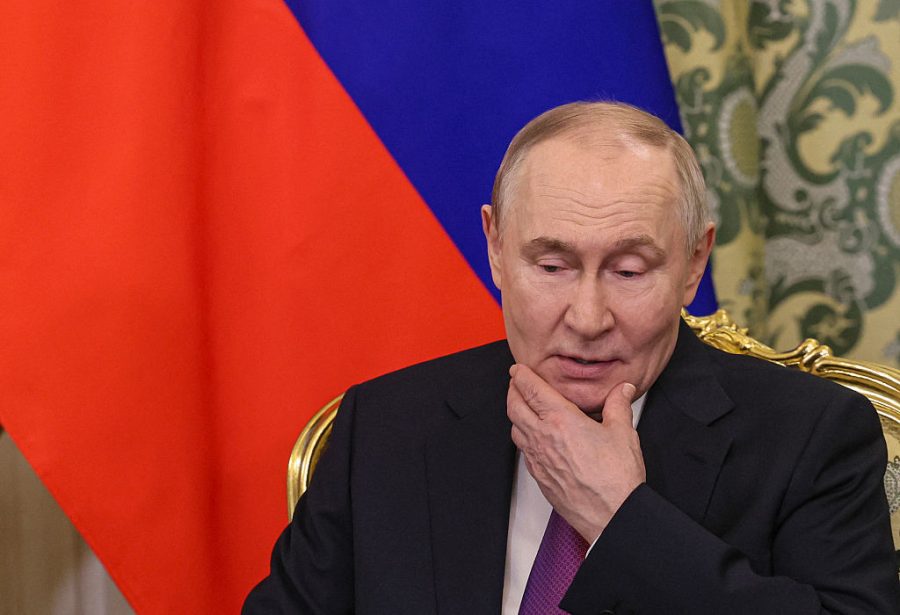
After losing his erstwhile allies and clients in Syria and Venezuela over the past 13 months, Vladimir Putin ought to be breathing a sigh of relief at the bloody suppression of the protests in Iran. Russia and Iran are natural bedfellows – a marriage of inconvenience, if you will. Both languish under Western sanctions, though Iran’s are stricter and have endured longer. Both economies depend heavily on China hoovering up their sanctioned oil at a discount and Beijing flogging them technology. Both deploy shadow fleets to export their oil. Neither has access to global financial markets.
The brutal suppression of Iran’s protests ought to reinforce Putin’s calculus that if dissent cannot be bought off, it must be crushed
There are, naturally, crucial differences. The Russian economy is more sophisticated and modern, less tethered to oil, and suffering not from rising youth unemployment but rather the opposite: an ageing population and labour shortages. The sanctions against Russia are softer than those throttling Iran, and its finances are in rather finer fettle.
Nevertheless, what lessons might the Kremlin have gleaned from how Iran has handled its protests? First, the idea that low inflation trumps economic growth when it comes to maintaining social stability. Inflation in Iran has been stratospheric for decades, rarely dipping below 10 per cent annually since the revolution in 1979. It’s been in double figures since the Covid pandemic, peaking at 46 per cent two years ago before dropping to 33 per cent at the start of last year – amid 4.5 per cent economic growth. The World Bank expects plummeting oil prices and war with Israel to propel inflation back up to 44 per cent in the current financial year while the economy contracts. It was the latest in a series of food price hikes that lit the fuse in Iran in December.
On this front, Russia has relatively few worries. Thanks to a set of draconian measures from its central bank, inflation is running at roughly a tenth of the pace of Iran’s. Though price rises for food and essentials exceed the headline rate of inflation, Iranian-style surges are unimaginable in Russia under present conditions.
Most popular
Steven Edginton
Invented claims of lynchings and racist violence are irresponsible — and dangerous

The Kremlin is prepared to sacrifice economic growth on the altar of price stability. Russia’s economic slowdown, especially in the civilian sector, is a direct consequence of this Faustian bargain. Faced with a contraction due to war and collapsing oil prices, though, Iran cannot stimulate growth by loosening monetary policy – but Russia can. Events in Iran will only embolden the camp in Moscow championing price stability in their long-running battle against those clamouring for growth at any price.
By Western standards, neither country sports a particularly alarming budget deficit. In 2023/24, Iran’s deficit stood at 2.5 per cent of GDP, rising to 3.3 per cent in 2024/25, and is expected to breach 4 per cent this year. Russia faces an almost identical predicament. Last year, it posted a 2.6 per cent deficit – five times higher than envisaged at the year’s outset. For this year, Moscow has budgeted a 1.6 per cent deficit, but both the oil price assumptions and growth forecasts underpinning it look overoptimistic.
On the face of it, both boast tolerable deficits, especially compared with most developed countries. Britain, after all, is running a shortfall of 5.2 per cent. But here’s the rub: sanctions compel Moscow and Tehran to rely exclusively on domestic banks for borrowing. This ratchets up the cost of servicing loans, and with interest rates sky-high, domestic borrowing becomes ruinously expensive, triggering a vicious debt spiral and, in effect, money printing by the central bank. This de facto monetary financing is partly a consequence of hermetically sealed financial systems in both countries.
The Iranian protests may strengthen the hand of those in the country agitating for spending cuts in Russia. But there, as in Iran, any decision on slashing military and social expenditure must emanate from the very apex of power.
Putin has doubtless harvested lessons from his Iranian counterparts on what to do when people flood the streets in protest
The next lesson for Moscow springs from the world of banking. One catalyst of the Iranian protests was the spectacular implosion of Ayandeh, one of the country’s largest private banks. For years, it had dangled high deposit rates to its customers whilst shovelling loans to affiliated companies. The bank’s owner boasted strong connections to the Iranian regime’s leadership, snapped up expensive real estate in London and deployed the bank’s loans to finance the construction of the Middle East’s largest shopping mall. A government bailout for Ayandeh last year fuelled Iranians’ fury, perceived as evidence of systemic corruption and a klaxon warning about the safety of savings elsewhere.
Russia has witnessed several high-profile bank collapses over the past decade, but a ruthless clean-up by the central bank in the 2010s has left things considerably healthier. When Russia invaded Ukraine in 2022, the domestic banking system had been largely decapitalised, cleaned up and partially nationalised. As a result, Russia harbours far lower levels of toxic debt than Iran.
But what about sanctions? Officials in both Iran and Russia peddle a rhetorical paradox: they blame foreign sanctions for the manifold domestic economic afflictions their countries are experiencing while simultaneously dismissing them as feeble. Iran has endured stringent restrictions for four times longer than Russia. One crucial difference is that the measures strangling Iran rest on UN resolutions and are therefore globally enforceable. Russia’s sanctions are piecemeal, levied only by the West and less deeply entrenched.
Both countries were severed from the SWIFT banking system and Western finance – though Russia’s excommunication isn’t total. Both have a turbocharged reliance on China for trade – though, again, Russia maintains financial arteries to other countries, particularly in the Global South. On the other hand, enduring sanctions for as long as Iran has without gravely eroding the well-being, security and forbearance of the public will prove far more arduous for Russia.
Despite its superior economic standing, Putin has doubtless also harvested lessons from his Iranian counterparts on what to do when people flood the streets in protest: don’t be coy about severing the internet and unleashing state repression. The Kremlin began throttling access to some online services before the invasion of Ukraine. Since 2022, those efforts have intensified with a vengeance.
Iran and Russia already share abundant common ground when it comes to digital repression – they both possess near-total state dominion over domestic media, multifarious content filtering mechanisms and laws criminalising critical social media posts. Compared with Iran’s crude, sledgehammer internet crackdown, Russia is deploying a more nuanced approach. Yet as Tehran has demonstrated, if the regime scents an existential menace, flicking the kill switch is both technically and politically feasible. Russian authorities are far more prepared to take that drastic step than they were at the start of the war in Ukraine.
The brutal suppression of Iran’s protests ought to reinforce Putin’s calculus that if dissent cannot be bought off, it must be crushed – the earlier the better. There’s also a comfortable understanding that the West will confine itself to stern rhetoric and hand-wringing condemnation for as long as possible. This lesson transcends economics.
Moscow has likely emerged even more convinced of the wisdom of its financial and economic strategy, particularly regarding controlling inflation and sanitising its banking sector. It also furnishes fresh ammunition for those in the Kremlin advocating for spending reductions. Beyond economics, Iran may well inspire Russia to further tightening of the screws of its regime – both in cyberspace and the real world.





Comments