Alexander Kolyandr

Alexander Kolyandr is a researcher for the Centre for European Policy Analysis specialising in the Russian economy and politics. Previously he was a journalist for the Wall Street Journal and a banker for Credit Suisse. He was born in Kharkiv, Ukraine and lives in London.

Russia’s tanking ruble spells trouble for Putin

From our UK edition

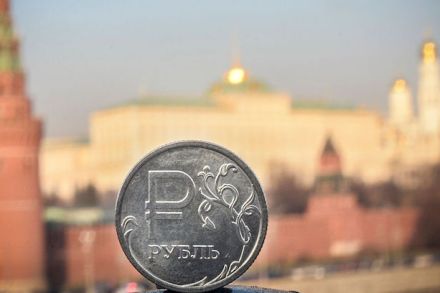
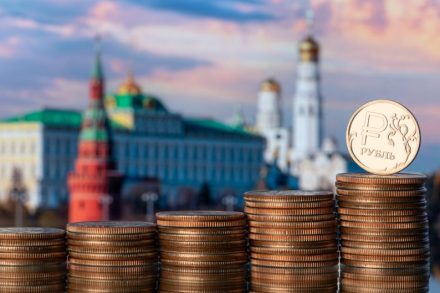
Russia's ruble is in trouble. The currency has plunged to its lowest rate against the dollar since the weeks after the outbreak of war against Ukraine. On Wednesday, the ruble hit 110 against the dollar for the first time since 16 March 2022. The currency has recovered slightly, to 108 against the dollar this morning, but in Moscow people are worried. There are no good remedies for the Russian economy’s malaise apart from ending the war Russians who lived through the tumultuous years after the collapse of the Soviet Union know all about the dangers of currency devaluation. While, clearly, things aren't as bad as they were in the 1990s, the long memories of this period haunt Russians.

Russia is creeping towards stagflation

From our UK edition

The Central Bank of Russia raised its benchmark rate to a twenty-year high of 21 per cent on Friday – and has indicated that it could go even higher. Even Vladimir Putin, a notorious serial boaster, won’t be caught bragging about this tell-tale sign of a not-so-healthy economy. The writing is on the wall: Russia is getting closer to stagflation – a no-growth, high-inflation economy.  An interest rate this high is unprecedented. In February 2003, still fresh in his job, Putin launched reforms to kick-start the Russian economy after the 1998 financial meltdown; the central bank brought its refinancing rate to 20 per cent and has kept it below that level ever since – until now.

The secret behind Putin’s booming war economy

From our UK edition

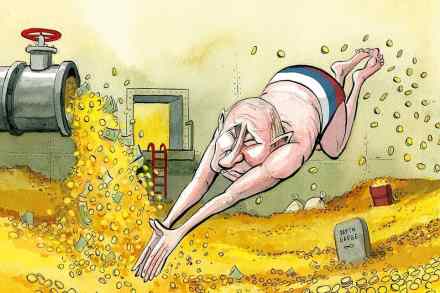
Russia’s spending on its war in Ukraine continues to grow. Somehow, despite tightening sanctions and increased global isolation, two-and-a-half-years in to the conflict, it appears Moscow can continue to splash the cash on its army – for now. Spending on president Vladimir Putin's military is set to increase by more than a quarter to 13.3 trillion roubles (£107 billion) next year, according to a draft of the Russian state budget for 2025 revealed this week. This colossal sum – which is nearly double the 6.4 trillion roubles (£52 billion) spent last year – is roughly twice the size of the amount spent by Britain on its own defence. Russia's government had planned to implement a steady reduction in defence bills across 2025 and 2026.

The sneaky way that Russia is still evading western sanctions

From our UK edition

The leaders of the European Union can give themselves a pat on the back. They have, on the face of it, delivered on a promise made following Vladimir Putin's invasion of Ukraine to end the export of European goods, machinery and parts critical to Russia's war effort. Yet things are not quite as straightforward as they seem. Exports from the bloc to Russia in June plummeted to a mere €2.4 billion (£2 billion) – a third of the €7.5 billion (£6.3 billion) shipped during the last peacetime June of 2021 before the war, according to data from the EU's statistical body Eurostat. The figure for June this year is the lowest since January 2003 and just a notch higher than the absolute minimum of January 2002 when Russia’s ascent to wealth had only just started.

How Putin plans to fund a forever war in Ukraine

From our UK edition

Vladimir Putin’s costly war in Ukraine has transformed Russia as the president has forced the country to pivot onto a war footing to support it. Now, going a step further, Russia is embarking on a significant tax regime overhaul, a move that hasn't been seen in almost a quarter of a century. The tax shake-up will allow the Kremlin to further prioritise military spending as it attempts to keep its invasion going. In the early years of Putin’s rule, Russia sought to attract a lot of foreign investment, boost the number of small and medium-sized businesses, grow the middle class and encourage them to spend. As a result, in the 2000s, private investments poured into trade, services, and the production of consumer goods, not only into oil and metals.

Russia and China have never been equal partners

From our UK edition

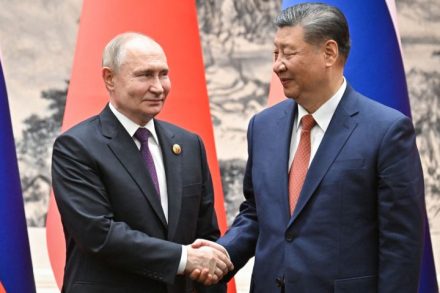
Barely a week after inaugurating himself as president once again, Vladimir Putin has gone to China – his first foreign trip of his new term. He is accompanied by a rarely seen entourage of all the principal ministers of state, the head of the Russian central bank, leading industrialists and top managers of state-controlled companies.  Along with all the pomp and grandeur laid on by the Chinese, this cast list provides a handy illustration of the deepening friendship and cooperation between the two superpowers. Moscow and Beijing have a history of ‘eternal friendship’. But Russia and China have never truly been equal partners in their friendship with benefits.

Is Andrei Belousov Russia’s Albert Speer?

From our UK edition

President Vladimir Putin’s appointment of the civilian economist Andrei Belousov as Russia’s defence minister in the third year of the full-scale invasion of Ukraine is bad news for Kyiv and its allies. Replacing the unpopular Sergei Shoigu with Belousov marks a clear shift in Putin's strategy: he views the war as a battle of economic attrition.  There is hardly anyone better suited for the job than Belousov. A Soviet-trained economist, he cut his teeth in academia before joining the government just months before Putin became prime minister in 1999. Since then, he has climbed through the ranks to become Putin’s economic advisor and, from 2020, the First Deputy Prime Minister, overseeing the country's finances and economy.

Why is Russia’s economy booming despite sanctions?

From our UK edition

Over two years on from the invasion of Ukraine, Russia is the most sanctioned nation in the world. And yet the country’s economy is set to grow faster than any G7 democracy this year. How is this possible? Back in 2022, Boris Johnson vowed to ‘squeeze Russia from the global economy piece by piece, day by day and week by week’. President Joe Biden promised that sanctions would ‘impose a severe cost on the Russian economy, both immediately and over time’. Russians are spending more on restaurants, white goods, and even property – they have never had it so good Yet these dire warnings never materialised: Russia's economy has proved resilient in the face of sanctions.