Culture

Culture

The good, the bad and the ugly in books, exhibitions, cinema, TV, dance, music, podcasts and theatre.

Leave well alone | 11 February 2012

Radio and podcasts

Maybe he was asking for it. Maybe his article in the New Statesman was a subconscious attempt to undermine his brother’s authority. But what was the point of grilling David Miliband about his relationship with his brother Ed on the Today programme (Radio 4) on Monday morning? What we wanted to know was whether Miliband senior had any fresh ideas about how to tackle the grievous problems of our economy, and especially how to remedy our inability to ensure that there are enough jobs for our young people to find gainful employment. Who cares whether he’s still simmering with rage about his brother’s seizure of power? Why, then, did John Humphrys try to reignite a Westminster bonfire that actually went out 17 months ago when Ed won and David lost?

Audio gongs

Radio and podcasts

No red carpet was rolled out on Sunday night when the first ever Audio Drama Awards were presented to best actor (David Tennant), best actress (Rosie Cavaliero), best drama (The Year My Mother Went Missing)...in a Hollywood-Lite ceremony at Broadcasting House. No tears were shed as the winners sought desperately to find the right words — not too smug, neither too self-immolating. There were no cheesy jokes from a rancid comedian as compère (David Tennant took on the role formerly reserved for Ricky Gervais). But at last, after 89 years of plays on the BBC, the extraordinary fact that at least once a day it’s possible to have a front-row seat in the most intimate of theatres-in-the-round and be taken out of your life and dumped in another is being grandly celebrated.

Only connect | 28 January 2012

Radio and podcasts

It was uncanny, discomfiting, even a little bit alarming. He seemed to be reading my mind, as if my thoughts were being hurled back at me through the ether. Why are we so tired? Why does it feel as though time itself is speeding up, making midlife so much more nerve-wracking an experience than it might otherwise be? Why do you never hear a middle-aged person talking about being bored? Toby Longworth was reading from Marcus Berkmann’s new book, A Shed of One’s Own: Midlife Without the Crisis, for Book of the Week on Radio 4 on Monday morning. A man, according to Berkmann, who usually writes about music and for this magazine, must have a shed.

Communal listening

Radio and podcasts

Where mostly do you listen to the radio? In the kitchen, on the M25 or M62, under the duvet, soaking in a bathtub? We’ve got used to moving around with the wireless, often listening with just half an ear, not really connecting at all, and with no opportunity to share the experience with anyone else. In the Dark, a band of radio enthusiasts who’ve got together to produce unusual audio documentaries, is trying to take us back to the sensation shared by those first listeners to radio, when families, friends, neighbours joined up to listen and laugh along to The Goon Show or Children’s Hour. They organise communal listening events in unusual venues, usually with the lights out, but with an unconventional twist.

…and on the air

Radio and podcasts

The trouble with Dickens is that there’s just far too much plot. How do you make sense of his incredibly complex stories in just three hours as the BBC tried to do at Christmas with its TV version of Great Expectations? It looked fabulous but the storyline made no sense because there was no depth to any of the characters. The melodrama was laughably inept, the plot so confusing you needed to have read the book to understand what was happening. Over on Radio 4, the writer Ayeesha Menon has also been given just three hours to retell one of Dickens’s least popular novels in a three-part edition of the Classic Serial (Sunday afternoons, repeated Saturdays).

Swapping stations

Radio and podcasts

‘Do you feel like crying?’ asked Shaun Keaveny on his 6 Music breakfast show this week, before replying, ‘Text us your tears.’ It was Tuesday, the first day back at work for many listeners. And Keaveny was trying to cheer us up. Then he played ‘Grey Day’ by Madness. Keaveny’s lucky. 6 Music reckons that its listeners, being creative types, don’t have to get up so early to leave for work. Their alarms will be set for later, and Keaveny doesn’t have to be in the studio for his three-hour show until 7 a.m. By which time, over on 5 Live, Phil Williams and Rachel Burden have already been up and chatting for an hour with their version of the Today programme — a little less news, a lot more football.

Highlighting the goodies

Radio and podcasts

Since the Home Service was relaunched as Radio 4 in September 1967, the station has established itself almost as the ‘heartbeat’ of the BBC. The chance to direct, shape and enhance such a treasure-house of programmes — ranging from Farming Today to ElvenQuest via Something Understood,  Classic Serial and The World Tonight — must be endlessly fascinating. But therein lies the challenge. Radio 4 does sparkle with its intellectual brilliance, its flashes of humour, its ability to make sense of the moment through its reporters, interviewers and the editorial wizards who pull the news together in seconds.

Twelve crackers

Radio and podcasts

It might cheer the spirits of our over-stressed EU leaders this weekend if they were allowed time out from their delicate financial machinations to listen to the Day of Christmas Music broadcast on Radio 3 on Sunday and in the other 55 countries of the European Broadcasting Union (set up in 1950 as a cultural balance to the economic community). This annual flit round the countries of the union is always a refreshing antidote to the festive frazzle; an upmarket Eurovision with snatches of announcements in exotic languages as a reminder of the spirit of co-operation.

Wild wastes of forgetfulness

Radio and podcasts

Too much dark, not enough light, often leads us inwards, into those dark regions of the mind where memory resides. Between the Ears (Radio 3, Saturday evening) echoed the mood of the month by taking us on a journey back into that hinterland of darkness where names begin to disappear, places can no longer be recognised, the fridge becomes the oven, and words become jumbled so that the Radio 3 announcer no longer makes sense. What happens to us when the memory begins to go? Is it just a loss of self, of personality? After all, most of us have no memory at all of those first three years of life, when everything is astoundingly new and fresh and challenging? Should we instead embrace amnesia as a way of extending the boundaries of self, as a way of becoming?

Dark time

Radio and podcasts

Keep awake, urges the Gospel messenger in the readings for the beginning of the Christian festival of Advent. That’s not easy in late November when by lunchtime the sun is already fast dropping to the horizon. The propensity to nap, to switch off, can be overwhelming. In Finland it must be so much worse. For two months, from mid-November to mid-January, the sun never rises at all. Everything has to be accomplished in total twilight. The Light in Darkness, a 20-minute short on Radio 3 (Thursday evening), took us inside the ‘dark time’, with an eerie impression of the northern winter that was so sharply evoked you could almost hear the air freezing on your breath, crackle, crunch.

Limited menu

Radio and podcasts

The changes to the Radio 4 schedule have been in operation for a couple of weeks. Have they made any difference? The extra 15 minutes added to the lunchtime news programme, The World At One, has had the knock-on effect of squeezing the afternoon. Do we need another 15 minutes of current affairs analysis? After all, we already have three hours first thing in the morning, 45 minutes last thing at night after the ten o’clock news, with another hour in the middle at five. The problem with extending news programmes at a time of budget cuts is that the only way you can fill the extra minutes is to add extra interviews. Anything else would cost too much money. There are just too few resources for in-depth coverage of world events.

History lesson | 19 November 2011

Radio and podcasts

When I was a student of history, the first book we were asked to read was E.H. Carr’s What Is History? I never understood Carr’s question. Or the answers that his book gave. If history is not about people and events, but causes and ideas, then I could see no sense in bothering to study it because for most people causes and ideas are irrelevant. They have to find ways of surviving whatever history, circumstance, events inflict upon them. I was of course born after the two world wars; Carr was born in 1892, as Victoria’s empire began to wane. On Radio 3 this week a group of historians and biographers have been looking again at Carr’s book, 50 years after its publication in 1961. What Is History, Today? they asked (produced by Katherine Godfrey).

Democracy on trial

Radio and podcasts

At the debate on parliamentary democracy recorded last week in Portcullis House for The Forum (broadcast on Sunday on the World Service) as part of Parliament Week, we in the audience were asked whether we thought democratic values were universal or whether they applied differently in different places. Most people voted for them being universal but I found myself in a dilemma. What does the question mean? Human rights must surely be everywhere the same. But does this mean that democracy should be the same wherever you are around the world? Do villagers living deep within the Swat Valley have the same democratic needs as shoppers on the Ku’Damm in Berlin?

After the tyrants

Radio and podcasts

What’s the best way for a dictator to fall, wondered Owen Bennett-Jones on Saturday night’s Archive on 4 (Radio 4, produced by Simon Watts). Is sending the deposed dictator into exile better for the recovery of the abused nation than execution? Would a domestic trial lead more quickly to justice than an international tribunal? These are tricky questions. Yet the recent fall of dictatorships in Tunisia, Egypt and Libya requires us to find some way of understanding how these countries might find a way of living peaceably with the reality of their violent pasts. Gaddafi’s rule of terror in Libya ended with his brutal death, but very few dictatorships are brought to an end in this bloody way, as Bennett-Jones reminded us.

Aussie rules

Radio and podcasts

The Australians do suburbia well. We seem to be interested in the working classes and the poor (EastEnders, Coronation Street, searing one-off dramas about sink estates), Americans like the rich (Dallas, Dynasty) and well-to-do urban folk (Frasier, Friends). But in Oz they are fascinated by the people who live in medium-size houses in leafy streets — think of Neighbours and the sublime comedy Kath and Kim, which was set in the Melbourne ’burbs. In Britain, a dramatic moment comes when someone rapes their ex-wife. In America, it’s when you manage to steal $10 million of oil shares from your brother-in-law. In Australia, it’s hitting a brat, who’s not your son, at a barbecue. I guess it is the halfway status of the suburbs which fascinates.

Great expectations | 29 October 2011

Radio and podcasts

‘We chose to believe things that could not be true,’ says Velma Hart, the American finance officer who famously confronted President Obama at a town hall meeting in Washington DC and told him straight that she was tired of constantly having to defend him against his former supporters among the middle classes. She voted for Obama, believing that with him as President real change was possible in America, but since then she has become less sure of his ability to make any difference. Having just lost her job, her fears for the future have been realised. Would she vote for Obama again? Hart was talking to Gary Younge, who reported on the Obama election campaign for the Guardian.

Sunday sustenance

Radio and podcasts

Before we knuckle down to the week’s offerings I’m going to seize the opportunity (this review is a one-off, so no need to panic) to champion a regular programme: Something Understood (Radio 4, Sunday mornings at 06:05 and repeated at 23:30). It’s on every week and, while some are better than others, I’ve never heard a dud. It is neither more nor less than a 30-minute encouragement to be human — just what my (church-free) Sunday morning needs before the bells take over the airwaves. Mark Tully (the most frequent presenter) picks up a subject in both hands (this week: mentors) and handles it with sympathy, good sense and good humour — he always sounds to me like a modest man who has understood not just something, but pretty much everything.

Smart operator

Radio and podcasts

Back in the Fifties, it was possible for a single TV sitcom to capture 92 per cent of the small-screen audience; 92 per cent? It sounds astonishing to us now. The idea of so many people watching the very same comic gags at the very same time. Those fabled water-cooler, coffee-machine chats about what was ‘on’ last night no longer happen. Offices have lost their communal buzz, and are often as dead quiet now as a funeral parlour. No more telephone calls, as everyone is texting. No need to talk to anyone, you just email. Nothing to talk about, because we’re all listening, watching, playing something different. No wonder we have a coalition government. There’s just no chance for any single party to be heard, or seen, by sufficient numbers to have any impact.

Eastern promise | 1 October 2011

Radio and podcasts

Sad to say that none of the ex-pats who were interviewed in India for Home from Home (Radio 4, Friday) talked about missing the BBC. Their removal to the subcontinent from the UK might have left them with a longing for a pint of Guinness, but not a word about Jazzer and the Grundys, Nicky Campbell or even John Humphrys. It was as if British radio had never touched their lives, in spite of growing up here. Hardeep Singh Kohli, the turban-wearing broadcaster with a broad Glasgow accent whose taste for highly spiced food derives from his family ancestry in the Punjab, went in search of British Indians who have gone back to live in India — PIOs as they are known there (People of Indian Origin).

Musical chairs

Radio and podcasts

It’s such a relief to come back from a trip to America, to switch on the first available radio and fall into Francine Stock talking about Nicholas Ray on The Film Programme. Americans have lost the radio habit. You won’t find sets in any, let alone every, room in the house. No one I know there listens to radio except in the car, where all you can find are music stations devoted to just one type of music, country, Cajun or classical, or the terrifying fire-and-brimstone lectures of the evangelist broadcasters. In the run-up to the presidential election, they’ll be joined by a flurry of far-right ear-bashers, dedicated to rustling up support for the Tea Party among the freeway cruisers. No nightly sequence of live concerts. No programmes like Analysis or In Touch.

Novel experiment

Radio and podcasts

Having argued last week that it takes time (maybe a couple of generations) before fiction can be appropriately applied to traumatic historical events along comes a Radio 4 season celebrating the work of the Russian writer and ‘heroic war journalist’ Vasily Grossman, who wasted no time in translating his bitter experiences into a series of novels. Grossman witnessed the struggle for Stalingrad in the winter of 1942–3 as the war correspondent of the Red Star newspaper. He followed the Nazis’ retreat from Russian soil, and was one of the first reporters to enter and then write about the extermination camps at Treblinka and Auschwitz.

Conversation piece | 17 September 2011

Radio and podcasts

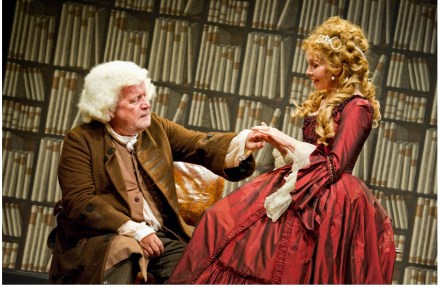
Dr Johnson would be thrilled. His name up there in lights in the West End. He craved theatrical fame, and was cruelly disappointed that his only play, an exotic tragedy set in Constantinople, had just nine performances in 1749. But here at the Arts Theatre on Great Newport Street (London WC2, until 24 September) he is brought to vivid dramatic life by Ian Redford. In A Dish of Tea with Dr Johnson, the rough-mannered and ill-figured dictionary-maker also finds himself on stage with a glamorous woman, Trudie Styler, who as Hester Thrale even pecks his cheek. Did they ever kiss? Who knows? Their friendship has puzzled scholars for 200 years. Adapted from James Boswell’s biography, a book that is unusual in the richness of its verbatim conversations, the play is rich in apt quotation.

One day

Radio and podcasts

‘History is not a dull subject,’ warned Caryl Phillips, the novelist, at the end of his 9/11 Letter. ‘It’s a vital, contested narrative, peopled with witnesses to events which touch both head and heart. It’s the most important school subject because not remembering is the beginning of madness.’ Perhaps he should have said ‘not remembering correctly’ in this week of commemoration of the events of ten years ago. Phillips’s letter was the most powerful of the five that were specially written for Radio 4’s Book of the Week (and produced by Julian May and Beaty Rubens).

The bees’ knees

Radio and podcasts

‘It makes you happy that something like that exists,’ says Devente, a young beekeeper from Hackney as he emerges from his protective suit in a halo of smoke, having just checked that all is well in the colony. ‘It makes you happy that something like that exists,’ says Devente, a young beekeeper from Hackney as he emerges from his protective suit in a halo of smoke, having just checked that all is well in the colony. You could almost hear the puffs of smoke. ‘Once you understand the bee,’ he says, ‘then your perspective changes from swatting to staying still.’ Devente has been keeping bees for a while now, with the help of a social enterprise foundation called the Golden Company.

Personal best

Radio and podcasts

Two programmes, two very different worlds, and all in the space of a Sunday afternoon. Imogen Stubbs gave us a Radio 4 moment when she used the network to campaign against those personal statement forms which young students have to write as part of their applications to colleges and universities. The instruction booklet (or guidance for parents) obtainable from Ucas (the centralised organisation otherwise known as Universities and Colleges Admissions Service) suggests that this is an opportunity for the prospective candidate ‘to demonstrate their enthusiasm and commitment and, above all, ensure that they stand out from the crowd’. Orwell would have been horrified by the use of that meaningless cliché. How can they all ‘stand out’?

Bearing witness

Radio and podcasts

Even the great Alan Bennett sounded out of synch with the times as he read from his new short story ‘The Shielding of Mrs Forbes’ for this week’s Book at Bedtime (Radio 4). Even the great Alan Bennett sounded out of synch with the times as he read from his new short story ‘The Shielding of Mrs Forbes’ for this week’s Book at Bedtime (Radio 4). His peculiarly English brand of wit, mordant, slightly sinister, a touch supercilious, grated on the nerves. No one else on radio can put together a character with such economy and yet such excruciating vividness. But in the light of the events of last week his characters sounded a bit jaded, a little worn out, too caricatured to gather us in as listeners.

Kate Chisholm on The Reunion

Radio and podcasts

There was a scary moment on last Sunday’s The Reunion when we heard that the derivatives market has ‘exploded’ since the collapse of Barings in 1995. Banking has become more, not less, dependent on the kinds of gambling on future (i.e., virtual) values that brought down Britain’s oldest merchant bank. When Barings fell, just over $1 billion went down the drain. Now, the derivatives market is worth $1.4 quadrillion — a figure that becomes more and more meaningless the bigger it gets, wafting through the ether like a cloud of poisonous gas.

Sporting Witness

Radio and podcasts

It took just ten minutes for the secret of Nadia Comaneci’s extraordinary success at the 1976 Olympic Games in Montreal to be revealed. Comaneci achieved the first-ever perfect score when she was given a clean sweep of 10s from all the judges for her performance on the uneven bars. ‘What I remember is the dead silence in the stadium,’ recalls Vera Atkinson, a champion gymnast herself who was reporting on the Games for Bulgarian national television. ‘She flew between the bars, performing so many different things with the human body, before landing perfectly still...Yet the routine took barely 30 seconds.

Spreading the word | 30 July 2011

Radio and podcasts

Sometimes the simplest ideas are the best. Take Dolly Parton’s Imagination Library. She wanted ‘to do something nice for the folks in my home county [Tennessee]. I wasn’t thinking on a larger scale,’ she says. But her idea to send a free book every month to every child enrolled in her scheme from the moment of birth right up until the age of five has now taken off and is reaching children across Australia, America and Canada. Four years ago she arrived in the UK to launch it in Rotherham, south Yorkshire, at the invitation of the local council. From sending out just 2,300 books each month when the scheme began 12 years ago, 700,000 children are now part of Dolly’s library.