Culture

Culture

The good, the bad and the ugly in books, exhibitions, cinema, TV, dance, music, podcasts and theatre.

Crime and punishment

Radio

Just a snippet on an edition of Today last spring taken from the programme that had just won an esteemed Sony Gold radio award was enough to create an impact. Ray and Violet Donovan were talking about the murder of their son, Chris, on a feature made by the Prison Radio Association. The programme was part of an innovative Restorative Justice scheme, using the power of listening to help victims, heal prisoners, and of taking that one further step by then broadcasting their conversations throughout the prison network. It was one of those moments when you just had to stop whatever you were doing. There was something in the voice, the stillness around that voice, the lingering echo of what was being said. It made you want to hear more from Ray and Violet, and from the prisoners.

Human stories

Radio

‘The aggregation of marginal gains’ is the key to success, according to Dave Brailsford, the extraordinarily successful cycling coach to Team GB. You could say that’s been the motto of this Olympic Games. Not massive injections of dosh (or drugs, for that matter). But a heady cocktail of supreme physical effort and tactical nous. Brailsford recognises it’s the little things that can make the difference when mere fractions of a second are all that’s between gold and nothing. We discovered that his cyclists sleep on specially chosen mattresses and wear heated hot pants (yes, I do mean hot pants). Cyclists, he reckons, need to sleep well before a race.

Save our soap

Radio

It’s no good. We’ve been putting up with weird character changes, laughably unconvincing plotlines, calculating theatricals for a while now. But life in Ambridge has now plunged into the danger zone. If we don’t rise up in protest, The Archers is doomed, destined for broadcasting oblivion, killed off by a flash flood of OTT dramatics. There were warning signs as soon as Ambridge Extra was launched on Radio 4 Extra with a mission to update life in the Borsetshire village, make it more appealing to younger listeners, provide a hinterland for all those minor characters whose names we knew but from whom we never heard — Freda, Ryan, Sabrina. Things in Ambridge changed, just ever so slightly.

Word perfect

Radio

‘Tyne, Dogger, Fisher, German Bight…’ It all began on Friday night with the Shipping Forecast, made world-famous by Radio 4’s team of continuity announcers. Radio reigns supreme in these Olympics. It’s so much part of why Britain is different from the rest of the world, and Danny Boyle sparked off his extravaganza by recognising this. Hurrah! We’ve stuck with the old wireless technology, adapting, renewing, ensuring that the power of radio as life-saver, fact-checker, storyteller not only survives but also grows in stature. TV gives us the brave new world of moving pictures, and brought Boyle’s creative vision to life, but the commentators never seem to have done enough preparation.

Olympian challenge

Radio

Who would have thought 15 years ago that not only would the BBC still be spending money on radio coverage of the London Olympics but that there’d also be a dedicated digital station? High definition TV, with its crystal-clear images of every pimple, tattoo and six-pack, should by rights have seen off its poor sound-only relation, with only words, words, words on offer, no pictures, no flashbacks, no sweaty post-triumph interviews. But on Wednesday, Radio 5 Live Olympics Extra came on air (and online), broadcasting to the world nothing but coverage of the Games, throughout the day but also on catch-up all night long. Radio 5 Live’s controller, Adrian Van Klaveren promises that we’ll hear ‘radio as you’ve never heard it before’.

In from the cold

Radio

When it was announced earlier this week that Aung San Suu Kyi will soon be cast away for Desert Island Discs, it was suggested her choices of music will be ‘really interesting’, because, under house arrest in Burma, she had been forced to live in ‘a time warp, a capsule away from the world’. But will she really be so out of touch with the musical tastes of Radio 4 listeners? Suu Kyi has often mentioned her gratitude to the BBC, and the World Service in particular, for leading her to places, ideas, music and poetry that were located and inspired thousands of miles away from the house where she was confined just outside Rangoon.

The power of words

Radio

‘Oddly enough,’ declared the actor John Hurt on the Today programme last Friday, ‘radio is closely linked with film.’ This grabbed my attention over tea and porridge. Radio like film? It’s not at first an obvious comparison. Radio deals in images, but surely only those we create in our minds. Hurt went on to explain: ‘Film deals with visual images. Radio deals with linguistic images.’ He was talking to Justin Webb about the plays Tom Stoppard wrote for radio when he set out to establish himself as a dramatist in the early 1960s. Four of them are now available as a five-CD set from the British Library as part of the celebrations for Stoppard’s 75th birthday.

Hooked by chance

Radio

I know we’re all supposed to be taking advantage of the new technologies and listening to whatever we fancy on the radio whenever we like. But I reckon you have to be under 25 to really get the hang of listening by download, podcast and stream rather than at the switch of a button. When, in any case, are we supposed to find the time to download it all and catch up with what we’ve missed? It’s like the conveyor belt in The Generation Game. By the time you realise you’ve missed something vital and/or desirable, the next week’s goodies are on offer. That’s why I’m still a switch-it-on-and-see-what’s-on listener, for most of the time. Chance, serendipity, happenstance are much more interesting than anything preplanned.

In love with words

Radio

No wonder Clive James thought he was writing his own obituary when he was interviewed by John Wilson for the Radio 4 series, Meeting Myself Coming Back (Saturday night). Wilson played him a clip from a recent Mastermind programme on which one of the Specialist Subjects was...Clive James. ‘I was halfway between being amazed and appalled,’ he told us. ‘I’m already being treated like some kind of historic monument.’ His mistake was to have agreed to do the programme in the first place. The series is made by the Archive on 4 team, whose job is to ferret around in the BBC’s repository of lost conversations, old achievements, forgotten soundtracks like audio archaeologists searching for mummies in the Valley of the Kings.

In full bloom

Radio

It’s as if James Joyce was writing for radio, as if he understood the potential of the new audio technology long before the BBC had begun to broadcast plays and poetry. All that freakish literary invention in his 1922 novel Ulysses suddenly begins to make sense when heard on air, spoken out loud, with sound effects to tell us where we are. If you’ve never read it, but are too embarrassed to admit this (like the academic guests at David Lodge’s dinner party who get caught out in a game of literary humiliation), you could have tuned in to Radio 4 on Saturday and become an instant expert on Joyce’s quarter-of-a-million-word blockbuster (at least three times the length of anything by Ian McEwan or Julian Barnes).

Borsetshire blues

Radio

Will and Nic’s canoodling in the woods. Adam’s bashed-in head. Amy’s makeover from wholesome midwife to foul-mouthed stepdaughter. Ambridge, home to the Archers, the Grundys and of course Lynda Snell, has been transformed from a sleepy village in the heart of Middle England into a crime-ridden soap, fuelled not by the everyday happenings of ordinary folk but the high-octane antics of a new crew of emotion-hugging soap stars. Joe and Eddie Grundy have all but disappeared from the scene, as have Peggy, Jill and Clarrie. Now we know why. There’s been a TV takeover and the daily soap is now under the editorial control of John Yorke, who used to work on EastEnders. For him, every episode has to end on a cliffhanger.

Time to reflect

Radio

It was my first Jubilee moment — Judi Dench on Radio 4’s Today programme suddenly launching into Shakespeare mid-glam (incredibly glam) party. She was talking to Jim Naughtie at the Queen’s gala for the arts at the Royal Academy and bewailing the decline in the teaching of Shakespeare in schools. Mid-sentence, she breaks into Cleopatra’s lament: ‘I dream’d there was an Emperor Antony/O! such another sleep, that I might see/ But such another man.’ It was so natural, so heartfelt, so extraordinary that she could remember the speech line-for-line and give it to us, just like that, with no preparation, no sense of performance or theatrical delivery. I just had to stop and listen; to pause instead of rushing on with the day.

Conflict management

Radio

7 Up, the TV series first made in 1964, would never have worked on radio. Ten young boys and (only) four girls were interviewed as they set out on their lives, with the intention of checking up on them every seven years thereafter to see what might have happened to them. They’ve now reached 56 and the series instead of looking forward to what these children might become is looking back over where they have been. The sad, guarded eyes of the young boy in a care home in 1964 made a powerful impact in black and white (colour had not yet arrived on TV), as did the sparky smile of another boy. Words alone somehow would not have had the same impact. We needed to see their faces, and those expressions, foretelling, we could have imagined, what would happen to them.

Lives of others | 19 May 2012

Radio

He was accused of listening too much to the ‘wrong people’, of being ‘too deferential’, not judgmental enough. Sometimes those he interviewed afterwards said that he was like ‘a ferret’, who pried too deeply into their lives, ‘looking for the facts that he wanted’. But Tony Parker, who died in 1996, gave a voice to those who were not usually heard or cared about. He made their lives sound special, individually important. In books such as Life After Life, The People of Providence, Lighthouse and Red Hill he opened up the lives of murderers, working people on a south-east London estate, lighthouse-keepers and miners, telling their stories in their own words.

Soaps and suds

Radio

Listeners beware. Especially those of you who are unashamed Archers addicts. The antics of the denizens of Ambridge might seem like casual, everyday stuff, but they’ve probably been carefully designed to indoctrinate us with the ‘right’ kind of behaviour. That’s if a two-part documentary on the World Service, hosted by none other than Debbie Archer (alias Tamsin Greig), is to be believed. Soap Operas: Art Imitating Life took us back to those first radio serials in America, funded in the 1930s by the big soap manufacturers to market their latest products. Yes, soap operas are so-called because they were originally given the means to go viral by firms like Colgate-Palmolive.

Good night out

Radio

It would never have worked on TV. Ann Widdecombe going out for a night on the town with a group of young professional women. No self-respecting binge-brunette would have allowed themselves to be seen on camera with a sexagenarian ex-MP who just happened to be off the booze for Lent. But there she was, in the Reggae Music and Soul Food Bar at gone midnight, knocking back her glass of fizzy water while Rebecca, Brooke, Phoebe and Kate sipped their shots and tots of vodka. Widdecombe’s challenge was to look for some ‘real human beings’ behind the screaming headlines about Britain’s binge drinkers, those dolled-up girls in high heels, staggering along the nation’s high streets at three o’clock in the morning. Who are they?

Beware the growlers

Radio

It’s the weirdest thing. This obsession with the sinking of the Titanic. Go to the BBC iPlayer website and you’ll find eight programmes you can listen to now, if by chance you missed them first time round. Take Titanic: Minute by Minute on Radio 2, broadcast ‘live’ on the very same night (100 years later) that the luxury ship went down. Billed as ‘experimental’, an ‘adventure’ in radio, this blow-by-blow account of what happened on that fateful night in April 1912 took place in real time in the studio in London, beginning at 11.30 p.m., just before the White Star liner hit the misplaced iceberg, and ending three hours later, by which time the Titanic was lying at the bottom of the North Atlantic.

Question time | 14 April 2012

Radio

You might be thinking ‘Oh no’ as you listen to yet another trailer announcing the BBC’s latest Shakespeare season, designed to showcase England’s great playwright across radio and TV in this Olympics year. ‘Do we really need a 20-part series on Radio 4, scratching through the surprisingly few facts that are known for sure about the Bard, or even trying to evoke that faraway world in which men dressed in slashed-velvet bloomers and heretics were hung, drawn and quartered?’ Actually, we do, and especially when it’s written and presented by Neil MacGregor, director of the British Museum. Shakespeare’s Restless World, which starts on Monday, doesn’t try to make the playwright more accessible by bringing him up-to-date.

Night life

Radio

He’s got the perfect voice for radio, gruff and gravelly, slow and measured so you can catch every word. His new series is not, as you might expect, on 6 or 1, or even 2, but on 4. Jarvis Cocker’s Wireless Nights (late on Thursdays) is quite a coup for the former Home Service, the Pulp frontman bringing a touch of street cred to the network once proud to be considered middle-of-the-road. Cocker promises that his series will wander through aspects of the night, drawing on the stories of those who stay awake through the witching hours. Tilly, a young shepherdess, is facing her first night shift alone, struggling to keep alive a ewe who is giving birth to twins. The legs of both lambs are out but their heads are stuck.

Close encounters

Radio

Kate Chisholm looks forward to The People’s Passion on Radio 4 which explores the role of the cathedral in a modern, secular world ‘We began by wanting to do something about cathedrals and the life that goes on within them,’ recalls Christine Morgan, head of religion and ethics at BBC Radio. That was about 18 months ago, when not much attention was being paid to these great beacons of British history and belief. But by coincidence (or perhaps divine intervention) cathedral stories have been hitting the front pages in recent months after the tortuous attempts by St Paul’s to extricate itself from Occupy London and its battle with money, capitalism and the workings of the City.

Con air

Radio

Imagine a small room, no windows, institutional cream on the walls. Bare of all decoration except for a circle of cheap chairs and the most basic of recording equipment. A gathering of people squeeze into the space — three young men, a strained-looking couple, an official-looking woman with clipboard and notes, a man in jeans with an earpiece. There’s not much room for manoeuvre, or to opt out of what’s going on. This is Prison Radio, an outreach scheme that began in HMP Feltham for young offenders in the early 1990s. Two radio producers wanted to do something about the high rates of self-harm, and of reoffending. Why not give prisoners the chance to learn new skills at the same time as providing them with a means to share experience, consolation, communication?

JAM today

Radio

On the page a minute’s worth of words doesn’t look like much. A hundred and forty-four or thereabouts. But try spouting forth for 60 seconds on any given subject without hesitation, deviation or repetition and those 144 words become an awful lot to find, especially when they have to be summoned up at speed from some inner reservoir of thoughts and phrases. Maybe that’s the reason why Just a Minute is still such a fixture on the Radio 4 schedule. The panellists make it sound so easy that we’re always puzzled when a new, unpractised contestant struggles to survive for longer than 20 seconds. We’re puzzled but we also relish their embarrassment. We feel superior. If only we were invited on to the show, we would be able to talk, no problem.

Healing art

Radio

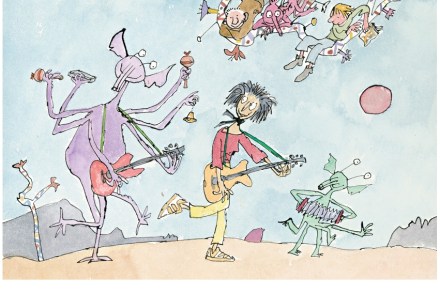
‘It’s like acting,’ says the illustrator Quentin Blake about his latest project. ‘You imagine yourself there, in that situation. You imagine you are that person.’ The first-ever children’s laureate has been taking his acute eye for gesture, for character, into hospitals, as part of the Nightingale Project. His funny, colourful, bursting-with-life paintings are now decorating the walls of a mental health ward at Northwick Park, the Vincent Square Clinic and a maternity hospital in France, and are being celebrated in an exhibition at the Foundling Museum (40 Brunswick Square, London WC1). They reflect so accurately the experience of illness, parenting, age and infirmity that Blake has been asked, ‘How do you know that?

Listen up!

Radio

Life-changing moments are not always as dramatic as Saint Paul’s Damascene experience. Often they emerge from conversations that begin with mundane exchanges about last night’s Masterchef, the film you saw last week, the last time there was a drought. Then gradually the talk moves on to other, deeper matters. Something is said, some connection is made which opens up a shaft of light on a problem, a question, a source of confusion that’s been troubling you for years. You might not realise for a while that the conversation marks a change, but looking back on what was said leads you to recognise how from that moment your life has taken a different (though not necessarily dramatically different) tack.

Overdoing the drama

Radio

What took them so long? For weeks and weeks he’d been limping into the farmhouse whining about how cold he is, how tired, how he’s had enough of Tom gadding about Borsetshire selling his gruesome-sounding pork meatballs while he’s stuck on the farm trimming leeks and getting up at the crack of dawn to do the milking. The clues were so obvious even Sergeant Lewis would have guessed that something bad must be waiting in the cowshed for Tony Archer. Perhaps it was intentional, the scriptwriters of The Archers (Radio 4) calling our bluff to prove that they’re in charge, and carefully manipulating our fears and premonitions to ensure that we keep on tuning in day-by-day. You might think you’ve second-guessed what’s in the script for Tony. But we know best.

Archive treasures

Radio

It’s a bit of a surprise to discover that my young nephews are huge fans of radio. Since Radio 4 abandoned programmes designed for children, and CBeebies disappeared from the airwaves, radio has become a kids-free zone. What on earth do they find to listen to? Why, of course, Radio 4 Extra, and especially the comedy classics, The Navy Lark, Beyond Our Ken and The Men from the Ministry. Kids are getting the listening bug from programmes that were created more than 50 years ago. Brilliant. To them, these treasures from the archives sound as weird and fantastical as Harry Potter. As Mary Kalemkerian, Radio 4 Extra’s director of programming, has proved so pertinently in these straitened times, who needs vast amounts of money to be creative?

New world order | 25 February 2012

Radio

Not much fuss has been made about it. We might not have realised it was happening if news of the leaving bash with its tales of uninvited guests (former staff members) had not been gossiped about in the press. But from March the BBC World Service will no longer be broadcasting from Bush House, that once very grand but now rather shabby crescent-shaped building at the heart of the Aldwych in central London. Instead, all 27 of the specialist radio teams broadcasting in Arabic, Persian, Swahili, Russian, Urdu, Brazilian Portuguese, Mandarin, Tamil and Nepalese...will be moving in to swanky new studios in Portland Place, just north of Oxford Circus, as part of the transformation of Broadcasting House. It’s hard to imagine the BBC, let alone the World Service, without Bush House.

Character building | 18 February 2012

Radio

He writes about the stuff you’d rather not know, prefer not to think about, pretend to ignore. But it lives on with you in the mind. It won’t let you go. By his words, the sharp, brittle, spot-on dialogue, he forces you to recognise the limitations of your experience, your understanding. Roy Williams’s new trilogy of plays for Radio 4, The Interrogation, takes three predictable situations — a Premier League footballer rapes an underage girl, a white woman batters her racist husband to death with a brick, a black kid joins a gang and shoots dead a young mother — and fills in the details behind those black-and-white headlines. It’s not the story outline that matters, but the characterisation, the way the people speak, the language they use.

Leave well alone | 11 February 2012

Radio

Maybe he was asking for it. Maybe his article in the New Statesman was a subconscious attempt to undermine his brother’s authority. But what was the point of grilling David Miliband about his relationship with his brother Ed on the Today programme (Radio 4) on Monday morning? What we wanted to know was whether Miliband senior had any fresh ideas about how to tackle the grievous problems of our economy, and especially how to remedy our inability to ensure that there are enough jobs for our young people to find gainful employment. Who cares whether he’s still simmering with rage about his brother’s seizure of power? Why, then, did John Humphrys try to reignite a Westminster bonfire that actually went out 17 months ago when Ed won and David lost?