War

Why Biden’s slip-up is so revealing

The White House might have issued the fastest correction of a sitting US president’s remarks in history this weekend. But it doesn’t matter one bit. The bottom line is Joe Biden — and most of the civilized world — wants to see Vladimir Putin out of power in Russia. More to the point: they want to see his regime changed and him most likely Gaddafi'd for his sins. And, to be frank, who can blame them? There is just one problem: getting rid of Vlad means World War Three. And I can tell you from gaming out such a conflict countless times in simulators, such a conflict leaves tens of millions of people dead. But let’s step back for a moment. I'm going to cut the president a little bit slack for saying out loud what we are all thinking.

regime change

A state of virtual war

My husband came into the living room the other day as I was sitting on the couch, scrolling on my computer — doomscrolling to be more accurate. “What are you doing?” he asked. “Are you watching... war?” We laughed at the absurdity of the comment but he wasn’t wrong. That’s exactly what we had been doing for days. Watching war on social media. Needless to say, it was a challenge to focus on this piece. As the conflict escalated rapidly in Ukraine, I couldn’t tear myself away from the drama as it unfolded on Twitter. Putin seemed backed into a corner, desperate and using many of the same barbaric tactics he used in Syria. Bombing hospitals. Bombing kindergartens. Killing civilians.

war
cyberattack

How bad could a Russian cyberattack be?

When I have designed wargames around a NATO-Russia conflict, I often left out cyberattacks for a simple reason: it was just too complicated. Too many unknowns make an accurate simulation impossible. The number of targets, scale of the attack, damage done, how the attack could be carried out and its ramifications were beyond calculation for a mere simulation on the scale I was running using just consumer-based computer technology. Honestly, nuclear war seemed easier to think about, and that says a lot. But that should give us pause. Our world is basically a giant computer now, with cloud-based networks controlling virtually every aspect of our lives, from sewage and water treatment plants, to our electrical grid, to our smart homes, and on and on we go.

energy

Energy independence is a false hope

In the wake of Russia’s attack on Ukraine, gasoline and energy prices soared in the United States. While they’ve come down a bit since, it’s worth examining why war in Eastern Europe caused a spike in prices thousands of miles away — and whether a common proposal in response would have made a difference. Over the last decade, Republicans and Democrats have made “energy independence” a major policy priority. The goal in a nutshell is to produce the energy we need at home, so that the United States is more insulated economically from international disputes abroad. On this goal, advocates have made progress — in fact, the United States is already energy independent by some measures.

Volodymyr Zelensky’s sitcom is now as sad as it is funny

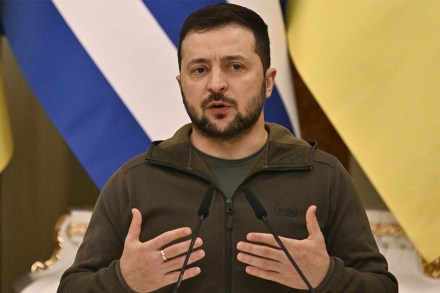
There are few world leaders braver than Volodymyr Zelensky. Ukraine's president spends his time holed up in his capital, defending his homeland from an onslaught of invading Russian troops. He's addressed every major parliament in the West to plead for weapons and aid. Joe Biden calls him weekly; Emmanuel Macron has started to dress like him. Given his present international standing, it's incredible to think that just six and a half years ago, Zelensky was settling down to watch himself play the president of Ukraine in the premiere of Servant of the People, the sitcom which set the stage for his political career.

stalemate

How will the battlefield stalemate end in Ukraine?

The simplest description of the war in Ukraine is this: stalemate, accompanied by constant, deadly bombardment. For the Ukrainians, that bombardment is aimed at the Russian military. For the Russians, it is aimed mostly at civilian targets, a deliberate strategy that is also a war crime. Russian artillery shells, cluster bombs and cruise missiles are killing tens of thousands of Ukrainian civilians and destroying their homes, schools and businesses. Meanwhile, Ukraine’s counterattack is imposing huge, irreplaceable losses on Russia’s army, killing soldiers, destroying their equipment and liquidating incompetent military leaders who come to the front to untangle the mess. Russia’s initial war plan failed, abysmally.

What’s the difference between Yemen and Ukraine?

Millions of innocent civilians uprooted from their homes. Residential areas turned into dust, rubble and wire. Thousands of people killed in errant airstrikes. Store shelves emptied of basic staples. A humanitarian crisis dominating the everyday lives of a large swath of the population, who just want to escape the shelling and the fighting. This is the scene the world now equates with Ukraine, which has been subjected to a barbaric war of choice courtesy of Russian president Vladimir Putin. Yet for one poverty-stricken nation more than 2,400 miles to the south, this has been the grim reality for years.

yemen

Why the Ukraine war might not end

One thing anyone who studies foreign policy for a living knows is that fairytale endings never happen in war. I suspect Ukraine will follow this sad trend. Why should we expect anything different? War never conforms to humanity’s desire for the good guys to defeat the bad guys. Indeed, great power politics grounded in realpolitik but shaped by mankind’s sense of morality is a mixture that yields tragic results. The demand for closure, clean endings to conflicts where the antagonists get punished, is rarely fulfilled. Wars only have happy endings in the movies. In fact, some wars never seem to end, as the combatants are left unfulfilled — or just haven't been weakened enough.

ukraine

Did the realists underestimate Putin?

Liberal internationalists, neoconservatives and NeverTrumpers are having the time of their lives these days, ridiculing anyone on the political right who has ever said a good thing about Vladimir Putin. Those “Putin groupies” as a Wall Street Journal columnist described them, include former Italian prime minister Silvio Berlusconi, far-right French presidential candidate Marine Le Pen, Hungarian prime minister Viktor Orbán and, of course, Trump himself. Trump described Putin as a “genius” and said he was a better president than Barack Obama — and he isn’t the only American president to compliment the Russian leader. President George W. Bush said about Putin, “I looked the man in the eye. I found him to be very straightforward and trustworthy.

putin

The strange ideology that could be driving Putin

Vladimir Putin’s motives in attacking Ukraine have become the subject of many deep and searching speculations. Is he seeking a personal legacy by attempting to reassemble the parts of the Soviet Union that fell asunder? Is he pursuing Russian national security by making sure Ukraine never becomes the frontline of NATO? Is he gleefully taking advantage of a weak and incompetent US president? Is he vindicating the glorious history of the KGB? These theories are not mutually exclusive, and there are many more possibilities. I want to enter the discussion from my nearly pristine ignorance of Russian geopolitical designs.

eurasianism
biochemical weapons

Yes, Putin could use biochemical weapons in Ukraine

The Russian Defense Ministry held a briefing last week claiming that they have discovered US-led biological laboratories in Ukraine. Moscow stated that a rapid halt was brought to the facilities’ activities, adding that Kyiv and Washington had violated the Convention on the Prohibition of Biological and Toxin Weapons. The Kremlin did not feel the need to provide evidence of its claims, par for the course in Putin’s Russia.

Stop enabling the crisis junkies

Did you make good use of the neatly palindromic 2/22/22? To refresh your memory, it was a day that turned out be the narrow window between the moment when the evolving “science” suddenly allowed Democratic governors to start lifting their states’ mask mandates, and Vladimir Putin launching his special mission to “protect the people” in eastern Ukraine. I hope you enjoyed it, because given the way the mainstream media portray the news these days, it may be a while before we’re all allowed our next respite from the seemingly permanent existential crisis that runs as a through-line to our human condition.

crisis

Sanctions on Russia will shake the world economy for years

The war in Ukraine will dominate the news for the foreseeable future. But while the bombings will eventually cease, the economic consequences for the world have just begun. That’s because in an era of increasing interconnectedness, economic impacts don’t stop at borders. Most attention has been focused on the immediate impacts of sanctions on Russia, and they are significant. In the past, sanctions have proven largely ineffective at punishing foreign enemies. President Barack Obama, for example, failed to use them effectively in 2014 during the last Ukrainian-Russian dispute. But this time, the actions taken against Russia were largely unprecedented, with even traditionally neutral countries like Switzerland and Sweden calling for restrictions that are “as big as they can be.

economy

Watch out for Ukrainian social media propaganda

Stop me if you’ve heard the one about the Ukrainian beauty queen who volunteered to fight the invading Russian forces. If you’ve been on social media these past few weeks, you’ve probably seen the striking photo of the woman clad in tactical gear and holding a rifle. “We are living in a materiel world, and I’m a materiel girl,” the stunner says to the viewer through her steely glare. Or the one about the Japanese ambassador to Ukraine kitted out in his ancestor’s samurai gear and ready to defend his adopted homeland? You’ve surely heard about the “Ghost of Kyiv,” a Ukrainian fighter pilot who has been terrorizing his Russian counterparts, accomplishing the feat — uncommon in contemporary air combat — of becoming an ace.

propaganda

Putin will escalate

“I can’t tell you how this ends. All I can tell you is that I just hope millions of people don’t die, or that both Ukraine and Russia aren’t both destroyed in some way thanks to this war.” Those words, spoken to me on an encrypted smartphone app yesterday, are from a Ukrainian commander actively fighting Russian soldiers that I have known for years thanks to wargames I helped organize that brought together national experts, military officials, and policymakers from around the world.

Ukraine and the art of viral war

The sky is dull and gray, the sun obscured by clouds. The camera pans down past some desolate Soviet housing blocks. Some wintry, apocalyptic trees line a road. It could be Kyiv, it could be Bucharest, it could be any city where the residents liberally pepper their words with the -sky suffix. Suddenly, a flash of metal across the sky, a fighter plane roars into shot, then out again. The caption proudly declares, “This is the Ghost of Kyiv, the bravest fighter pilot in the Ukrainian Air Force. He has downed six Russian planes just today.” You don’t know that much about Ukrainian fighter pilots, but placed among a million other viral clips of heroic Ukrainians fighting against Goliath, you think it seems believable enough. You retweet it. You send it down group texts.

Pro-Ukraine citizens clash with authorities in Georgia

Tbilisi, Georgia After one week of fighting, Russia's invasion of Ukraine has already caused far-reaching geopolitical consequences, most of which point to gross miscalculation from the Kremlin. Following an arguably hesitant start, the Western world has united to provide Ukraine with lethal and non-lethal aid, as well as economic and humanitarian support. In addition, despite Putin ostensibly launching his war to prevent Ukraine from becoming a NATO member and curtail the alliance's easterly expansion, Kyiv's relations with the West have ironically become closer. Both Sweden and Finland appear to be closer than ever to considering joining NATO.

georgia

The Ukraine invasion is nothing compared to Iraq

Of the war in Ukraine, New York Times columnist Thomas Friedman writes, “Our world is not going to be the same again because this war has no historical parallel.” In the very next sentence, he describes the Russian invasion of Ukraine as “a raw, eighteenth-century-style land grab by a superpower,” thereby acknowledging that the episode actually has innumerable historical parallels — just not ones that Friedman cares to acknowledge as legitimate. Friedman figures prominently among those claiming to have divined the essential character of the present age. His key finding: tech-driven globalization has rendered old-fashioned power politics obsolete. The rules of the game have changed irrevocably. Practically speaking, nations have no choice but to submit.

invasion iraq

Ilya Kaminsky’s poetry in a time of war

There is currently a poem going viral on Twitter. “We Lived Happily During the War” is by the Ukrainian-American poet Ilya Kaminsky, and it is the first poem of his prize-winning collection Deaf Republic (2019). It is easy to see why it feels particularly relevant: Kaminsky was born in the former Soviet city of Odessa, which is now under attack from Russia. The poem opens: “We Lived Happily During the War” And when they bombed other people’s houses, we protested but not enough, we opposed them but not enough. It is a heart-breaking meditation on the way normal life continues despite crises. The speaker describes how “I took a chair outside and watched the sun.” But he ends with a plea: “we (forgive us) / lived happily during the war.

llya Kaminsky

Let Russia choke on Ukraine

At least for the moment, it looks like Russian president Vladimir Putin is intent on conquering Ukraine, a nation he's never believed has the right to exist. While the fog of war always limits accurate real-time military analysis, it seems for now that Russia has committed to annexing at least large sections of Ukraine and is winning the day militarily with ease. Of course, the media has predictably gone into overdrive, warning of World War Three, gas prices that will stay high for years and perhaps even Putin attacking NATO and nuclear war. But let’s put away the hysterics for a moment and think about the here and now. Russia’s goal in Ukraine has always been clear and does not involve war on NATO or even conquering Ukraine in its entirety.

ukraine