Virtual reality

The Zuck that stole Christmas

From our US edition

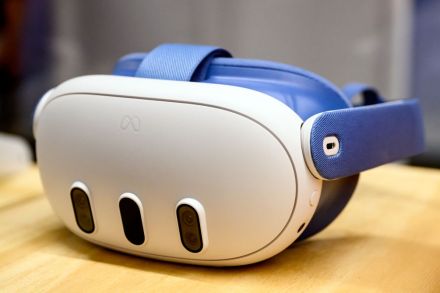
I got Meta's flagship Quest 3 headset last year. Not only did I love it and use it all the time — as described in my April feature on VR  — but so did my sister, who would play Beatsaber every time she visited. As a good brother, it was pretty obvious what this year's Christmas present for her should be, so I picked up a late-model version of the Quest 2 and a bunch of the most premium accessories. When she opened it on Christmas morning, she had tears in her eyes, so happy to have her own headset and play Beatsaber whenever she wanted — and to do so in multiplayer with me, despite us living countries apart. She put it on and went through the initial set-up, at which point the headset said it needed to download an update, and she left it to install.
zuck christmas headset

The VR and AR arms race

From our US edition

You probably don’t remember the Humane Pin, despite its dominating the tech-news cycle a few months ago. It’s an elegant AI-powered square that sticks to your lapel and can send messages, search for information and tell you about what you’re seeing, all through voice commands. The Humane company raised more than $230 million in venture backing, and its rollout included a runway appearance at Paris Fashion Week, a TED talk and a chic announcement video where the pin repeatedly misinformed its user. According to the pin, almonds have far more protein than they do, and April’s solar eclipse would have been best viewed from Australia, where it wasn’t even visible. Also, there’s no way to use the pin other than with voice control.

VR

Heart of Darkness revisited: The Dimensions of a Cave, by Greg Jackson, reviewed

When Joseph Conrad sent his narrator into the heart of darkness, Africa was unknown territory. Revisiting the scene now, Greg Jackson dispatches his explorer to an even stranger destination: an algorithmic universe.  Jackson, a Granta Best of Young American Novelists in 2017, won prizes with his story collection Prodigals. His debut novel, The Dimensions of a Cave, could hardly be better timed. New fears about AI give it disquieting relevance. Conspiracy theories mingle with deep state corruption. Gradually it grows into a Chandleresque adventure: down these mean cyber streets a man must go. Dropped into the thick of it, the reader might get the feeling of arriving late at a party where everyone else has already been introduced.

Has VR finally come of age?

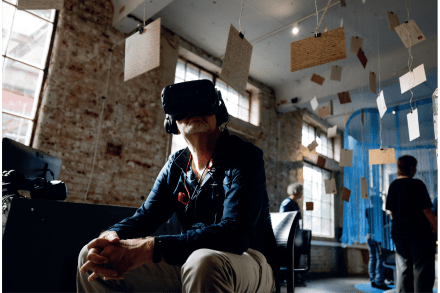
A heavily made-up Iranian woman in bra and knickers is dancing seductively before me. We’re in some vast warehouse, and she’s swaying barefoot. But then I look around. All the other men here are in military uniforms and leaning against walls or sitting at desks, smoking and looking at her impassively. I slowly realise we are in a torture chamber and this lithe, writhing woman is dancing, quite possibly, for her life. Me? I have become one of her tormentors. You can immerse yourself in war-ruined Ukraine, go on the run from the Holocaust, become a mushroom Welcome to The Fury, a bravura attempt by Iranian artist Shirin Neshat to use virtual technology in her art. ‘Have you ever experienced VR before?

Reality check: could our universe be a simulation?

Are we all living in a computer simulation? Is the world we imagine to be real simply virtual reality instead, an elaborate computer program? That sounds ridiculous, but nonetheless it’s what many clever people actually think — or at least, think possible. One of them, the philosopher David Chalmers, has just written a book on the subject, Reality +: Virtual Worlds and the Problems of Philosophy. Chalmers is a serious intellect. He won a bronze medal in the International Mathematical Olympiad as a child and did his undergraduate studies in Pure Mathematics before turning to philosophy. Part of his argument is that we are already building simulated worlds ourselves — computer games as well as virtual environments like Second Life.

Can VR help to sell art to kids?

Some pictures are now so mediated that their actual physicality has long been dwarfed by a million reproductions. The ‘Mona Lisa’, obviously. ‘The Haywain’ is the subject of countless cushion covers and trays. ‘The Birth of Venus’ has marketed trainers, hair dye and the New Yorker. Now, Georges Seurat’s ‘Un dimanche après-midi à l’Île de la Grande Jatte’, possibly the most famous painting to have inspired an entire musical and which has, along the way, inspired umbrellas, duvet covers, dresses, socks and face masks, is the subject of an ‘immersive’ creative experience. This does not mean paintballing outside the Art Institute of Chicago, where the actual art work resides.

Leonardo da Virtual

From our US edition

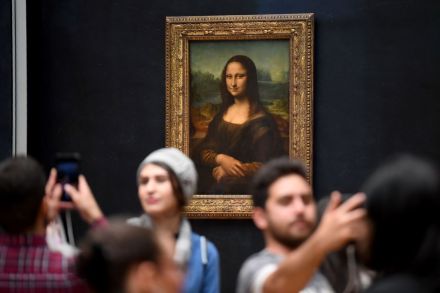
This article is in The Spectator’s December 2019 US edition. Subscribe here. The first time ever I saw her face, she was smiling. I knew her face before I saw it, but I cannot remember when I first knew it, because I had always seen it. But when I first saw her in the flesh, I couldn’t really see her at all. She was behind thick glass and a waist-high wall, and a crowd of people 20-deep were pushing toward her, shouting and pointing and taking photographs. She was still smiling, but as I forced my way out of the crowd, I felt as though the smile no longer expressed the mysterious inner mood of a high-born Florentine sitting in a loggia, but the bemused contempt of a woman sitting in the stocks for the entertainment of the mob.

mona lisa leonardo

When will American schools catch up with the technological revolution?

From our US edition

As 75 million children head back to school for the fall semester, there are concerns among academics, technologists and social scientists that the current American education system is no longer fit for purpose. Such is the pace of the technology revolution that children in kindergarten or middle school today are likely to be educated for a world that will largely have disappeared by the time they graduate. Even those in high school today are going to find a different world where learning about the past or the present has less and less value for the future. Even universities, which have changed little in the past 25 years are confronting a revolution where whole professions, such as accounting or medicine, which have provided a steady income stream are going to be under assault.

education schools