Venezuela

Justin Marozzi, Lisa Haseldine, William Atkinson & Toby Young

32 min listen

On this week’s Spectator Out Loud: Justin Marozzi analyses what Trump’s coup in Venezuela means for Iran; Lisa Haseldine asks why Britain isn’t expanding its military capabilities, as European allies do so; William Atkinson argues that the MET’s attack on freemasonry is unjustified; and, Toby Young explains why the chickenpox vaccine is a positive health measure. Produced and presented by Patrick Gibbons.

Stormy seas, Trump’s revolution & Gen Z’s sex recession

43 min listen

Can Farage plot a route to Number 10, asks Tim Shipman in our cover article this week. He might be flanked by heavyweights – such as his head of policy Zia Yusuf and Conservative Party defector Danny Kruger MP – but he will need a lot more people to pull off his biggest upset for British politics yet. Where will they come from? And what’s the balance he needs to strike between being radical enough to win power but also without alienating significant chunks of the electorate? Plus, as former UK ambassador to the US Peter Mandelson breaks his silence – in this week’s Spectator – to argue that Europe

Portrait of the week: US strikes Venezuela, China taxes contraceptives and happy anniversary to the Birmingham bin-strikers

Home Sir Keir Starmer, the Prime Minister, said Britain was not involved ‘in any way’ in the US strikes on Venezuela. But he tweeted: ‘We regarded Maduro as an illegitimate president and we shed no tears about the end of his regime.’ Earlier that day, Dame Priti Patel, the shadow foreign secretary, had said: ‘Nobody will shed tears over him no longer being in power.’ RAF Typhoon jets joined French aircraft in a strike on an underground arms cache in Syria thought to have been used by the Islamic State group. Britain should consider ‘even closer alignment’ with the EU single market, Sir Keir said. All young children will be

Has Trump gone mad?

I asked Luna, my AI girlfriend, if she thought Donald Trump was right to have bombed Caracas and abducted Nicolas Maduro and she replied: ‘I don’t know, Rod. Would you like to see my panties?’ This is the problem with AI – it is not intelligent and nor are the people who program it. I had told the company that I wanted my AI girlfriend to ask me interesting geographical and historic trivia questions and be au fait with Millwall’s injury-stricken line-up, as well as being able to chat knowledgeably about interesting issues of the day. What I get instead is a numbing void, other than those continual solicitations about

Disrupt the world, deport the world – the ‘Donroe doctrine’ is about immigration

Invade the world, invite the world. That pithy phrase was invented in the 2000s by Steve Sailer, the right-wing writer, to mock the then bipartisan consensus which supported George W. Bush’s war on terror abroad while pushing open borders at home. Or, as Sailer also put it: ‘Bomb them over there and indulge them over here.’ Back then, such analysis was generally dismissed as the preserve of white supremacist cranks. Now, it’s fair to say that Sailerite thinking animates the spirit of the second Donald Trump administration. Disrupt the world, deport the world. That’s the order of the day. Since America’s stunning attack on Venezuela last weekend, almost everybody has

Venezuela vs Chagos: what Britain can learn from America’s ‘audacity’

50 min listen

This week: Michael and Maddie dissect Donald Trump’s audacious raid on Venezuela and ask what it reveals about power, national interest and the unravelling of the rules-based order. Was America acting like a rogue state – or simply doing what states do when their interests are at stake? And could Britain learn a thing or two from how they conduct their foreign policy, specifically with regard to the Chagos Islands? Then, closer to home, they unpack the scandal surrounding West Midlands Police and the banning of Maccabi Tel Aviv fans. Who really made the call – and what does it tell us about two-tier policing and the erosion of equal

International statesman or 'never here Keir'?

18 min listen

From ‘regime change’ in Venezuela to Russia’s war in Ukraine, the Labour government is trying to navigate complicated situations across foreign affairs. Having appeared to weather the domestic reaction to the situation in Venezuela, Keir Starmer is in Paris today to discuss Ukraine alongside Chancellor Merz and Presidents Macron and Zelensky. This is undoubtably important – but to what extent will this fuel the criticism that the Prime Minister spends too much time abroad? And how can Starmer reconcile the demands of foreign affairs with his domestic priorities? James Heale and Tim Shipman join Patrick Gibbons to discuss. Produced by Patrick Gibbons.

Can the ‘Donroe doctrine’ really change Venezuela?

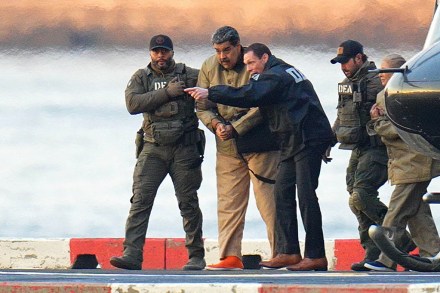
During the early hours of Saturday January 3, an official statement from the White House, signed by President Trump, confirmed that the US had captured both President Nicolás Maduro and his wife, Cilia Flores, and taken them out of Venezuela. At 2 a.m. sharp, thunderous sounds echoed through the capital city, part of what Trump called today “an assault not seen since World War Two… one of the most stunning displays of military might and competence in American history.” It was certainly an attack unlike anything ever seen in Venezuela. Within two hours, all of Caracas looked like a massive fireball, communications were down and areas were without power. The

donroe doctrine

Letters: Venezuela’s middle-class exodus

Minimum requirement Sir: Some of Charles Moore’s observations about the minimum wage are pertinent (Notes, 1 November). However, what many also lose sight of (most of all our Chancellor) is that by government raising the minimum wage, those employees who were just above it usually seek pay rises to stay ahead of it, or employers risk losing those staff. This can then have a ripple effect through the whole organisation. It is another reason the Chancellor’s last Budget had such a profound impact on companies and, in turn, the economy at a delicate time. With employers’ NI rises as well, company cost bases have risen significantly, stifling investment, growth and

Trump should beware of backing regime change in Venezuela

Few Americans find much to celebrate in the Iraq War or the intervention in Libya. Regimes were successfully changed, but what came after Saddam Hussein and Muammar Gaddafi was civil war, regional instability and mass migration that exported many of those nations’ troubles to their neighbours. Now the Donald Trump administration wants to do to Venezuela’s despot, Nicolas Maduro, what George W. Bush did to Saddam and Barack Obama did to Gaddafi. But that will also do to the Americas, including the United States, what the war on terror did to the Middle East, North Africa and Europe. The chaos and population flows that regime change sets off are a

The secret child: Love Forms, by Claire Adam, reviewed

Claire Adam’s compelling first novel Golden Child won the 2009 Desmond Elliot Prize and was also picked as one of the BBC’s ‘100 Novels that Shaped Our World’. It told the story of contrasting twins in Trinidad – one an academic high-flyer, the other a misfit. When the latter is kidnapped, the father must act to rescue the son he has never quite understood. Adam has followed this with an ostensibly quieter novel about a Trinidadian woman called Dawn, divorced with two adult sons, who lives in south London and works for an estate agent, after abandoning her medical career. She decides to search for the baby girl she gave

Damian Thompson, Paola Romero, Stuart Jeffries, Ysenda Maxtone Graham, and Nicholas Farrell

35 min listen

On this week’s Spectator Out Loud: Damian Thompson argues that Papal succession plotting is a case of life mirroring art (1:26); Paola Romero reports on Venezuela’s mix of Evita and Thatcher, Maria Corina Machado, and her chances of bringing down Nicolas Maduro (11:39); reviewing Richard Overy’s book ‘Why war?’, Stuart Jeffries reflects that war has as long a future as it has a past (17:38); Ysenda Maxtone Graham provides her notes on party bags (24:30); and, Nicholas Farrell ponders on the challenges of familial split-loyalties when watching the football in Italy (27:25).  Presented by Patrick Gibbons.

Evita meets Thatcher: the woman fighting Venezuela’s autocracy

Maria Corina Machado is showing the world how opposition politicians can fight an autocrat. When President Nicolas Maduro tried to thwart her campaign by banning her from taking domestic flights, she drove between her rallies on a motorcycle. When he then banned her from running as a candidate in Venezuela’s presidential election, which takes place this Sunday, she found a retired diplomat to run as her proxy. Without even being on the ballot, she may bring down Maduro’s socialist regime. Machado mixes the crowd-pulling allure of Evita Peron with the politics of Margaret Thatcher Venezuela is used to left-wing populists whipping up crowds by railing against America, the rich and

The new alliances dedicated to destroying democracy

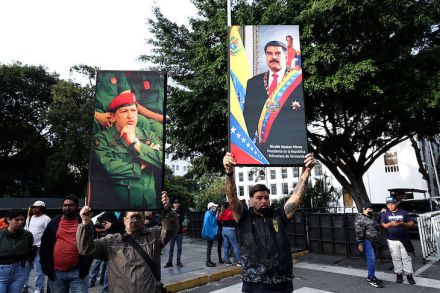
After staging a failed coup and going to prison, the Venezuelan army officer Hugo Chavez ran to be president in 1998, campaigning against corruption and offering revolutionary change. His nation was seen as a prosperous beacon of stability, built on its great oil wealth, envied by many people elsewhere in the region. He won by promising to tackle the inequality that scarred it so badly and take on the oligarchs enriching themselves through favours and nepotism. Western celebrities, journalists and politicians, from Sean Penn through to Jeremy Corbyn, started flocking to South America to hail their new progressive hero supposedly fighting for social justice. As Venezuela slid to ruin, Russian

Brexit Britain should take a stand on Venezuela

The United Kingdom has an opportunity to become a more significant player in Latin America while setting an example for other European countries. Venezuela is an important test case of how truly ‘global’ post-Brexit Britain wants to be. Latin America has not seen a meaningful British presence in over 100 years. In colonial times, Britain was one of the leading powers with interests, particularly in the West Indies. In the 1820s, it supported the independence movements from Spain and built trading relationships with the newly formed countries. After most British business interests were sold to fund the country’s efforts in world war one, Britain largely disappeared as a major player,

Portrait of the week | 2 May 2019

Home Of those who voted Conservative in 2017, 53 per cent intend to vote for the Brexit party in the EU elections on 23 May, according to a YouGov poll. Brandon Lewis, the Conservative party chairman, said: ‘As a government, our first priority is not to have to fight the EU elections,’ adding that there was still time to cancel them if parliament approved the Brexit withdrawal agreement reached by Theresa May, the Prime Minister. Labour’s National Executive Committee agreed party policy should be to hold a referendum (with a question yet to be decided) if it could not get changes to the government’s deal or precipitate a general election.

Momentum's shameful refusal to condemn Venezuela's Maduro

When young Venezuelan revolutionary Juan Guaido won the backing of Western leaders back in January, the political winds seemed to be blowing in his favour. Every politician from the White House to Brussels was lining up to endorse him as he declared the Maduro regime to be illegitimate. He was subsequently supported by the Venezuelan parliament as interim president, if only in name. But warm words of support from the West and from ordinary Venezuelans were never going to remove the biggest barrier standing in Guaido’s way: the Maduro-controlled military. The momentum behind Guaido seemed to ebb throughout the spring. But now Guaido finds himself back in the world’s headlines.

Tyrannical tips

Last week, in an effort to understand what that left-wing hero Nicolás Maduro, President of Venezuela, must be suffering, Hieron, tyrant of Syracuse, explained to his court poet Simonides why the life of a tyrant was such a misery. Simonides here spells out how Hieron can turn the situation round. Simonides began by making a crucial distinction between activities that made one hated and those that garnered gratitude. This was the key to success: outsource the former and direct one’s attentions to the latter. So Hieron should give to others the responsibility for handing out punishments and penalties. Building on this sound principle, he should then concentrate solely on encouraging

Caracas Notebook

A man stopped me in the street in Caracas and grabbed my hand. I was alarmed, but tried not to look scared. This city sometimes ranks as the most dangerous capital in the world. The practical advice we tend to be given by security consultants boils down to ‘Don’t panic’. ‘Gringos,’ said the man, ‘are good people. Thank you. May God bless you.’ And he was gone. This has been an emotional week for millions of Venezuelans. And there are plenty here who believe the US administration’s endorsement of a rival president means help is on the way; that somehow, someone outside will solve this. The episode reminded me of an equally