Velazquez

Goddesses and courtesans: six centuries of the female body in art

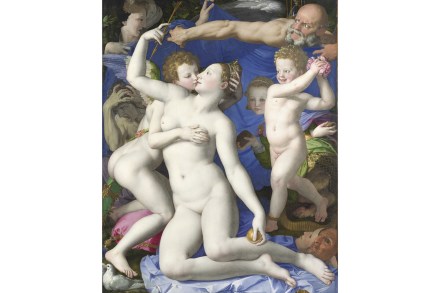
This is a book that many of us might like to have on our coffee tables – beautifully produced, not too heavy and full of pictures of pretty ladies, many of them with no clothes on. Its purpose is to show not only how artists have viewed the female body from the Renaissance to the present but also to explain how this body has been used to express both emotion and the attitudes of the day. Take Hiran Powers’s 1845 marble sculpture of a naked woman in chains, entitled ‘The Greek Slave’. This appeared after Britain had abolished slavery but before the American Civil War had put an end to it in the US. Thanks in part to the statue’s symbolism, beauty and perhaps also to its slight but titillating hint of bondage and thus of female subjection, it touched many nerves.
How ever did the inbred Habsburgs control their vast empire?

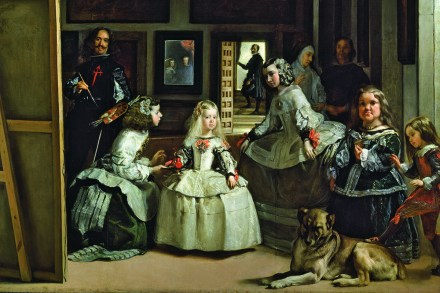
In 1960, Felipe Fernández-Armesto and Manuel Lucena Giraldo tell us, Lucian Freud went to the Goya Museum in Castres in search of a particular painting. He wanted to create portraits that were character studies and ‘not mere likenesses’, and Goya’s collective portrait ‘La Real Compañía de Filipinas’,a study in human nullity that represented ‘absolutely nothing’, was just what he was looking for. Fernández-Armesto explains: The work belongs in the tradition of what might be called Spanish ‘anti-portraiture’, from Velázquez’s ‘Las Meninas’ to Goya’s own devastatingly candid royal family group, ‘Familia de Carlos IV’, moral as well as physical delineations of regal vacuity.

Bright and beautiful: the year’s best art books reviewed

When he was a student, the celebrated American modernist master Robert Rauschenberg once told me that his ‘greatest teacher’ — Josef Albers — would proclaim ‘art is svindle’ in heavily accented English at least ten times a day. By that provocative remark Albers probably meant not so much that art was a cheat but that intellectualising about it is usually bogus. He once thanked his lucky stars that his father was a painter-decorator rather than an intellectual. For him it involved simple forms, clear colours and no nonsense. Albers and his equally brilliant wife are the subject of a remarkable and visually beautiful joint biography, Anni & Josef Albers by Nicholas Fox Weber (Phaidon, £100).

Entertaining – but there’s one abomination: National Gallery’s Sin reviewed

Obviously, we’re living through an era of censorious puritanism. Granted, the contemporary creeds are different from those of the 16th century. But the imperious self--righteousness is much the same — which gives the entertaining little exhibition at the National Gallery entitled Sin an unexpectedly contemporary edge. Personally, I’ve always thought that the doctrine of original sin has a great deal of explanatory power (it explains why history can’t ‘end’ and plenty of things will always go wrong — because that’s the way people are). Arguably, the medieval list of deadly failings — anger, pride, sloth, etc — provides a better summary of human nature than many later attempts.

The eyes have it

From our US edition

Art historians do not generally become household names, as Kenneth Clark did later in life after embracing television, most famously with Civilisation (1969). They can, however, acquire legendary or semilegendary status within the profession and among amateurs. One such was Leo Steinberg (1920-2011), who taught for many years at the City University of New York and the University of Pennsylvania. Academic art historians are expected to ‘publish or perish’: college texts, monographic studies on individual artists, or down-the-rabbit-hole treatises on arcana that seem to require more pages of footnotes than text. Steinberg mainly wrote for professional journals. He also lectured widely, testing ideas that later might make their way into print.

steinberg

The joy of socially distanced gallery-going

Not long after the pubs, big galleries have all started to reopen, like flowers unfolding, one by one. The timing reminded me of an anecdote that Lucian Freud used to tell about a Soho painter friend he took into the National Gallery after it had shut (as some senior artists are entitled to do). They arrived after closing time in the drinking holes of Soho, and the painter friend was staggering and swaying so much that Lucian — who was not easily rattled — became alarmed that he was going to put one of his flailing arms through a Rembrandt. I wonder how those art-lovers of yesteryear would have coped with socially distanced visits. I think they may be an improvement, at least in some respects.

An old master who still feels new

From our US edition

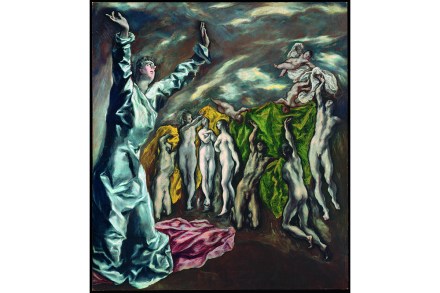
This article is in The Spectator’s March 2020 US edition. Subscribe here. Velázquez prized his work, but El Greco’s reputation fell quickly after his death in 1614. Another Spanish painter, Antonio Palomino (1655-1726), called The Greek ‘contemptible and ridiculous, as much for the disjointed drawing as for the insipid colors’. In the 1800s, ‘The Burial of the Count of Orgaz’, now regarded as one of his masterpieces, lay rolled up in the basement of a Toledo church.

el greco