V&a

How China’s Bayeux Tapestry differs from ours

The V&A’s remarkable survey of Chinese painting begins quietly with a beautiful scroll depicting ‘Court Ladies Preparing Newly Woven Silk’, from the early 12th century, which, with its bright colours, shallow space and lack of setting, invites comparison with a western masterpiece of a similar date, the Bayeux Tapestry. The crowded urgencies and narrative drive of the English/French embroidered cloth couldn’t be further from the refined intervals and sophisticated relationships of the Chinese scroll, and yet both tell much about the cultures that produced them. However, neither should be read simply as historical documents: both offer rare aesthetic pleasures of quite different distillations. The Chinese elixir seems to me to
Pearls: if you’ve got ’em, wear ’em

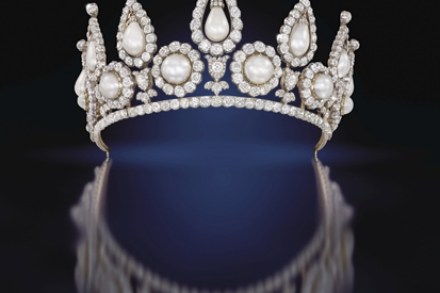
‘Women spend more money on their ears in pearl earrings than on any other part of their person.’ So said Pliny the Elder, who disapproved of the increasing fashion for pearls in the 1st century. It’s lucky he’s not around now to see the V&A’s new exhibition Pearls (until 19 January), where there are natural, cultured and freshwater ones in abundance (including, at the end of the show, eight buckets stuffed with cheap freshwater ones from China, which produces  — overproduces — more than 2,000 tons of pearls a year). Pearls do not, as I thought, form around grains of sand in an oyster shell but are made by a

English embroidery: the forgotten wonder of the medieval world

Think of an art at which the English have excelled and I doubt you would come up with the word ‘embroidery’. As I muttered when my agent asked whether I should like to make a film for BBC4 about the golden age of this forgotten but brilliant native art form: ‘Embroidery? What, like sewing?’ But no, not like sewing. Or, actually, only a little bit. During the ‘high’ Middle Ages, English embroidery was one of the most desired and costly art forms in Europe. It was known as opus anglicanum or ‘the work of the English’ — a generic name that instantly conjured notions of craftsmanship, beauty, luxury and expense

Royal bling with the Tudors at the Queen’s Gallery and the V&A

As soon as the battle of Bosworth was won, Henry VII’s politically astute mother sent him appropriate clothing for his state entry into London. A king was expected to look like a king, having ‘a prerogative is his array above all others’. Sumptuary laws policed the system under the Tudors, with everyone — in theory — wearing only as much glitter and flash as their rank permitted. You really were what you wore. The Great Wardrobe Accounts of Henry VII and Henry VIII offer numerous unexpected insights into contemporary events. One sinister detail I spotted during my research on the period is a warrant issued in November 1498 for black