Ukraine

Where are Barack Obama’s ‘red lines’ in Crimea?

From our UK edition

When Barack Obama warned Vladimir Putin that “there will be costs” for violating Ukrainian sovereignty, I doubt the Kremlin worried too much. The Syria crisis taught is all about Obama and his ‘red lines’. This is a president who recoils at the idea  of any new entanglement, whose attention is on the Pacific rather than Eurasia and is less worried than any of his recent predecessors about Russian aggression. And that’s what makes this situation so dangerous: Putin wants to know where the new red lines lie, and may keep pushing until he finds out. His asking Russia’s parliament for the authority to use troops is, I suspect, is a ploy to see how Washington reacts.

Conservative ministers link Russian aggression to Miliband’s Syria stance

From our UK edition

Sajid Javid isn't the only observer of Russia's behaviour over the situation in Ukraine to link Vladimir Putin's aggression to the situation in Syria. Perhaps the West's decision not to intervene in that conflict has given Putin the sense that he can do what he wants without any response from other countries. But Javid's suggestion in a tweet this afternoon that there is a 'direct link between Miliband's cynical vote against Syria motion and Russia's actions on Ukraine. Completely unfit to lead Britain' goes rather further than that. It also doesn't fit particularly comfortably with the fact that 30 of Javid's own Conservative colleagues rebelled on that motion and many more abstained. His colleague Nick Boles has made a similar point: https://twitter.

William Hague summons Russian ambassador as Russian parliament approves sending troops to Ukraine

From our UK edition

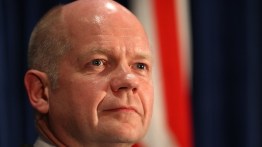
William Hague, the Foreign Secretary who is off to Kiev tomorrow, has issued the following statement:- 'I am deeply concerned at the escalation of tensions in Ukraine, and the decision of the Russian parliament to authorise military action on Ukrainian soil against the wishes of the Ukrainian Government. This action is a potentially grave threat to the sovereignty, independence and territorial integrity of Ukraine. We condemn any act of aggression against Ukraine. 'I spoke today to Russian Foreign Minister Lavrov to urge steps to calm this dangerous situation. I told Minister Lavrov that Britain supports the Ukrainian Government’s request for urgent consultations in accordance with the 1994 Budapest Memorandum signed by the UK, US, Russia and Ukraine.

Putin asks the Russian parliament to approve sending troops to Ukraine

From our UK edition

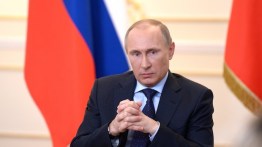
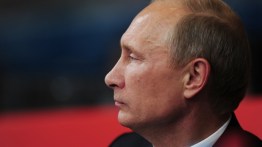
Vladimir Putin’s decision to ask the Russian parliament to approve the deployment of Russian troops to Ukraine makes the situation there even more serious. The request shows that Putin has no intention of heeding Western warning to request the sovereignty of Ukraine. It is also noticeable that the request doesn’t simply cover the Crimea, with its ethnic Russian population, but the whole of Ukraine. It now seems that at the very least this situation will lead towards the de-facto partition of the Ukraine. But the question is whether Putin will be satisfied with this. His ambition has always been to restore Russia’s pride about its place in the world, ‘defeating’ the West in Ukraine would—in Putin’s worldview—do that.

Crimea, Russia and the power of ‘provokatsiya’

From our UK edition

What to make of the appearance at two airports in Crimea of armed men wearing uniforms without insignia? The airports are strategically placed – Belbek near Sevastopol, and the main airport outside Simferopol, the regional capital. Obviously, an airport is a vital piece of local infrastructure that provides an entry point for reinforcement and supply; their possible seizure by unidentified troops is a very serious business. Authorities in Crimea insist that the armed personnel belong to the Russian Black Sea fleet, and that this is a ‘military invasion and occupation’.

The Today programme’s ‘Phwoof!’ moment

From our UK edition

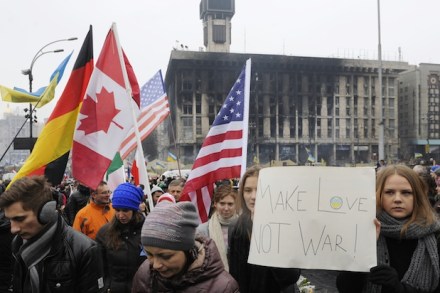
‘Phwhoof!’ exclaimed Evan at 8.27, before reluctantly turning us over to the sport report on Saturday morning’s Today (Radio 4). His intense connection with what he had just listened to in the studio (and we had heard at home while slowly waking up to the day) as Gavin Hewitt and Duncan Crawford reported from the centre of Kiev was palpable. Things were happening in Ukraine. The situation was changing fast. What we had been told at 7 a.m. — that anti-government demonstrators were continuing to occupy their protest camp in Independence Square — had become, in fewer than 90 minutes, very much old news. Evan Davies was signalling to us in very audible expression that we were witnessing a moment in history, and he was live on air trying to make sense of it.

Portrait of the week | 27 February 2014

From our UK edition

Home Moazzam Begg, a former Guantanamo detainee who won substantial compensation after suing the British government, was arrested in Birmingham on suspicion of terrorism offences relating to Syria. John Downey, accused of killing four soldiers in the IRA Hyde Park bombing in 1982, will not be prosecuted, because he was given, in error, a guarantee he would not face trial; an Old Bailey judge ruled it was in the public interest to make state officials keep their promises.

The Spectator – on 400 years of unease between Ukraine and Russia

From our UK edition

Ukraine declared independence from the USSR in 1991, but Moscow has made sure it’s remained heavily involved in Kiev’s affairs ever since. That has been relatively simple. Soon before independence, Anne Applebaum described how Russia’s ruthless annexation of its neighbour had left Ukraine without much identity of its own. 'It took 350 years of Czarist domination, several decades of Stalinist purges, two collectivisation-induced mass famines, two world wars, and the refusal to teach Ukrainian children how to speak Ukrainian, along with the systematic elimination of anyone who might be thought a leader, an intellectual, a capitalist, or even a wealthy peasant. But they did it.

Vladimir Putin is a reactionary autocrat, not a conservative

From our UK edition

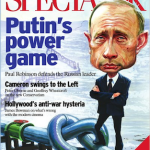
Apparently the new Muppets film features Russians as the baddies, a sign of the times as we increasingly draw into a new ideological cold war with the old enemy. Or perhaps a hot, ethnic war, if events in Crimea get any worse, events which raise questions about western foreign policy. Why are we getting involved in this country ‘steeped in blood and carpeted with unquiet graves’, as Peter Hitchens calls it? Another paleocon type, the Telegraph’s semi-deprogrammed former leftist Tim Stanley, says that by provoking Russia into a direct confrontation we look foolish and weak. The ideological cold war was the subject of last week’s cover story, in which Owen Matthews argued that, as in tsarist days, Russia is setting itself up as the leader of reaction.

Russia’s restraint over Ukraine thus far has been remarkable

From our UK edition

Perhaps it's premature to say this now that the Russian prime minister, Dmitry Medvedev, has sounded off about Russian citizens in Ukraine being in danger, but it strikes me that Russia has behaved in the current crisis with a certain commendable restraint. Judging from most pundits in most British papers, there is no redeeming element to the Putin regime – soup to nuts, gay rights to corruption - and if it hasn’t actually sent the tanks in, well, it probably wants to. Yet, reading the statement from its foreign ministry that ‘a forced change of power is underway’, it’s hard to say that it’s not strictly correct.

William Hague: Ukraine is not about a strategic competition between East and West and we must engage with Russia

From our UK edition

Russia has been presented as one of the bad guys in the coverage of the turmoil in Ukraine. But today, Sir Menzies Campbell told the Commons that the one thing that linked the three countries mentioned in William Hague's urgent statement on Ukraine, Syria and Iran was that 'progress, however limited, was made as a result of engagement with Russia'. Hague's reply made clear that bad guy or not, the UK needs to continue engaging with Russia: 'This is a very important point and again this is why the Prime Minister spoke to President Putin on Friday, why I have spoken to Foreign Minister Lavrov today, and agreed to speak again in the near future.

Tory Europhobia cripples Britain’s attitude to the Ukrainian crisis

From our UK edition

Colin Freeman, the Telegraph's fine chief foreign correspondent, made a remarkable claim the other day that merits wider attention. What, he asked, was Britain's view on the crisis in Ukraine? The answer was revealing for many reasons, not the least of which being the extent to which eurosceptic myopia has, according to Freeman, caused Britain to misjudge the dramatic events unfolding in Kiev and elsewhere. According to Freeman: The depth of Euro-scepticism in Britain meant it cared little either way when Ukraine was gearing up last year to sign an EU trade agreement that would have brought it out of the Russian orbit. In Downing Street, the view was that Europe’s outer borders were already quite extended enough.

Ukraine’s turmoil highlights Vladimir Putin’s battle lines

From our UK edition

After two decades in the economic basket, Russia is decisively back as an ideological force in the world — this time as a champion of conservative values. In his annual state of the nation speech to Russia’s parliament in December, Vladimir Putin assured conservatives around the world that Russia was ready and willing to stand up for ‘family values’ against a tide of liberal, western, pro-gay propaganda ‘that asks us to accept without question the equality of good and evil’. Russia, he promised, will ‘defend traditional values that have made up the spiritual and moral foundation of civilisation in every nation for thousands of years’.

Europe minister denies UK taking ‘back seat’ in Ukraine talks

From our UK edition

Has the UK been doing enough to respond to the dreadful situation in Ukraine? A peace deal is on the table, but it's clear this morning that nothing has been agreed, with Polish PM Donald Tusk sounding a note of caution that there's an end in sight to this crisis. But there are suggestions this morning that the West has been a bit sluggish and weak in its response. Europe Minister David Lidington answered accusations that the UK was taking a 'back seat' in pushing for a resolution when he appeared on the Today programme: 'I wouldn’t describe it as taking a back seat. I think it would be slightly ridiculous to have 28 foreign ministers all going off in concert. They are acting on behalf of all of us, and we are continuing to be active.

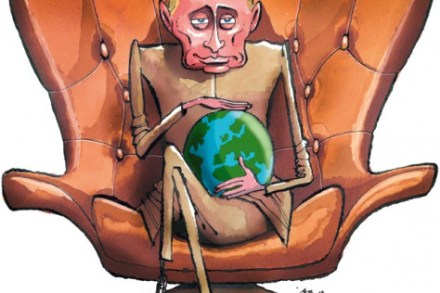
Vladimir Putin’s new plan for world domination

From our UK edition

[audioplayer src="http://traffic.libsyn.com/spectator/Untitled_2_AAC_audio.mp3" title="Anne Applebaum and Matthew Parris discuss how far we should let Putin go"] Listen [/audioplayer]It’s been a generation or so since Russians were in the business of shaping the destiny of the world, and most of us have forgotten how good they used to be at it. For much of the last century Moscow fuelled — and often won — the West’s ideological and culture wars. In the 1930s, brilliant operatives like Willi Muenzenberg convinced ‘useful idiots’ to join anti-fascist organisations that were in reality fronts for the Soviet-backed Communist International.

Ukraine: It’s not about Europe vs Russia

From our UK edition

To discuss the Ukrainian crisis in terms of a choice between Europe and Russia is misleading for several reasons. First, the European issue has been ruthlessly exploited by the Ukrainian opposition and its Western backers as an excuse for overthrowing the government illegally and by force. Opposition leaders have never distanced themselves from the most radical elements on the streets of Kiev, even though these include neo-Nazis. On the contrary, they have done everything to use their violence as a bargaining chip in their battle with the government.

Ukraine reinforces the case for a wider but shallower EU

From our UK edition

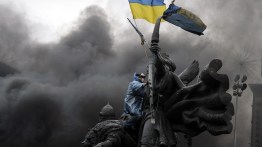
With Ukip heading for possible victory in the European elections and anti-EU fervour growing across the continent, it is hard to imagine a country where people are so desperate to join the EU that they are prepared to take on water canon in order to make their point. But that country is Ukraine. The violence which has been brewing for weeks and which erupted yesterday has its source in many tensions in the country, but one issue defines the two sides: protesters who are looking westwards towards EU membership and a government which rejects this and looks eastwards towards Russia.

David Cameron warns Ukraine’s president: the world is watching

From our UK edition

As violence flared up again in Kiev this afternoon, and EU leaders threatened to impose sanctions on those responsible for the violence in Ukraine, David Cameron issued this statement: 'I am deeply concerned by the scenes we are witnessing in Ukraine. The violence on all sides is completely unacceptable and President Yanukovych has a particular responsibility to pull back government forces and de-escalate the situation. 'Violence is not the way to resolve the political differences across the country. The President needs to engage with the opposition and work with all sides in Ukraine to agree political reforms that reflect the democratic aspirations of the Ukrainian people. There must be a clear commitment to the rule of law, respect for fundamental human rights and civil freedoms.

Why condemn the US diplomat caught on tape denouncing the EU? She has a point

From our UK edition

I have my criticisms of the Obama administration, but it does seem to have the right idea about the European Union’s diplomatic efficacy. His top diplomat for European and Eurasian affairs, Victoria Nuland, has been taking a lot of stick after she was caught on tape (or hacked, as we Brits would call it)  discussing the Ukraine problem with the US ambassador in Kiev, Geoffrey Pyatt. She was rude about the EU, but the condemnation of her language seems to have overlooked her central point. The EU has been trying to muscle in on talks about Ukraine’s pro-democracy moves. It could have helped by offering membership to Ukraine, but it prevaricated – and now wants to insert this prevarication into the negotiations.