Uk politics

How are the Tories responding to Labour’s pay freeze?

From our UK edition

So what do the Tories make of Alistair Darling's limelight-grabbing decision to freeze public sector pay? The ones I've spoken to seem perfectly relaxed with it. A little bit annoyed perhaps: wouldn't you be, if your opponents appeared to cynically delay an announcement that they could have made during their own party conference last week?  But they're confident that the public will see through the stunt, and that it will actually reflect badly on Brown & Co.  On top of that, the Tories are sure that Labour will make little headway in a news agenda that will be dominated by Tory announcements for the next few days. It's hard to disagree with them.

Will the civil service block Tory Euroscepticism?

From our UK edition

Of all the countless leaflets, pamphlets and circulars being handed out in Manchester, one of the most interesting is a glossy collection of essays entitled Cameron's Britain.  It has been put together by the folk at Portland PR - who recently hosted that "war game" which James reported back on - and has entries on everything from the NHS to tackling global poverty. As it doesn't seem to be online, I figured it's worth quoting from one of the most insightful essays of the bunch: that by Steve Morris, a former Downing St adviser, on the Whitehall machinery that the next government will have to get to grips with.  Norris makes some important points - e.g.

Further, stronger, faster

From our UK edition

Later today, George Osborne will elaborate on the Conservatives’ plan to raise the state pension age to 66. The rise will be enacted by 2016 at the earliest and will save an estimated £13bn per year. The Tories will review how they can accelerate the original planned pension age rise, dated for 2026, that would link the state pension with earnings. There’s much to elaborate upon, notably how the rise will affect female retirement age and exactly how much money would be saved overall. But essentially, this move should be welcomed. It is realistic and proves that there’s substance to the Conservatives’ cuts agenda beyond ‘trimming bureaucracy’ and burning quangos.

Lansley keeps the spending taps on

From our UK edition

Struggles with the conference internet connection prevented me from posting on it at the time, but it's still worth flagging up Andrew Lansley's big speech on the NHS today. Why so? Well, because it exemplifies how the Tory message on health undermines their general rhetoric on public spending. At the heart of the speech was a pledge that I'm sure many CoffeeHousers would cheer: to slash the money spent on NHS bureacrats by a third, from £4.5 billion to £3 billion. Good stuff, you might think. That's what governments should be doing in there difficult times. And you'd be right. But the rest of Lansley's speech was at odds with this basic position. There were, of course, the familiar reminders that the Tories would increase health spending year-on-year.

Tory welfare plan is welcome but does not go far enough

From our UK edition

The Tories new welfare plan is, it seems, their old welfare plan – with a more ambitious timeline. It’s to be welcomed, but this is not the step change that you’d expect. In Jan08 Chris Grayling broke new ground when he proposed diagnosing all 2.7m on incapacity benefit for what work they could do (as opposed to the ‘ill’ or ‘sick’ binary distinction). Today, they express an ambition to get this done in three years. Set aside questions as to whetehr you can find enough doctors to do 2,500 “capabilty asssessments” every day – all this means is going a little faster on the original Freud proposal. There is a welcome move towards benefit simplification, but I have to agree with the conclusions of James Purnell on Open Left.

We have a tax cut

From our UK edition

George Osborne has just announced a tax cut. Any new business started in the first two years of a Tory government will pay no employers’ national insurance contributions on the first ten people it hires. This means these first ten employees will cost new businesses 12 percent less. This is a move that makes sense in both economic and political terms. Economically reducing the tax on jobs is a good move, getting more people into work will eventually result in more money coming into the Exchequer. Politically it is smart as it gives the Tories something they can point to on the doorstep to show they really are serious about boosting job creation.

The Tories in the stocks

From our UK edition

Here’s something new for party conference season: real people. About 200 of them. Firemen. Unemployed. And, yes, workers. They are brought to you courtesy of Victoria Derbyshire’s Five Live show, where I am sitting at the back listening to this mass focus group session. It has become (for me, anyway) an unmissable feature of the party conference season – a welcome injection of real life into the all-too-myopic conferences. Cabinet and Shadow Cabinet members turn up knowing that this session will be about all the normal, disinterested person will hear about the conference. Now and again, she asks them to clap or boo depending if they agree or disagree. It’s fast-moving, and very much to the point.   One point has jumped out at me immediately.

Book Club October book of the month

From our UK edition

Following a lively discussion and a member’s poll, the Spectator Book Club’s October book of the month is Bilton, by Andrew Martin. By all accounts it is an extremely funny satire of politics and the media in the late 90s, and it comes highly recommended by a number of Book Club members. You can buy a copy at a 10% discount, courtesy of Blackwells, if you register with the Spectator Book Club.

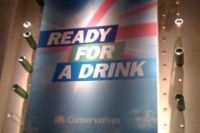
Labour isn’t working. Have a drink

From our UK edition

Thanks to Guido for snapping this arresting political slogan. The Conservatives will now sweep the country; of that I have now doubt. But as ever, there is a complication. In what is clearly an indication of the Tories’ target audience and political intent, lashings of Scotch and Newcastle Brown Ale are readily available, but Eric Pickles has banned Champagne. Is this the precursor of a hardening Eurosceptic line…?

The need to go further and faster on Welfare reform

From our UK edition

I’m on my way to the home city of the best football club in the world (and one of the worst) shortly.  In the meantime, it’s worth flagging up this morning’s reports on Tory welfare policy, which we’ll be hearing more about later today.  Basically, the Tories are going to re-emphasise that they’d put incapacity benefit claimants through medical tests, to check their ability to work, and that the more effective private-sector wing of the welfare service would be massively expanded.  While this is, in essence, an extension of existing government welfare policy, it’s certainly to be welcomed.

The Tories look evasive on Europe, but now is not the time to clarify

From our UK edition

The phrase “we will not let matters rest” sounds slightly menacing, but it’s completely opaque. Is it time for the Tories to define what they mean by it? The leading article in the Times argues that perhaps it is. ‘Now that the Irish have ratified the Lisbon treaty at the second attempt, the Conservative Party needs to listen to Robert Peel. In 1834 Peel issued a manifesto in Tamworth in which he said the Conservative Party should now accept the Great Reform Act which it had vigorously opposed. Now that David Cameron finds himself struggling to clarify the circumstances in which he will offer the nation a referendum on the Lisbon treaty, he could do worse than echo Peel’s sentiment.

Straight talk on Lisbon?

From our UK edition

I have just been on a phone-in with Five Live, and heard Greg Clark getting into a fix over Europe. “Are you going to do some straight talking with us tonight?” asked Steven Nolan. Yes, he replied. What will the Tories say if Lisbon is ratified, then? Wriggle wriggle wriggle. “We don’t deal in hypotheticals” Clark said – the worst possible answer in my view. Any question starting in the word “if” is a hypothetical, and politicians answer them all the time. To claim otherwise insults the intelligence of listeners. But what other option did Clark have? I can’t understand why the Cameroons don’t say that there is no point in a post-ratification referendum. Who would they be upsetting?

A festival for the political class

From our UK edition

When you get on a train on a Sunday and find First Class is more full than the cheap seats, it can only mean one thing: a political party conference is starting. The Tories starts tomorrow – but still, folk travel up today. Why a Monday start? And why Manchester? The seaside resorts were chosen when party conferences were rallies of the grassroot members, and venues were chosen for their supply of cheap (usually B&B) accommodation. Now, most people who attend are the new breed of political professionals who are not paying their own hotel bills. Lobbyists, quangocrats, NGO advisers, journalists, the whole lot. And they come to meet each other, not really watch what’s going on.

Who won’t make it into Cameron’s Cabinet?

From our UK edition

There are 29 members of the Commons and the Lords speaking from the podium at conference. Four shadow cabinet members are not — Lord Strathcylde, Lady Anelay, Patrick McLoughlin and Mark Francois. We shouldn’t read too much into who is not speaking. The Leader of the Lords and the Chief Whips in the Lords and the Commons are not regular conference turns and there is an obvious reason why the Tories don’t walk to talk about Europe. What might be more significant is that one person who is on the front bench but not in the Shadow Cabinet has got a slot, Maria Miller — suggesting that the party hierarchy rate her communication skills. But the 29 speakers beg the question of who won’t make it into Cabinet.

We await the beef

From our UK edition

The Tories have been briefing heavily that this would be a policy heavy conference. Indeed, I’m told that every shadow Cabinet member will have at least one substantive announcement to make. But there is relatively little that is genuinely new in the Sunday newspapers. One explanation for this is that the Tories accept that Lisbon is going to crowd out any other story. One senior source told me on Friday that CCHQ thought that nothing other than Europe would have cut through until Sunday afternoon. So far, the Tory containment operation on Europe appears to be just about holding. There is, though, grumbling about Boris’s comments in the Sunday Times which are seem as being distinctly unhelpful and threaten to reignite the stories about tension between him and the leadership.

Cameron’s radicalism is best for Britain

From our UK edition

The Observer’s leading article asks the question: will David Cameron’s modernism serve Britain’s interests? The article’s conclusion is a firm ‘no’; its key is that the ‘Conservatives' apparent relish in tackling the budget deficit is not entirely economic in motivation. It expresses a broader ideological commitment to a smaller state.’ A smaller state is better for Britain. The consistent growth of the state over more than a decade has demolished Britain’s financial strength. In changed economic circumstances, its continued growth is unsustainable. July is a month that should produce a revenue surplus, as tax receipts outweigh borrowing. This year saw a £8.1bn deficit.

The European issue gets the Tory conference underway

From our UK edition

The Conservative conference is just hours old, but already Cameron faces a battle to hold the line over Europe and the Lisbon treaty.  He produced his standard response on the Andrew Marr show: that he wanted a referendum if the Czechs refuse to ratify the treaty. And he added: “I don’t want say anything or do anything that would undermine what was being decided and debated in other countries”. Meanwhile, rent-a-quote Europhiles and Eurosceptic Tories exchange blows in Manchester. Leon Brittan described a possible referendum on the Lisbon Treaty as “ludicrous” and Dan Hannan has just told Sky News: “This is not the Conservative party of the past. This is a 1990s story.

Signs of the changing political landscape

From our UK edition

So how radical is David Cameron? I  was on a Radio Four panel yesterday for “Beyond Westminster” (now online) where, for once, I was not the only token right-winger. It was presented by Iain Martin and had Bruce Anderson, who wrote this week’s cover piece about Cameron, and Jackie Ashley. I was begging Iain to introduce her as being from “the left-wing Guardian” to repeat the intro that the BBC so often gives the “right-wing” Spectator (“Warning: the views you are about to hear are not from the consensus”). Iain asked me if I thought Cameron had the courage and the character needed to transform Britain. I concluded with words of endorsement that had TGF UKIP choking (on another thread). In spades, I said.