Uk politics

Is this the death of another anti-Brown plot?

From our UK edition

An eagle-eyed spot by Hopi Sen, who has posted on Barry Sheerman's comments in the Huddersfield Examiner today.  If you remember, Sheerman was mooted as a key component in an anti-Brown plot, whereby he'd stand as chair of the Parliamentary Labour Party on a Get Gordon Out platform. Votes for Sheerman, it was thought, would be votes against Brown - and increase the pressure on the PM to stand down.  But in the Huddersfield Examiner, Sheerman suggests that, while he will stand for the PLP position, he won't do so as part of a coup: "...Mr Sheerman denied this was part of a move to topple Gordon Brown. He said “If colleagues ask me to stand I will consider it.

Smith to apologise to Commons

From our UK edition

Sky report that the Commons Standards and Privileges Committee have judged that Jacqui Smith was "clearly" wrong to claim that her sister's home was her main residence.  Smith has been ordered to apologise to the Commons, which she's expected to do later today.  No further action will be taken. Throw in the news about Damian Green's "not proportionate" arrest, and the hubbub over Sir Thomas Legg's letters, and you feel that today will do little to restore the public's faith in the political class...

The politics of growth

From our UK edition

One strange side-effect of the car crash that was the Liberal Democrat conference is that no one dares say the word “cuts” anymore. Since Nick Clegg promised “savage cuts” – alarming his base in the process – we’re back to the normal euphemism of “efficiencies”. This, like so much in life, will have Gordon Brown hopping mad. He didn’t want to say “cuts” in the first place, and the whole farrago will prove (in his head) that he should stop taking advice from people outside his coterie.   The next stage in the debate is to focus on growth. As James revealed in his political column for the current edition of the magazine, the Tory plan to do this is an aggressive cut in corporation tax.

The Commons closes ranks

From our UK edition

They are all in it together. This morning’s papers lead with the story that Members’ Estimate Committee will challenge Sir Thomas Legg’s demands that MPs repay excessive expense claims, on the grounds that Sir Thomas’ has applied retrospective rules on maintenance grants. Many MPs will take legal action to avoid repayment. The pro-transparency MP John Mann told the Guardian: “The Legg team have clearly got problems, because [MPs] don't have the receipts for a lot of this stuff. Clearly, if someone has managed to get [a claim] signed off by the fees office then they have a case when asked to repay. "There could be as many as 200 MPs who refuse to pay anything.

Davis for Home Secretary?

From our UK edition

The Express’ William Hickey column reports that David Davis, not Chris Grayling, will serve as Home Secretary should the Tories win the election. Here’s what Hickey heard: ‘I’m now told there have been mounting whispers among MPs that Grayling could lose out to David Davis for the Home Secretary’s job should the Tories win the general election. Only this week Davis, who stood down from the shadow post last year in order to champion civil liberties at a by-election, signalled he was ready to return to frontbench politics if offered a “proper job”.

They’ll have to start thinking about expenses again

From our UK edition

So expenses are back - and in a fairly big way.  Not that they ever really went away, of course.  But you'd be forgiven for thinking that the parties had pretty much forgotten about them during conference season, so little was said about the issue.  But today it's back on the front pages and, you suspect, back to the top of MPs' priority lists.   According to the Sunday Telegraph, "more than half" of the Commons will be either told to repay dubious claims, or provide extra information about those claims, during the next part of Sir Thomas Legg's investigation into expenses this week.  Gordon Brown is said to be among the former group.

Brown’s double hit

From our UK edition

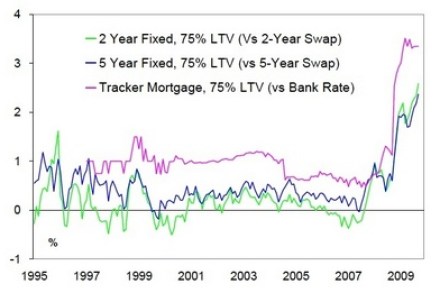
What is the true price of Gordon Brown’s economic incompetence and inept bank regulation? The soaring national debt is one. And if you own a mortgage, you’ll find that you’re paying another. The gulf between the Bank of England base rate and the average mortgage rate is now at a huge high – as banks rip off their customers, trying to fill the hole in their balance sheets. This is an under-discussed topic. The “action we have taken” (a phrase Brown uses to try to lay claim to the Bank of England’s base rate reduction) would have a far greater effect on the economy if the UK banking system was not (still) so badly broken. The below graph, from Citi, shows spreads (ie, gap between base rate and retail rate) on key UK mortgages from 1995.

A shaming episode

From our UK edition

The Culture Secretary would be advised to keep his fingers to himself. Following Wednesday’s Twitter gaffe, he let fly on Twitter once again. His target was David Cameron’s demolition of the state. All Bradshaw hit was Cameron’s dead son Ivan. He tweeted: ‘the camerons got good nhs care thanks to Labour’s investment and reform. Is this the ‘big government’ the derides.’ (sic) Bradshaw then issued a clarification, not an apology, on Twitter: ‘it wasn’t meant to be offensive. Point is they will the ends but not the means. Need positive government to deliver these things.

What would the Tories take back from Europe?

From our UK edition

Assuming that the Lisbon Treaty is ratified, that the Conservative Party wins the next election and that Angela Merkel and Nicola Sarkozy want Britain to remain in the European Union, what “sovereignty package” will EU leaders come up with for Prime Minister Cameron, so that the Tory leadership can placate its eurosceptic base? The deal cannot be cosmetic, but make it too tough and other EU leaders will not want to compromise.

One last chance on Lisbon?

From our UK edition

The Independent reports that the Czech Republic’s Euroscpetic President, Vaclav Klaus, is seeking to opt-out of the Lisbon Treaty’s Charter of Fundamental Rights. His argument is that Charter, which would come into force as soon as the Lisbon treaty was ratified, will lessen national sovereignty over social policy. During negotiations at the time of the treaty’s inception, the UK and Poland obtained a “protocol” measure to ensure that the Charter didn’t create new rights – effectively the last gasp opt-out the Czech seek now. Klaus describes his request as a “footnote”; it’s anything but. EU diplomats make it clear that negotiations would have to open.

That Wellington became Prime Minister is irrelevant to the Dannatt case

From our UK edition

General Dannatt denies that he’s been in cahoots with the Tories. He gave a lecture last night and said: “[David Cameron] put it to me that he was concerned that his defence team - at a time when defence was really important, and Afghanistan was really critical - lacked expert understanding. "And would I be prepared to advise his team, and, if the Conservatives win the election, would I be prepared to take a peerage and maybe join his ministerial team… it was a recent decision and indicates that there was no long-term plot." Only a bolus of ministers, who believed they could smear a General who was renowned for his frugality over expenses, could be preposterous enough to suggest that Dannatt was a Tory mole all along.

Should Cameron have told us how he will do it?

From our UK edition

The left’s criticism of Cameron’s speech is that it contained no new policies and that begs the question: how will Cameron set the people free? Steve Richards has an essential article on the subject in today’s Independent. Here are the key paragraphs: ‘Against quite a few paragraphs in Cameron's speech I wrote a single word: "How?" I used to do the same with Blair's early speeches only to discover in 1997 that he had no answers to the question in several key policy areas. Most fundamentally it is still not at all clear how Cameron plans to reduce what he calls Labour's debt crisis.

Gove’s ‘free schools’ will be able to profit

From our UK edition

In all the excitement, I forgot to flag up to Coffee Housers a fact that we dropped in the leader column of today’s magazine. Michael Gove’s new Swedish schools will, it seems, be allowed to make a profit. I said in the editorial that: “Crucially, it now looks likely that the new schools will be able to run for profit — as Anders Hultin, the architect of the Swedish system, argued in this magazine last week. This may come in the form of a ‘management fee’. But if this happens, then Britain’s obsession with the quality of schools could blossom into an education industry.” Hultin’s article was picked up by The Daily Telegraph. Profit, he says, means Britain would have an education industry.

The people will make it happen

From our UK edition

Cameron’s speech might have lacked flair, but it was a brilliant rhetorical exercise. He cast himself into the distant future and reflected on his premiership. He saw a society that had paid its way back from the brink of collapse by rationing excess and embracing austerity. He saw a society that was flourishing, where the poorest attended the best schools, where people were empowered to work hard and were rewarded for doing so. Returning to the sombre present he said: “It will be a steep climb. But the view from the summit will be worth it.” But this rhetorical tour de force was inspired by a substantial philosophical argument. Cameron’s vision saw the State diminished to subservience.

Cameron’s revolutionary speech

From our UK edition

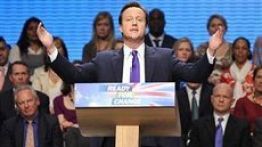
This was one of the best speeches I have heard David Cameron give. It may not have been a masterpiece of oratory, he may have read from notes, left too make lulls lulls inspiring only a few standing ovations.  But it was packed with mission, seriousness, vision, principles – and, most of all, a real agenda.   Just as last year’s conference speech laid out a Conservative defence of the free market, this year’s laid out a vision of the conservative society. That is to say: one which hands back power to communities, which trusts people and places huge emphasis on social mobility.   First, he positioned the Conservatives squarely in the fight against poverty – on the explicit grounds that Labour has lost that fight.

Dave will slay the Goliath-esque government

From our UK edition

Clever in its lack of cleverness. Cameron’s performance today was shrewd and unexciting, a speech of nursery-school simplicity. Large bland ideas, plain language. No detail. This was certainly no masterpiece. It didn’t have to be. Cameron’s in a holding pattern. Keep circling and he’ll land safely. Before he arrived, William Hague frustrated the eager delegates with two corporate videos of more than ordinary dullness. The BBC, flouting its own policy of censoring political broadcasts, aired both of them on BBC Parliament (albeit with the sound turned down.) First, a surpise. No less a figure than Bono, the UN's top Guilt Ambassador, spoke to the Tories about debt relief.

The Cameron transcript: Part II

From our UK edition

George Osborne has embraced the 50p tax as a central tenet of the “We’re all in this together” theme. CoffeeHousers will be aware of my deep scepticism about this. It is justified on presentational grounds: if you squeeze the rich, and their pips squeak, it will create ‘permission’(to use that Blairite phrase) to do the horrible things like deny pay rises to nurses and social workers. Ergo, presentation and economics are fused together on this issue, he says. Without popular support for the cuts agenda, it cant happen and the deficit won’t be tackled. So the 50p tax should be judged not on its own merits, but on the grounds of its ability to unlock the ability for deeper cuts to be made.