Uk politics

Is privatising the Royal Mail viable?

Over the summer, as the postal crisis mounted, the government argued that adverse market conditions deterred potential investors. Regardless of the ongoing industrial dispute, the government maintain that Lord Mandelson’s bill will not be reintroduced unless conditions improved. According to the Guardian, Ken Clarke, the shadow business secretary, believes that there is still demand in the public sector to buy the Royal Mail, providing the CWU accepts modernisation and ends the strikes. ‘Ken Clarke, the shadow business secretary, has held talks on the sale of Royal Mail with potential bidders, and the party believes there is still a desire in the private sector to take over the company.

Efficiency savings are no match for budget cuts

Jack Straw has abandoned what he described as “simply unacceptable” efficiency saving recommendations. This is self-evidently the correct action, as the proposals would have endangered the processes of our democracy for a negligible saving. Everyone, even the Prime Minister, though grudgingly on his part, recognises the need for cuts. Efficiency savings are part of this process - £5bn a year is wasted by the NHS on middle management alone. However, there is a danger that Civil Servants will make counter-productive and paltry efficiency savings in an attempt to ward off substantial budget cuts.

The Rabbi speaks

Poland's Chief Rabbi, Michael Schudrich, told the Today programme that Michael Kaminski is, as far as he knows, not an anti-semite today - though the Jewish leader made clear he "could not read his heart", and thought Mr Kaminski's teenage views extremist. The rabbi's words will further fuel the spat between David Miliband and William Hague. Expect the Shadow Foreign Secretary to renew his calls today for an apology to be issued to Kaminski. Expect the Foreign Secretary to ignore this and find support, including from within the Jewish community, to his charges against Mr Kaminski and his accusation that the Tories mingle with madmen. Both parties think the fight is important. Miliband thinks he has stumbled upon political cryptonite to the Tories' electoral superpowers.

Dangerous efficiency savings

The Times reports that the Ministry of Justice has produced proposals to close polling booths, hire fewer employees, raise candidate’s deposits and introduce telephone and email ballots in the hope of saving, wait for it, £65million – less than half of Manchester City’s summer transfer spending. In exchange for that trifling sum, the MoJ is prepared to chance the quality of democratic processes. Increasing candidate deposits may preclude minority parties from standing. Fewer electoral staff will increase the possibility of widespread counting errors, occassionally labelled 'malpractice' in other areas.

Blair’s campaign falters

A contact just back from Brussels tells me that the putative Blair candidacy, which I wrote about this week, is in trouble. Apparently the supporters of Jean Claude Juncker, the Luxembourg PM, are frank that the purpose of his candidacy is to polarise the field with him—Federalist, anti-Iraq—on one side and Blair on the other. In typical EU fashion, the compromise candidate will then be looked for.   Blair’s problem is that he is the high-profile front-runner. He is the man everyone is either for or against and in a selection that is decided by consensus that person rarely gets the job. In the meantime, the Dutch PM Jean Peter Balkenende, who I am told Merkel favours, is neatly tucked up on the rails ready to break through when there is a gap in the field.

Should MPs be given a free vote on Kelly’s reforms?

No, was Harriet Harman’s answer. With a very peculiar turn of phrase, the Leader of the House said that MPs would “have their say” without having a free vote, which is perhaps a recognition that there will be much chuntering in the bar after the whipped vote. With an eye on gentrification, Harman recently abolished ‘the stocks’ and invented the ‘Court of Public Opinion’. The public will, reasonably, be up in arms if freeloading MPs are seen to wriggle out of new proscriptions. Additionally, the argument that ‘normal employees do not control the terms of their employment, why should MPs?’ is powerful. A free vote is a risk the government will not but should take, as should the other parties.

Road to perdition

It is another black day for Gordon Brown. The financial news from America, contrasted with continuing decline here, indicts Brown’s recession strategy. Playing the long game, Osborne is being vindicated, and Guido is correct that the ongoing UK recession negates Labour’s attack line on Osborne: the novice has trumped the alleged master. More damaging though is the resurfacing of Damian McBride and the ‘omerta’ of Brown’s inner circle, with its sordid and cynical connotations. The news that Nadine Dorries will receive £1,000 from McBride reflects poorly on the Prime Minister. Worse still, there is possibly more to come – Dorries has two suits outstanding, against Number 10 and Derek Draper respectively.

Once again, Britain stands alone

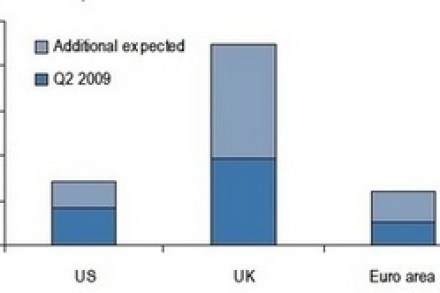
It’s fortunate that pluck and stoicism are fundamental British characteristics and that we are at our best when backs are to the wall. Figures published today suggest that the US economy grew by an annualised 3.5 percent in the third quarter. Britain is now alone among developed countries in fighting a shrinking economy. So much for Mr Brown’s confidence last autumn and Alistair Darling’s growth forecasts. Even Italy is doing better. One crumb of comfort for Labour is that the American consumer has regained confidence thanks to government stimulus: sales of manufactured goods, such as cars covered by the government scheme, are up by 22.3 percent. This should have global consequences that benefit Britain.

Welcome reforms, but they do not provide the complete answer

Baroness Royall has confirmed the Eames inquiry’s recommendation that the House of Lords has its own standards watchdog, following allegations that four Labour peers offered to amend laws for specific companies in return for substantial sums of cash. Whilst this move is welcome, the more pressing issue is how to redress financial strains on members, which tempted corruption originally. Whilst a separate review will examine the options for a system of financial support, current reforms are merely concentrated prescriptions. James Landale revealed today that the amount claimed for overnight accommodation will be reduced, though peers will have to provide claim receipts (for the first time, incredibly).

A report that must inaugurate reform

Chairman of the Nimrod inquiry Charles Haddon Cave QC is convinced that the fire on board Nimrod XV230 would not have occurred had those tasked with ensuring airworthiness fulfilled their responsibilities. Haddon Cave lists Air Commodore George Baber, Wing Commander Michael Eagles and the leadership of BAE Systems among the chief culprits – the MoD and BAE face costly negligence suits and perhaps criminal proceedings in consequence. Identifying culpable individuals is unusual, illustrating quite how damning this report is to the MoD and the Defence industry – those bodies, as well as allegedly negligent individuals are responsible. The report provides a clear insight into the MoD’s modus operandi.

Raging against the dying of the light

George Osborne’s speech on Monday calling for huge cash bonuses not to be paid this year drew an angry response from those hoping to receive huge cash bonuses – and various City and business pressure groups. A few years ago I would have felt deeply uncomfortable with what Obsorne proposed, but because nearly every bank has drawn heavily on state support over the last year, I think politicians do have a right – even a responsibility – to offer firm guidance to the banks. The FT led the charge against Osborne with both a critical news story, gleefully dissected by Iain Martin, and a harsh leader. Today, the paper follows up with a page two story on a letter Alastair Campbell has sent the paper criticising the shadow Chancellor.

Iain Duncan Smith’s overlooked “affordable policy solutions”

After his superb work with the Centre for Social Justice, it's encouraging that Iain Duncan Smith is being tasked by the Tory leadership to come up with "affordable policy solutions" to spring the traps which keep people stuck in worklessness.  It's thought that David Cameron rated the proposals of the CSJ's recent report on this issue – as, too, did Coffee House – but was put off by the £3 billion upfront cost of the reforms. But there's an important aspect of that report which hardly got any attention at the time: it already includes more affordable options.  The £3 billion was for a universal benefits system which would see claimants losing*, at worst, only 55p of every extra £1 they earn from taking extra employment.

Learning to let go of the police

Today's Mac cartoon in the Daily Mail is, for me, a cut out and keep. It epitomises everything that has gone wrong with policing in Britain - a copper running past thieves to nick an old lady who has wrongly parked. And it touches on a wider theme: this is why regard for the police has fallen in the last dozen years. Their priorities seem to have switched from those of the public to those of the bureaucratic elite. This impression is, of course, deeply damaging and will be tough for the Tories to reverse. The plan for directly elected police chiefs, and Nick Herbert's seminal work on the subject, did seem to make sense to me. But not much has been said about it since. The Tories are, of course, in two minds about it.

PMQs Live Blog | 28 October 2009

Stay tuned for live coverage from 1200. 1159: Still waiting for the main event.  You can watch it here, by the way. 1203: And we're off.  Brown starts by paying tribute to British troops in Afghanistan, as well as aid workers killed in Kabul 1204: First question from Stephen Hepburn on whether pleural plaque victims will get compensation. 1205: Here's Cameron now.  As expected, he leads on Brown's embarrassing U-turn of TA cuts; an issue the Tories have been pushing for the past couple of weeks.  Cameron asks hopw Brown could have thought about cutting training during wartime. 1206: Strange.  Brown responds by repeating his condolences - it's basically a carbon copy of his opening statement.  Seems like he's using it to defuse Cameron's point.

If you see an MP wandering around with a stopwatch, this is why…

So the details of Sir Christopher Kelly's review into expenses are starting to leak ahead of their formal publication next week.  The proposals will include an expected ban on employing family members, reductions in living allowances, and a ban on claming mortgage interest for a second home.  Of all the measures, though, the most eye-catching is that MPs whose nearest railway station is within 60 minutes of Parliament will be unable to claim for a second home. Most of Westminster is expecting a parliamentary uproar over the proposals.  And it's easy to imagine how that last one, in particular, will be quibbled over and opposed during the next few weeks and months.

Two polls to please the Tories

There have been two polls today which are worth mentioning belatedly.  The first is YouGov's voting intention poll for Wales, which Anthony Wells has analysed here and here.  It's not often you see a Welsh voting poll - which is a shame - and the results of this one are striking.  Labour are on 34 percent; the Tories are on 31 percent; Plaid Cymru on 15 percent; Lib Dems on 12 percent.  Overall, that's much better news for the Tories than it is for Labour: the last time the Tories scored 31 percent in Wales was in the 1983 election.

Cameron in front of the press

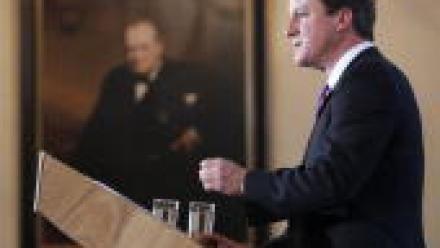
David Cameron was in confident form at his press conference this morning. Most of the questions were about the possibility of President Blair and Tory opposition to that. But three other things from the event were worth noting. First, Cameron’s announcement that the Tories will publish their top three or four priorities for each department shows the influence of the Institute for Government on Tory thinking. Michael Bichard, the director of the Institute, was David Blunkett’s permanent secretary at the Department for Education and Employment and Blunkett’s success in this job is largely credited to him and Bichard working out a few priorities and sticking to them. The Tories are now adopting this Bichard / Blunkett approach for every department.