Uk politics

Bad news for the country, bad news for Labour

From our UK edition

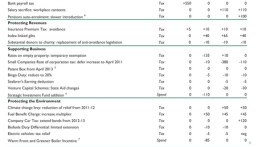
Abandon hope all ye who enter here.  While we mostly knew what to expect from Darling's PBR, it's still surprising just how uninspiring, how thin and how insufficient it is in the flesh.  It's pretty much a bad news budget for anyone you could mention.  Bad news, of course, for the bankers who will be hit by the hazily outlined bonus tax.  Bad news for public sector workers, who are already smarting at the frozen pay rise they'll have to accept in a few years time.  Bad news for anyone who cares about the state of the public finances, which look just as grim, if not worse, as they did back in April, with no significant plan for recovery.

Brown’s bonus smokescreen

From our UK edition

If today ends up with the government in a row with the City over plans to tax bank bonus pots with bankers threatening to take the government to court, then it will be mission accomplished for the Labour party. The same goes if we end up in a debate over the merits of a Tobin-style tax. For obvious reasons, Labour would rather talk about anything other than the state of the public finances so anything that distracts attention from that central question is, to use the word of the morning, a bonus for Brown. The Tories know this and will try and turn the debate back to the public finances and the fact that Britain was the first major economy into recession and is going to be the last out. It is imperative for them that they succeed.

One year on | 9 December 2009

From our UK edition

Coffee House will be live-blogging Alistair Darling's PBR statement from 1230 on.  In the meantime, here's a brief video reminder of George Osborne's PBR response from last year – probably the Shadow Chancellor's finest moment at the Dispatch Box.

Your guide to the PBR Brownies<br />

From our UK edition

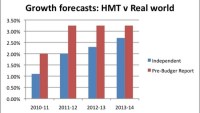
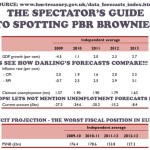
How can you tell if you’re being lied to on budget day? Normally its easy: Gordon Brown’s lips move. But, today, there's a handy guide. You can compare Darling’s fiction with the independent average calculated by HM Treasury.

Darling carves up the spending pie

From our UK edition

It’s the eve of the Pre-Budget Report, and the lunacy has already begun. Tomorrow's FT says that Darling will copy the Tories’ plans to protect the NHS budget – and throw police and schools in to the protected status as well. This is introduced as "the biggest squeeze in pubic spending for a generation," with the headline figure of 14 percent cuts. How to make sense of that? My guide: 1. Any sentence that starts “A Labour government would...” can be ignored. Darling can promise to fund free beer for everyone after 2011 – he won't be in office. These are decoys for the media: the wilder his claims, the worse he expects to lose. 2.

Ringfence-a-rama

From our UK edition

Just watching Newsnight, and the show's economics editor, Paul Mason, has said we can expect several budgets to be ringfenced from spending cuts in tomorrow's PBR – hospitals, schools and perhaps even the social security budget.  If so, it's another sign of how political the document is set to be.  Ringfenced budgets are the other side of the soak-the-rich coin: sending out the twin message that Labour will batter the "City fat cats," while also "investing" in public services "for the many".  Just a shame that it's all insufficient to the scale of the debt crisis.

Clocking on

From our UK edition

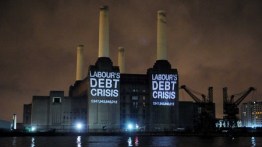
As publicity stunts go, the debt clock the Tories beamed onto Battersea Power Station this evening is quite a decent idea.  Their thinking's pretty clear – get some coverage in tomorrow's papers, and increase the likelihood that the horrendous state of the public finances becomes the story of the PBR – but it's probably no less effective for it.  Anyway, here are some pictures so you can judge for yourself: P.S. Yes, I know it's out of sync with the Coffee House debt counter. We're going to update our numbers on the back of tomorrow's PBR.

Tackling the deficit

From our UK edition

Reform’s report, The Front Line, focused on the how of the public finance question – how to get the deficit down in practice.  We pointed out that since the public sector workforce accounts for around a third of the total government deficit, it should contribute a third of the reduction in the structural deficit.  That would mean reducing the costs of the public sector workforce by £30 billion, equivalent to a reduction of one million of the six million public sector jobs in the UK.  That would take public sector employment back to the levels of 1999 when the recent period of major spending increases began.

Tomorrow could be a turning point for the Tories

From our UK edition

The number of polls showing the Tories below forty percent are causing some heartburn for the Tory leadership. When the first poll came out showing the Tory lead down, there was a feeling that this wasn’t all bad, that it would help remind the party that the election isn’t in the bag. But there is now mounting concern at Tory slippage, this is being reinforced by the fact that the party’s own research shows the same trends. Today’s leader in The Times, a paper which is normally editorially supportive of the leadership, was another unhelpful development.

Luck shines on the brave

From our UK edition

Nevermind the bankers, the UK Border Agency should have been awarded £295,000 in performance bonuses. Phil Woolas’s defence that “brave” border workers deserved remuneration beyond their basic salaries is imaginative, though unremittingly egregious. The agency is plainly maladroit. Keith Vaz’s Home Affairs Select Committee has found: 'There is still a huge backlog of unresolved cases and UKBA simply must get through them faster than they have promised.

A significant endorsement for Osborne and Hammond

From our UK edition

Bernard Gray, a member of the Tories’ Public Service Productivity Advisory Committee, explains why he has joined forces with the Tories. He writes in today’s Times: ‘From my experience of working in and with the Ministry of Defence over the past decade I know how strong such vested interests are and how much commitment is required to overcome resistance to change. It will take acts of extraordinary political will to take on these entrenched interests. The Shadow Treasury team, George Osborne and Philip Hammond, have persuaded me that they are have the determination, drive and belief in change to tackle this issue at this critical time. That’s why I’ve been persuaded to help them.

Ever the optimist

From our UK edition

It seems absurd to describe our dour and jowly Prime Minister as an eternal optimist, but he is. Rachel Sylvester’s column contains this delicious snippet of gossip: ‘When Mr Darling said that Britain was facing the worst recession for 60 years, Mr Brown telephoned him to tell him the downturn would be over in six months.’ Prudent foresight, there's nothing like it.

Darling contra Brown, Part 573

From our UK edition

Ok, so tomorrow's Pre-Budget Report is shaping up to be a horrendously political affair.  But, rest assured, it could have been so much worse.  In what is, by now, a familiar Budget-time story, Alistair Darling is fighting the good fight against some of Brown's most inharmonious fiscal brainwaves.  According to Rachel Sylvester's column today, here are just some of the measures that the Chancellor has resisted: -- A long-term windfall tax on bankers' bonuses (Darling favours a temporary, one-year tax). -- A call to lower the 50p tax threshold from £150,000 to £100,000. -- A reversal of the plan to make it easier for couples to pool their inheritance tax allowances. -- A, ahem, "more optimistic picture of the British economy".

When did the Tories become an “alternative government”?

From our UK edition

There are a couple of noteworthy snippets in today's FT interview with George Osborne: the claim that the Tories may not take corporation tax as low as it is in Ireland; the outline of a "five-year road map" on business tax policy, etc.  But, I must admit, it's this passage which jumped out at me:    "[Osborne] says his Tory conference speech in October, which included plans for a public sector pay freeze and an increase in the state retirement age, 'was an important moment' that showed a mental leap to being 'an alternative government, not just an opposition'." These self-bestowed titles – "alternative government," and the like – are silly, really.  The only thing that actually matters is whom the public regards as governing material.

The Lib Dems’ hunt for an issue may lead them to an Afghan pull-out

From our UK edition

As Anthony Wells says over at his UK Polling Report, there are plenty of reasons to doubt whether Labour could convert a third of Lib Dem voters over to their cause.  But the article in today's Times on Labour's new strategy will still give Team Clegg pause for thought. The problem for the Lib Dems is that they haven't yet managed to hit on an attention-grabbing issue to make their own – their favourite, perhaps only, election strategy.  The cause of Parliamentary reform could have done the trick, but – beyond Nick Clegg's call to prevent MPs from taking their summer holiday – very few of the Lib Dem proposals have received much coverage.  Likewise, electoral reform, which Labour now seem to be comandeering for their own manifesto.

This week’s PBR looks set to be Brown’s most political Budget yet

From our UK edition

Ok, so all Brown Budgets are political – but signs are that this week's PBR could be his most blatantly partisan yet.  I mean, just look at his speech this morning on improving efficiency in the public sector.  Some of its measures are welcome – for instance, pledging to cut the pay of senior servants, and the general idea of using technology more effectively in government.  But, as other folk have pointed out (see Guido and Iain Dale), the measures are insufficient to the scale of the debt crisis, and many are old news.  All in all, the signs are as we expected: Brown is paying only lip service to cuts. Instead, Brown is going to go heavy on soak-the-rich measures; thereby strengthening what Labour see as two dividing lines.

The politics of distraction

From our UK edition

If everyone concentrates on the actual numbers in the PBR then it will be a disaster for Labour. So, instead Labour will try and distract us all with small but eye-catching measures — a new rate of inheritance tax for estates worth more than £5 million, that kind of thing. The aim will be to move the debate from the grim reality of the country’s fiscal situation to Labour’s dividing lines. There will be a lot of pressure on Cameron and Osborne to denounce Labour’s soak the rich measures. But the most important thing for them to do is to get the debate back to the state of the public finances and that is inevitably going to involve side-stepping the arguments that Brown wants to pick.