Uk politics

Meet Farmer Mandelson | 15 December 2009

From our UK edition

Our Christmas double edition is out today, and is choc full of writers to keep y’all entertained over the festive season. Someone who certainly entertained me is Lord Mandelson. I interviewed him just after Charles Moore’s disclosures about the shooting party: he didn’t shoot, he says, but was at a large dinner chez Rothschild where Saif al-Gaddafi was present. What’s Gaddafi like, I asked? Is he all right kind of chap? PM: “I don’t regard him as an alright chap or a bad chap, I mean how can you judge?” FN: “I thought you knew him a little bit.

Should an opposition sell itself as a responsible government?

From our UK edition

One of the Tories’ favoured lines recently has been that they are acting like a responsible government while Labour is behaving like an irresponsible opposition. But I wonder if this attitude is entirely healthy for an opposition, or whether it ends up blunting its campaigning edge. For example, the Tories’ refusal to say for definite that they will repeal Labour’s planned increase in national insurance stems from their view that they aren’t certain where they would find the £8 billion from. But given the number of black holes and blanks in the PBR and that the deficit is over £170 billion this seems slightly absurd.

So what if Zac Goldsmith’s loaded

From our UK edition

Hold your breath, the ‘Zac’s filthy rich’ furore is coming to a front page near you. In addition to scurrilous insinuation about his tax status and the fact that he has spent Walpolean sums on campaigning in Richmond, Paul Waugh breaks the news that the Electoral Commission intends to investigate an allegedly impermissible donation Zac made to the Conservatives. An impermissible donation is of course illegal, but Goldsmith is innocent until the local Tory association’s case that his was an honest mistake made during the interim between moving out of Kensington and Chelsea and registering in Richmond is disproved. Other criticism is simply bunk.

The Labour leadership question hasn’t been answered

From our UK edition

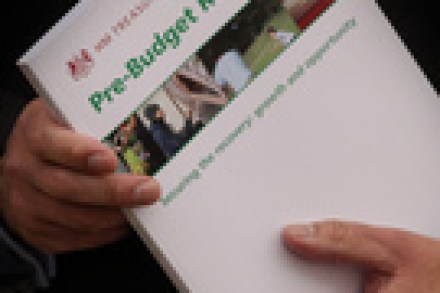
Rabble-rouser and bruiser-in-chief Charles Clarke has taken a hatchet to the government’s highly political Pre-Budget Report. Writing on his blog, Clarke argues: ‘He (Brown) felt that the main purpose of this pre-election Pre-Budget Report was to recycle his old political dividing lines.   This weakness can only come from fear of discussion of our past failures and fear that it is too dangerous to set out our future plans.   The real danger for Labour is that this weakness will pave the way to political defeat in 2010.’ The Labour leadership crisis has retreated from the limelight recently, but the spectre of internecine war after a whipping at the polls has not.

The Tories should resist any temptation to go soft on debt

From our UK edition

Of all the findings from today's ICM poll for the Guardian, I imagine this one will concern the Tory leadership most: "Just two months ago, 49 percent of voters said they thought Cameron and Osborne would do better than Darling and Brown, but that figure is 38 percent today." They're still ahead of Brown and Darling – who are langushing on 31 percent – but the drop is still pretty striking.  What's more, it seems to go against conventional wisdom about fixing the fiscal mess we're in.  While they could still go further in setting out a few specifics, the fact is that the Tory pair have spent the last couple of months railing against the the twin debt and deficit burdens, and stressing the need for spending cuts.

Only Ireland and Iceland have had a bigger debt explosion than the UK

From our UK edition

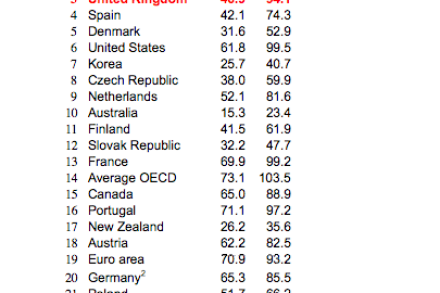
An argument put forward by some Labour types is that we're not really facing a debt crisis at all.  "Yes, the national debt levels are bad," they say, "but we started off at a low level in comparison to other countries, so we can absorb the deficits we're racking up." Well, you can take issue with the idea that we had "low levels" of debt before the crisis kicked in – but the real mistake this statement makes is to ignore the rate at which we've accumulated debt.  As the latest OECD data shows, UK debt is set to rise faster than any other nation save for Iceland and Ireland: The picture would probably look even worse if you accounted for all the off-balance sheet fiddles, like the toxic bank assets and PFI.

Exceeding expectations

From our UK edition

Today’s Guardian has an interesting story on the success of the New School Network, an organisation set up to get parents’ to take up the opportunities offered by the Tories’ planned school reform. The Guardian reports that 200 parents groups and 100 groups of teachers are interested in setting up schools. I suspect that take up of the Tories new schools will exceed expectations. One person involved with the New Schools Network told me recently that they would judge the policy a failure if it did not lead to the creation of a 1,000 new schools in the first two years.

Things the Speaker shouldn’t discuss in public

From our UK edition

As Andrew Sparrow says, it's well worth reading Iain Dale's interview with John Bercow in the latest issue Total Politics.  It's a fun read, mostly because the Speaker is remarkably candid – a quality that's normally to be admired in a politician.  But I can't help thinking that he made a mistake in admitting this:   "I received various approaches from various senior people in the Labour party saying: 'Aw, you know, we'd love to have you on board. We think you're being discarded by the Conservatives. We think you'd be quite at home with us.' Senior people, not in a formal setting, but people sidling up to you – ex-ministers, current ministers, backbenchers, whatever.

Balls beats the drum for investment

From our UK edition

Oh, look, Ed Balls is talking about "investment" again.  This time it's an address on the Government's Children's Plan, and, judging by the preview in today's Independent, it's all going to be about how much more money his department is spending.  I doubt Alistair Darling will be impresssed - especially as much of that money was strong-armed out of the Treasury in the early hours of Wednesday morning last week.  And I doubt that some of Balls's other colleagues will be too amused either.  Their departments will be subject to even deeper cuts thanks to his brinksmanship. But you suspect that Balls isn't just hoping to rile his fellow ministers - he'll probably want to divert some attention away from the important u-turn which he outlined on Marr yesterday.

Playing politics with the public finances

From our UK edition

It has started. The Labour attack unit is out today talking about a "Tory VAT rise" - as per Paddy Hennessy’s scoop. Osborne stated his (to me, relatively paltry) position on the deficit: that he’d reduce it faster than Labour but can’t say how much. The Labour attack unit keeps partying like its 1999 with the "Tory cuts" line, now augmented with a "Tory tax rise." Here are the words which the attack unit has crafted for Stephen Timms, chief secretary to the Treasury: "George Osborne refuses to say what services he would cut or what taxes he would increase in order to cut the deficit 'further and faster' than Labour.

Labour fell between two stools this week

From our UK edition

There were two possible strategic approaches Labour could have taken to the PBR. One option was to surprise everyone by actually making cuts. They then could have said, "we've made all the cuts we can. Anything else would really hurt frontline services". This would have put them in position to challenge the Tories as to what they would cut to reduce the deficit faster. The other was to be really populist. They could have carried on spending, bashed the bankers, soaked the rich, and hope that they could get away without a crisis in the markets until the election. Instead, they’ve fallen between two stools.

Has Mandelson given up on Brown?

From our UK edition

For any Kremlinologists among us, Peter Oborne's latest column in the Mail sure is a juicy read.  It claims that Mandelson and Brown are "at war again" – only, this time, insiders say the damage to their relationship is "irreparable".  The Business Secretary is said to be "bitterly unhappy" with Labour's class war strategy, and with Brown's reluctance to deal with the fiscal crisis.  And – as Martin highlighted the other day – he wants out. None of this is too surprising.  Indeed, Mandelson has been conspicuous by his absence from the government's PBR media drive, fuelling more than a few Westminster mumblings about his commitment to the Brownite cause.

Why not just scrap ID cards, then?

From our UK edition

So the protracted, wheezing death of ID cards continues, with Alistair Darling admitting in today's Telegraph that: "Most of the expenditure is on biometric passports which you and I are going to require shortly to get into the US. Do we need to go further than that? Well, probably not." The government are letting it be known that this doesn't contradict their existing policy, but their shifting rhetoric remains striking.  Last year, we had the then Home Secretary, Jacqui Smith, proposing that British citizens should be able to choose between a card and a biometric passport.  Earlier this year, Alan Johnson said that ID cards wouldn't be compulsory for British nationals, after all.

Blair admits to misleading the British public over Iraq

From our UK edition

It has taken eight years, but Tony Blair has finally leveled with the British public and admitted that the WMD thing didn’t really matter: he wanted to depose Saddam Hussein anyway. That's what he has said in a BBC interview, presumably to pre-empt his appearance before the Chilcot inquiry. His chosen confessor: Fern Britton. His medium: BBC1 on Sunday. It has been trailed to the newspapers, including tomorrow’s Times. As it says: "He said it was the 'threat' that Saddam presented to the region that was uppermost in his mind. The development of weapons of mass destruction was one aspect of that threat. Mr Blair said that there had been 12 years of the United Nations going 'to and fro' on the subject, and he noted that Saddam had used chemical weapons on his own people.

The Tories dust off their baseball bats

From our UK edition

Is it just me, or have the Tories developed a slightly harder edge in the couple of days since the Pre-Budget Report?  We had an unusually acidic address from David Cameron yesterday, in which he likened Brown 'n' Darling to "joy-riders in a car smashing up the neighbourhood," and criticised the PBR for its "irresponsibility, basic deceit and complete lack of moral principle".  There have been a couple of quite powerful attack posters from CCHQ.  And now we've got George Osborne saying that Brown may have "betrayed the responsibilities of the office he holds." "So what?" you say, "they're the Opposition – it's their job to oppose."  Well, yes, of course.  But that opposition seems to have been concentrated over the past few days.

Committee overload

From our UK edition

We all know how bureaucratic and convoluted a lot of Parliamentary practice is, but this reminder from Heather Brooke of the bodies involved in reforming MPs' pay and expenses is still pretty astonishing: "Currently we have: the senior salaries review body (which makes recommendations on MPs' salaries and pensions); the committee on standards and privileges (appointed by the House of Commons to decide on complaints against individual MPs reported to them by the parliamentary commissioner for standards – currently John Lyon); the committee on standards in public life (which deals with complaints about unethical conduct among MPs – the current chair is Sir Christopher Kelly); the members allowances committee (made up of MPs who advise the members estimate committee on the rule.

Why class wars don’t work

From our UK edition

Well, it seems like Paul Richards – a former aide to Hazel Blears – wants to corner the market in quietly persuasive demolitions of his own party's strategy.  If you remember, he wrote a perceptive piece on Labour's shortcomings in the aftermath of the Norwich North by-election, which we highlighted here on Coffee House.  And, today, he's at it again, with a very readable article in PR Week on why the class war won't work.  His three reasons why are worth noting down: "First, it is hypocritical. The Labour Party has a disproportionately far higher number of former public schoolboys and schoolgirls in parliament and in the government than a random sample of the public they serve.

How far could Boris go?

From our UK edition

At Tory conference a bunch of candidates got together for supper. The conversation turned, as it so often does on these occasions, to who might be the next leader. One candidate was advancing the case for Boris with some gusto, until another interrupted saying, ‘can you imagine Boris representing Britain at the Security Council.’ The table agreed that they couldn’t and so the conversation moved on. Certainly, this perceived lack of seriousness will be Boris’s biggest problem in going further than Mayor of London. Cameron had a point when he said that Boris was stuck in a buffoonish rut from which he would find it hard to escape. But if Boris can win re-election he will have enough of time to establish a record which demonstrates a certain level of competence.