Uk politics

The economy has gone precisely nowhere in 5 years, but at considerable cost

From our UK edition

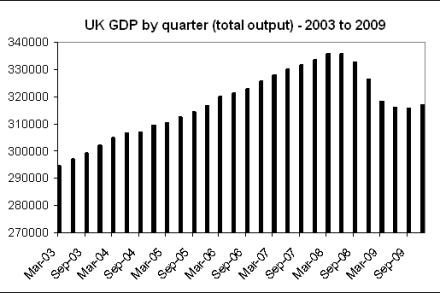
The longest recession suffered by any major country in this cycle seems thankfully to be drawing to an end, even if only by the narrowest of margins.  Such has been the severity of the downturn though, that, as the above chart shows, GDP has fallen back to the levels of mid-2005. The economy is basically the same size as at the time of the last election. This means for probably the first time in modern British history, living standards have failed to rise for almost the entire duration of a Parliament.   Sadly, the cost of the economy going nowhere has not been as lacking as the growth or living standard increases. The national debt has virtually doubled since the last general election, rising from £440 billion to £870 billion now.
Growth but of the weakest possible sort

From our UK edition

So Britain did grow in the fourth quarter of last year but only by 0.1 percent. Many on the Labour side had hoped that the moment that the country started growing again, Brown would be able to go on the offensive; arguing that his handling of the economy had steered Britain through the crisis. But the fact that the growth number is considerably lower than expected, most predictions were for growth of 0.3 to 0.4 percent, has rather stymied that plan. There are now only one more set of GDP figures before the election, presuming that it is held in May. So, it is now almost certain that Brown will not be able to go to the country boasting of a robust recovery. (The worst case scenario for Brown is that these figures are revised downwards meaning we are still in recession).

The demographics of power-sharing

From our UK edition

The union of irreconcilables was unlikely to last: power-sharing in Northern Ireland is on the verge of collapse. Where once Blair and Ahern would descend on Stormont as a couple of charismatics, today Gordon Brown and Brian Cowan face an enormous and unenviable task. They deserve support: both governments have been courageous in their approach to Northern Ireland, and the Tories were right to offer unconditional support. In which case, why did the umbrella of unionists, including the Tories’ Northern Ireland spokesman Owen Paterson, convene at the Marquis of Salisbury’s house in secret? A mixture of the furtive and the preposterous, one expected reports of Richard Hannay emerging from behind a curtain and fixing his Colt on Peter Robinson.

Redwood is right – prison sentencing may need reform out of fiscal necessity

From our UK edition

John Redwood is one of the most original thinkers on the right; and tasked with finding solutions to cut expenditure, he has concluded that too many petty thieves and fraudsters are imprisoned. Redwood argues: ‘The first is all those people who commit crimes by taking money or property that does not belong to them, ranging from the common thief to the fraudster. Surely it would be much better to prove to them that crime does not pay. They should be made to pay the costs of the police and judicial system in handling and prosecuting their case. They should make full restitution to any third party affected by their actions, including an element of compensation.

Here’s how you raise £100bn through tax hikes

From our UK edition

Policy Exchange has repeatedly urged that the country’s fiscal problems should be addressed principally by spending cuts, combined with some tax rises.  We have recommended a ratio of 80 percent spending cuts to 20 percent tax rises. The “structural” deficit in the UK (i.e. the bit of the total deficit that will still be there once the economy has recovered) is estimated by the Treasury at 9 percent of GDP, or about £125 billion.  Not all of that needs to be eliminated quickly, but the vast majority of it does, say £100 billion.  So on a ratio of 80:20 our position equates to £80 billion in cuts in underlying spending (spending that isn’t the direct result of the recession) and about £20 billion in tax rises.

Nest-eggs for some pre-election goodies

From our UK edition

Labour’s tax on banks that pay bonuses has failed to change behaviour and so will raise significantly more money, roughly two and a half billion more, than the Treasury budgeted that it would. How Labour uses this extra revenue will tell us a lot about how Labour intend to campaign and the balance of power within the government. At Brown’s press conference, Gary Gibbon pressed the Prime Minister on whether this money would all be earmarked for deficit reduction, the option that those close to Darling prefer. Noticeably, Brown failed to endorse that idea. He also would not commit to using any other extra revenue exclusively for deficit reduction. The significance of this is that there are rumours floating around that a bank might be sold before the election.

Out of recession and into debt

From our UK edition

The deficit is in the Tories' crosshairs this morning. George Osborne pens an article in the Times, castigating Brown's obsession with continuity: ‘We need a new British economic model that learns from the mistakes of the past. First, that new economic model requires government to live within its means. We entered the recession, after years of growth, with one of the highest deficits in the developed world and we leave the recession with our credit rating under threat. That will have potentially disastrous consequences for international confidence. If Britain starts to pay the sort of risk premiums that Greece is paying, the interest bill on a £150,000 mortgage would go up by more than £200 a month.

When it comes to localism, absolute clarity of aim is essential

From our UK edition

How deep is David Cameron’s commitment top empowering local government? His response to the New Local Government Network’s latest report will be an indication. The report argues that elected mayors should raise or cut business rates and council tax, and spend the proceeds on local services. Mayoral coffers will hardly match the riches of the Spanish Main, the Times reports: ‘The authors have calculated that a 4p levy on business rates could raise £30 million for Birmingham, £10 million for Newcastle, £26 million for Leeds and £11 million for Milton Keynes.

An election victory is only the start of the battle for Cameron

From our UK edition

The News of the World has done its poll of marginal seats today (story here, Anthony Wells here) – a hugely expensive operation, but worthwhile because British elections are decided in marginal seats. National polling, while interesting, can be a misleading indicator of outcome. The result is that the Tories have a safe lead of 13 points (take a bow, Lord Ashcroft), but would still end up with just a 38-seat majority due to Westminster’s unfair voting system. As I say in my column, this is nowhere near a ‘safe’ majority, because it means the government can be defeated by 20 rebels.

Darling talks sense on public sector pay

From our UK edition

How things change.  A few months ago, Alistair Darling would only go so far as to not rule out a public sector pay freeze.  By the time of the Pre-Budget Report, that became a 1 percent cap on pay rises.  And now, in an interview with the Sunday Times, he's talking explicitly about public sector pay cuts.  He cites the example of the private sector, where workers have accepted cuts to hang onto their jobs. It certainly makes sense.  Wages make up such a hefty proportion of public spending, that any serious plan to cut the deficit will have to take them into account.

Labour have Osborne in their sights (and on their fridges)

From our UK edition

It's only a small thing, but does anyone else find this detail from today's Times interview with Alastair Campbell a little, erm, peculiar: "On the [Campbell] fridge is a Christmas card from David Miliband, a clipped photo of George Osborne in the Bullingdon Club shooting pheasant, a GCSE revision schedule. It is the type of handsome but unostentatious London professionals’ house that the Blairs once owned in Islington." I mean, it's no secret that the Labour hierarchy loathes the shadow Chancellor – but putting what I assume is this photo on your fridge?  Armchair psychologists, the comments section is yours...

Good advice for Dave

From our UK edition

Ok, ok – so PMQs may be of more interest inside Westminster than out.  But, love it or loathe it, it's still one of those things which affects the mood music of politics and how it is reported.  Far better for a party leader to do it well, than to be bludgeoned by his opponent at the dispatch box. Which is why Team Dave should internalise Matthew Parris's article in the Times today.  Not only is it typically readable, but it's packed full of sound advice for how the Tory leader should present himself in the weekly knockabout sessions.  Here's a snippet: "Millions are now eyeing Mr Cameron up as a potential prime minister, and considering, not unhopefully, whether he’s up to it.

Don’t be surprised if Jowell is kept on by a Tory government

From our UK edition

As Ben Brogan outlined in his Telegraph column last November, there are plenty of Tories placing a good deal of emphasis on the London Olympics.  By the time it comes around, they may well have spent two years cutting spending, raising taxes, and generally struggling against the fiscal problems that Brown has hardwired into our nation's fibre.  A successful Games, the thinking goes, could be just the tonic for their midterm government – as well as for the country as a whole. Which is why today's story about the Tories somehow keeping on Tessa Jowell, the current Olympics Minister, is unsurprising.  The thinking is clear: a bit of continuity could prevent the organisational problems, as well as power struggles, which always seem to beset political handovers.

Publishing the serious case review in the Edlington case is the best way to prevent more awful mistakes

From our UK edition

The Edlington case is shocking and depressing to think about. But I would urge you to watch Gavin Esler’s interview of Ed Balls on Newsnight where he challenged Balls over his reasons for not publishing the full case review. Newsnight, who were leaked a copy of the full case review in the Edlington case, pressed Balls on why the full report was not being published when the summary was misleading and did not highlight some of the biggest problems. Balls, as the government does whenever it is challenged on this point, invoked the support of the NSPC, Lord Laming (whose record, as Iain Martin points out, isn't that great) and various other members of the establishment.

The public aren’t seeing Brown’s “green shoots”

From our UK edition

We've been rather starved of opinion polls over the past week, which is probably no bad thing.  But this PoliticsHome poll on the economy has come along to give us at least something to mull over.  And its findings aren't good news for Labour. First, only thirty-four percent of repondents think that the economy has turned a corner into recovery.  And, crucially, only 36 percent are willing to give Labour "a lot" or "some" credit for their handling of the recession (down from 40 percent last August).  That's against 29 percent saying "not very much," and 34 percent saying "none at all". As we saw on Wednesday, Labour is eager to seize on any potential "green shoots," and sell them as successes for government policy.

Dirty tricks are off and running

From our UK edition

The Tories are bracing themselves for an election campaign of smears and dirty tricks. Today the sniping begins. Attack dog Liam Byrne has criticised Cameron’s ‘Broken Britain’ speech in the following terms: “I think when people read what Mr Cameron is saying today they will see that it is quite an unpleasant speech…Mr Cameron is seizing upon one appalling crime and almost tarring the people of Doncaster and the people of Britain.” Cameron is not tarring anyone; he is clear that Doncaster was one of a number of extreme incidents (Baby P being another) that exist alongside a groundswell of anti-social behaviour. The terms ‘Broken Britain’ and ‘moral recession’ are sensational but Cameron has a point.

Obama is playing politics<br />

From our UK edition

FDR was plainly confident when he indicted the "practices of unscrupulous money lenders" during his 1933 inauguration address; Obama’s speech yesterday was scented with desperation. He exchanged eloquence for provocation. “If these folks want a fight a fight, it’s a fight I’m ready to have.” Bankers do not want a fight with a President seeking cheap political capital; they want to turn profits and do business. Obama’s proposals frustrate that aim - by carving up corporations and neutering investment banking on the grounds of excess risk. As Iain Martin notes, Obama has departed from the G20’s emerging narrative, and though the details are imprecise there is no doubt of the direction Obama is headed. It is the wrong one.

Cutting drugs

From our UK edition

On Wednesday, Baroness Kinnock told the Lords that a number of Foreign Office departments had been hit been hit by an estimated £110 million budget shortfall, and that an anti-drug program in Kabul has been cut.  Coming after British dismay at President Karzai's desire to put Afghanistan's former (and widely-discredited) Interior Minister, Zarar Ahmad Moqbel, in charge of the country's anti-drug effort, the cuts are bound to cause concern. Afghanistan is the world's leading supplier of opiates, trafficked as opium, morphine and heroin. Over 90 percent of the heroin on the UK's streets originates from Afghanistan. Though cuts to counterterrorism programs are probably ill-advised, there is less reason to worry about the impact on any anti-drug efforts.