Uk politics

A composed and calculated Blair takes round one

From our UK edition

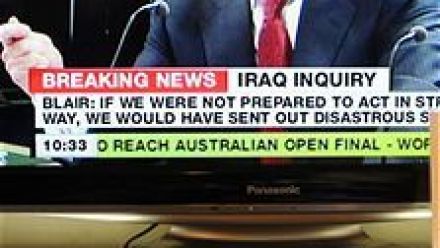
So, what do we make of round one? Blair looks younger, in a strange way. A shorter haircut. But all those thespian mannerisms that I had forgotten about are still there - and are being used to full effect. A complete mastery of his facial expressions – which, for Blair, do the communicating. He can torn on anxiety, bemusement etc on tap.The quizzical look, the mock concern. The pause, as he thinks about something (or pretends to). It wouldn’t surprise me if he was faking the slight shaking of the hands which Joey Jones at Sky has just picked up.   We have seen the usual Blair lawyerly hair-splitting habit: “regime change” is not the same as wanting to “remove” Saddam – etc. Blair will, today, throw up something for a headline.

There were real, human costs to containment

From our UK edition

On Today this morning, Nick Robinson said that Tony Blair would point to improvements in infant mortality and the like. Today then cut back to the studio where a reporter analysed this claim. The reporter disputed the validity of this claim and said that sanctions had ‘skewed’ the numbers. But the sanctions were a consequence of Saddam being in power. As long as he was there, there were going to have to be sanctions to contain his ambitions. Dennis Halliday, a UN official who resigned over sanctions, said that four to five thousand children a month were dying because of sanctions. There are intellectually respectable arguments on both the pro and anti-war sides. But to claim that the containment status quo was cost free is simply not accurate.

Why does the Iraq war still fascinate the politics of the present?

From our UK edition

This week has seen confirmation that social mobility has stagnated, that the economic recovery is dangerously anaemic and that peace in Northern Ireland is threatened. Yet a conflict that was declared won nearly 7 years ago has been ever present on the frontpages. Bagehot is not at all surprised that the Iraq war remains definitive: ‘There is one way in which, despite the inquiry, Iraq has come to seem a less definitive issue: in Mr Brown’s handling of the public finances, it has a rival for the status of Labour’s worst mistake. Yet Iraq remains the most important single decision the government has made. Even taking a generous view of its behaviour—that it was cavalier and naive, rather than actively mendacious—the war remains an enormous stain.

The Gove agenda goes Hollywood

From our UK edition

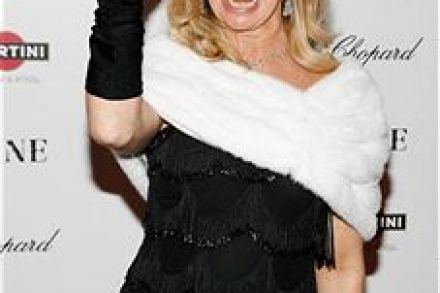
News reaches me of a surprising meeting in the lobby of Portcullis House today, Goldie Hawn — of Private Benjamin fame — swept in to Westminster wearing big shades and more fur than a member of the Household Division. She was in the Commons to meet with Michael Gove’s chief of staff, Dominic Cummings. Gove’s office won’t be drawn about what was on the agenda. But Hawn has an educational foundation specialising in how neuroscience and social and emotional learning techniques can be used to transform teaching techniques so we can presume that this was the main focus of discussions.

Blair’s real crime

From our UK edition

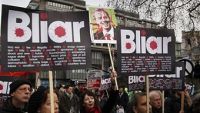
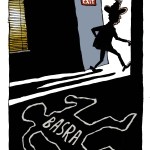
As Tony Blair prepares to sit in the dock tomorrow, I suspect he knows he’ll walk it. The focus is on the case for war and how it was spun – which will be his Mastermind specialist subject. Nor will anything new be uncovered. As one of the journalists whose summer holiday was eaten up by the Hutton Inquiry, I have been getting a sense of deja lu throuhout the Chilcot Inquiry – and Hutton was more informative because he exposed emails written at the time. They had more meaning and impact that the hazy recollections we hear now. The real story is one that Chilcot has unearthed almost accidentally: the betrayal of Basra.

Bypassing the centre and trying to broker a peace of the extremes in Northern Ireland was always going to come back to haunt the government

From our UK edition

The prospects of a deal in Northern Ireland seem to be receding. If the talks and, therefore the executive, do collapse, it will show how foolish it was of Jonathan Powell to try for this peace of the extremes. Powell decided that rather than spending hours negotiating with the UUP and the SDLP, the quicker way was to just go round them and deal directly with the extremes  on both ends of the spectrum (though, it is important to remember that however bigoted some DUP members are there is no moral equivalence with Sinn Fein). The theory was that these parties would have more room for manoeuvre as they could not be outflanked. But this has, unsurprisingly, not turned out to be true. The DUP have made the abolition of the parades commission a condition of any agreement.

Goldsmith’s advice strikes at the heart of all that is wrong with cronyism

From our UK edition

Yesterday, I wrote that Jack Straw’s savagery in response to Goldsmith’s original advice bespoke of personal animosity. That may well be so, but Goldsmith’s testimony reveals that he was long convinced of his initial advice’s validity. Blair was exasperated with his friend’s stubbornness: “your advice is your advice,” he said pointedly. Yet eventually Goldsmith changed his mind. Why? Well plainly the government wanted him to because they thought he was wrong. Chronology is important here. Goldsmith wrote a note to Blair dated 12 January 2003 (three months before the invasion) reiterating his objections. Later in the month and at someone else’s suggestion, Goldsmith met Greenstock, who wanted to put the Attorney General right.

The Tories’ Northern Ireland policy has nothing to do with electoral advantage

From our UK edition

If Tory policy in Northern Ireland was based around electoral advantage, as their critics have been insinuating these last few days, then they never would have attempted to get a new political force off the ground there. Rather, they would have waited for the election result and then, if necessary, made a deal with a unionist party that could offer them enough support. As the vote on 42 days showed, the DUP is not averse to deal-making. Indeed, until recently it appeared that the Tory approach would cost them if there was a hung parliament as it made the DUP far less inclined to support the Tories, their electoral rivals. The mutterings you hear from the Northern Ireland Office is that the Tories decision to contest seats in Ulster means that they can no longer be seen as impartial.

Is Boris’ resignation a problem?

From our UK edition

Boris Johnson has resigned as Chairman of the Metropolitan Police Authority, apparently because he could not devote enough time to the job. The deputy mayor for policing, Kit Malthouse, replaces him. This is a marginally embarrassing turn of events for Boris and the Tories. It’s a puerile point but Boris still has the time to write his extremely readable and by all accounts admirably remunerated column in the Telegraph. Equally, the Tories cited Boris Johnson as their first elected police commissioner – a famous face for one of their flagship policies. I don’t see either problem as being serious, certainly not beyond the present.

Stimulating social mobility will take decades

From our UK edition

Another pallid dawn brings more statistics proving that Britain is riven by inequality – ‘from the cradle to the grave’, concludes the Hills report. Unless the offspring of professionals pursue a peculiar urge to be writers or enter Holy Orders, they will bequeath ever greater advantages to their children. For those in converse circumstances, Larkin’s line about inherited misery comes to mind, albeit in a slightly different context. 50 years of unparalleled prosperity, and social mobility has stagnated. Before the wailing and navel gazing begins, it must be asserted that the continued aspirations of the privileged and the fulfilment of their opportunities are not to blame.

Of course the Conservatives are Unionists, but why keep it a secret?

From our UK edition

Over at Three Line Whip, Ben Brogan takes me to task for criticising the Owen Paterson’s attendance at the Marquess of Salisbury’s shindig. ‘But it seems a stretch to lambast Mr Cameron for doing his job as a unionist politician, which should be to find political ways to ensure Sinn Fein doesn’t end up the winner as the result of the failure of Unionism in Northern Ireland to get its electoral act together.’ The Conservatives are a Unionist party so there is no objection to their attending, especially as the Unionist cause is so disorganised. My objection was to its secrecy. Iris Robinson will tell you that there is no such thing as secrecy in Northern Irish politics.

The economy has gone precisely nowhere in 5 years, but at considerable cost

From our UK edition

The longest recession suffered by any major country in this cycle seems thankfully to be drawing to an end, even if only by the narrowest of margins.  Such has been the severity of the downturn though, that, as the above chart shows, GDP has fallen back to the levels of mid-2005. The economy is basically the same size as at the time of the last election. This means for probably the first time in modern British history, living standards have failed to rise for almost the entire duration of a Parliament.   Sadly, the cost of the economy going nowhere has not been as lacking as the growth or living standard increases. The national debt has virtually doubled since the last general election, rising from £440 billion to £870 billion now.

Growth but of the weakest possible sort

From our UK edition

So Britain did grow in the fourth quarter of last year but only by 0.1 percent. Many on the Labour side had hoped that the moment that the country started growing again, Brown would be able to go on the offensive; arguing that his handling of the economy had steered Britain through the crisis. But the fact that the growth number is considerably lower than expected, most predictions were for growth of 0.3 to 0.4 percent, has rather stymied that plan. There are now only one more set of GDP figures before the election, presuming that it is held in May. So, it is now almost certain that Brown will not be able to go to the country boasting of a robust recovery. (The worst case scenario for Brown is that these figures are revised downwards meaning we are still in recession).

The demographics of power-sharing

From our UK edition

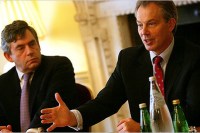
The union of irreconcilables was unlikely to last: power-sharing in Northern Ireland is on the verge of collapse. Where once Blair and Ahern would descend on Stormont as a couple of charismatics, today Gordon Brown and Brian Cowan face an enormous and unenviable task. They deserve support: both governments have been courageous in their approach to Northern Ireland, and the Tories were right to offer unconditional support. In which case, why did the umbrella of unionists, including the Tories’ Northern Ireland spokesman Owen Paterson, convene at the Marquis of Salisbury’s house in secret? A mixture of the furtive and the preposterous, one expected reports of Richard Hannay emerging from behind a curtain and fixing his Colt on Peter Robinson.

Redwood is right – prison sentencing may need reform out of fiscal necessity

From our UK edition

John Redwood is one of the most original thinkers on the right; and tasked with finding solutions to cut expenditure, he has concluded that too many petty thieves and fraudsters are imprisoned. Redwood argues: ‘The first is all those people who commit crimes by taking money or property that does not belong to them, ranging from the common thief to the fraudster. Surely it would be much better to prove to them that crime does not pay. They should be made to pay the costs of the police and judicial system in handling and prosecuting their case. They should make full restitution to any third party affected by their actions, including an element of compensation.

What Tory split?

From our UK edition

He never deviates and he never hesitates; if he stopped repeating himself Brown could be the star of Just a Minute. He was at it again today: “We must reduce our deficits steadily according to a plan, but we must do nothing this year that will put our recovery at risk.” The cuts-investment dividing line has been nuanced into a question of timing. Brown cited Ken Clarke among the “major world leaders” who lend his policies authority. Brown has overreached himself.

Here’s how you raise £100bn through tax hikes

From our UK edition

Policy Exchange has repeatedly urged that the country’s fiscal problems should be addressed principally by spending cuts, combined with some tax rises.  We have recommended a ratio of 80 percent spending cuts to 20 percent tax rises. The “structural” deficit in the UK (i.e. the bit of the total deficit that will still be there once the economy has recovered) is estimated by the Treasury at 9 percent of GDP, or about £125 billion.  Not all of that needs to be eliminated quickly, but the vast majority of it does, say £100 billion.  So on a ratio of 80:20 our position equates to £80 billion in cuts in underlying spending (spending that isn’t the direct result of the recession) and about £20 billion in tax rises.

Nest-eggs for some pre-election goodies

From our UK edition

Labour’s tax on banks that pay bonuses has failed to change behaviour and so will raise significantly more money, roughly two and a half billion more, than the Treasury budgeted that it would. How Labour uses this extra revenue will tell us a lot about how Labour intend to campaign and the balance of power within the government. At Brown’s press conference, Gary Gibbon pressed the Prime Minister on whether this money would all be earmarked for deficit reduction, the option that those close to Darling prefer. Noticeably, Brown failed to endorse that idea. He also would not commit to using any other extra revenue exclusively for deficit reduction. The significance of this is that there are rumours floating around that a bank might be sold before the election.