Uk politics

The burka is a symbol of division, but it should not be banned

From our UK edition

On the face of it, Nigel Farage is right: “There is nothing extreme or radical or ridiculous” about banning the burka. It is a manifestation of many British Muslims’ indifference to society; it is an expression of wilful separation and a symbol of a nation riven with cultural division. In the sphere of private behaviour becoming political, the burka engenders intolerance – reactionary Islam’s intolerance of liberal democracy and vice versa. In this atmosphere, writers and politicians of all hues have drawn the same conclusion and there is capital to be extracted (perhaps cynically) by taking the seemingly sensible decision to ban the burka. To do so would be misguided as well as intolerant.

Clegg has one great policy but he doesn’t know how to sell it

From our UK edition

Nick Clegg has one policy that he should be talking about at every opportunity, his plan to make everyone’s first ten thousand pounds of income tax free. It is a radical idea that would lift millions of people out of tax altogether and be a massive step towards making work pay. As one Tory candidate fighting a marginal seat said to me this week, ‘I wish we had something like that to offer people.’ But as Clegg’s appearance on Andrew Marr this morning showed, Clegg doesn’t know how to sell his policy. Rather than emphasising the first ten thousand point, he mainly talked about his plans for a mansion tax and removing the tax breaks on pensions contributions for upper earners.

The insiders bite back

From our UK edition

Another weekend, another set of embarrassing revelations for Gordon Brown.  The Mail on Sunday continues its serialisation of Peter Watt's Inside Out; this time focusing on what Watt wryly describes as Labour's "plans ... for swapping the most electorally successful Labour Prime Minister in our history for Gordon Brown."   Ok, so the Blairite-Brownite wars are nothing new, but this alleged Brown quote, made at the time of the cash-for-honours scandal, deserves adding to the notebook: "Later, rumours swirled in No10 of a furious bust-up between the Chancellor and the Prime Minister. ‘I’ll bring you down with sleaze,’ the Chancellor was said to have yelled.

“Conservative” silence on the British Council may undermine their value-promoting credentials

From our UK edition

The Conservative party’s security proposals have sparked a bit of debate, with many on the right concerned that democracy-promotion is getting short shrift. A lot of the attention has focused on Pauline Neville-Jones’ role in a future government, rather than anything the documents say. Though she is likely to take over Lord West’s job, rather than become the Prime Minister Cameron’s adviser -– in their security blueprint, the role of National Security Adviser is described as being taken up by “an official” –- many fear Dame Neville-Jones’ old-school, realist instincts will unduly influence Tory policy.

Osborne looks to Sweden, but let’s not turn Japanese

From our UK edition

The Tories have said plenty to dismay me in the last few weeks, so I was delighted to pick up the FT today to see George Osborne talking sense – and boldness. Given that we have to increase taxes, it’s an obvious one to raise. The “too big to fail” principle means that the state now provides de facto insurance to banks – so it’s reasonable that they pay for that insurance. The whole tone of Osborne’s interview is reassuring, especially as he indictates he is studing the aggressive Swedish reponse to the fiscal crisis. He indicates Tories are looking at plugging the deficit with 80 percent cuts and 20percent tax rises – even more radical than the 70:30 split which (as James told us back in October the Tories were then thinking about.

Gentlemen interrupt their lunch for no one

From our UK edition

Why did it take Peter Mandelson so long to support Brown on the afternoon of the snow plot? Well, his lordship was taking luncheon. His interview with the Telegraph contains the disclosure: ‘As the scheming by Geoff Hoon and Patricia Hewitt unfolded, the Business Secretary ate haddock with an old friend. “We had a good talk which did not focus on events back at Westminster. When I got back, I put out a statement suggesting that it was a very minor storm in an even smaller teacup. I called it right. By teatime it had become a two-hour wonder.”’ Mandelson must eat at a Gladstonean pace.

Will faith prove Cruddas’ undoing?

From our UK edition

What intrigues me most about the Cruddas/Purnell axis is their commitment to faith in public life. Many politicians discuss faith carefully and define its role in society as essentially passive – remember David Cameron’s recent interview with the Evening Standard. Cruddas and Purnell envisage faith and the civic mutualism it engenders as an active ingredient to renew both party and country. Writing in the Guardian earlier this week, Purnell wrote: ‘The Labour movement was built upon organisation, the practices of reciprocity and mutuality that, if successful, led to a shared responsibility for one another's fate...

The government caves in to the Muslim Council of Britain

From our UK edition

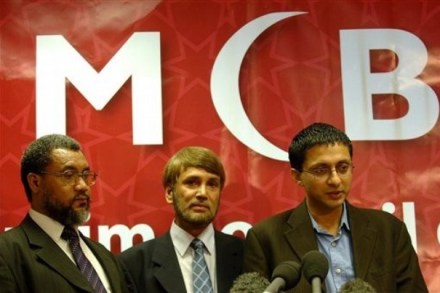
The government has caved in its dispute with the Muslim Council of Britain. The government broke off relations with the group over its deputy director-general Daud Abdullah signing the Istanbul Declaration. Indeed, Daud Abdullah even instigated legal action against the then Communities Secretary Hazel Blears over her statements about what the declaration called for. But now Stephen Pollard is reporting that the government is bringing the MCB back in. A DCLG spokesperson tells Pollard that an MCB commitment to examine “their internal processes and ensure that the personal actions of all members, including senior leaders, remain true to the organisation's agreed policies, avoiding a repeat of the issues which arose after one member signed the Istanbul Declaration...

Boothroyd slams quotas for women and ethnic minority MPs

From our UK edition

Andrew Neil’s guest on this week’s Straight Talk (BBC News Channel – Saturday at 0430 and 2230 and Sunday at 0130, 1530 and 2330) is former Speaker Baroness Boothroyd. There is a delicious anecdote about the time Boothroyd invited herself round to Bercow’s flat and advised him on several weighty matters, but I’ll leave you to discover what was said. With characteristic independence, Boothroyd set herself firmly against the decision to impose, presuming the election doesn’t alter the social make-up of Commons’ membership, quotas on parties to increase the number of women and ethnic minority MPs.

Burnham’s exocet misfires

From our UK edition

The sword of truth is working overtime this afternoon. First, Andy Burnham writes a letter to David Cameron demanding answers about a £21,000 donation from John Nash, chairman of CareUK, to the office of, oh dear, Andrew Lansley. As Paul Waugh notes, a conflict of interest scandal looms here because CareUK is a private firm that makes £400m running GP surgeries and so forth for the NHS. But the truth will out as they say. It turns out that the Chairman of BUPA, Lord Leitch, wasted £5,000 on Gordon Brown’s unopposed leadership campaign. BUPA also does rather well out of the NHS. The indefatigable Waugh has dug up this gem from a speech Leitch made to the Lords: 'When we debate healthcare in the UK, all too often the focus is on the NHS alone.

Surprise, suprise, inflation’s on the rise

From our UK edition

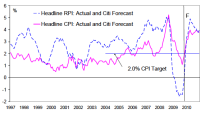
Oops! Britain's inflation is heading back to 4 per cent territory ­ as you'd expect with the Bank of England printing money and using the debt to finance government spending. If you create more money, you reduce the value of the money. Citi has done another brilliant research note, which it is putting online, laying out the implications. The punters are facing pay freezes, or settlements below 2 per cent. The cost of living is soaring. Result: misery. Here are the two graphs from Citi that spell it out. First, inflation (much affected by the VAT hike ­ in the same way that it was artificially reduced by the VAT cut. The resulting inflation was, of course, a great excuse to print money to finance Brown¹s fiscal debauchery.

The cost of saving the Army

From our UK edition

We have led the magazine this week on coming Tory defence cuts, with a brilliant piece by Max Hastings. Look closely at the cover image (our second by Christian Adams) and you can see the guillotine blade will hit he RAF and Navy guys before the Army. This, Hastings argues, will be the effect of the Tory Strategic Defence Review. And even this will leave cuts of up to 20 per cent across the defence budget under the Tories. How could Cameron justify that, in this dangerous world of ours? David Cameron prepares the ground today with an important speech in Chatham House promising “one of the most radical departures in security policy we’ve seen in decades”. He goes on to say that “We need to do much better at stopping wars from ever starting.

The Tories may raid the aid budget to fund the military

From our UK edition

The think tank, Chatham House, is the next venue for Cameron’s intermittent policy blitz. He will unveil his national security strategy, part of which, the Telegraph reports, will enable the government to raid the international development budget to fund military projects. ‘The Conservatives are committed to increasing the international development budget to meet a United Nations target of spending 0.7 per cent of gross national product on aid. However, some Tories believe the party can honour that pledge by counting some spending done by the Ministry of Defence as development aid, since the work of the Armed Forces contributes to the development of countries like Afghanistan.

Google poses Obama a problem

From our UK edition

Google’s decision to publicly confront the Chinese government over cyber attacks that have been hitting Google customers for the past year or so poses a difficult challenge for the Obama administration. The threat by Google to shut down its operations in China over the attacks is the first public acknowledgement by a major US corporation of the attacks which the US intelligence community has known about for almost a decade. The facts are that China has been waging a cyber war against the US government and companies that involve literally millions of attacks each day. Every major US corporation operating in China has been targeted, as have universities, research laboratories and other American companies that have intellectual property worth stealing.

Labour rebels muster to oppose reform of universal jurisdiction

From our UK edition

Martin Bright and the Jewish Chronicle have the scoop that Labour will change the laws so that the power to issue arrest warrants under universal jurisdiction will pass from magistrates to the attorney general. What this means is that foreign politicians will not be arrested in this country for human rights abuses or war crimes without the say-so of the attorney general. The aim is to prevent a repeat of the situation where the Kadima leader and former Israeli foreign minister Tzipi Livni could not visit the UK because of an arrest warrant issued by a magistrate. As I blogged yesterday, there is a Labour revolt brewing over this issue. Martin is hearing that up to 60 MPs might oppose this change so the government will have to rely on Tory support to get this through.

Cutting the Foreign Office

From our UK edition

Spending cuts are coming – we all know that.  And if any party is serious about tackling the debt mountain, then pretty much every department will have to face the axe in some form or other.  But wherever that axe falls, you can expect loud protest in reponse.  Cut the RAF, and a former Chief of the RAF will pop up on TV and say that the cuts will endanger the nation. Rationalise the NHS, and the party responsible will be called heartless. Close the High Commission in Port Moresby, and the newspapers will be full of stories about the historical link between Britain and Papua New Guinea. So to make matters easier for a future foreign secretary, I have decided to have a first go at cutting British legations – i.e. its embassies, high commissions and consulates.

Labour put “guarantees” at the heart of their campaign

From our UK edition

Does Gordon Brown look like the kind of guy who can keep a promise?  Because that's the main question which stands in the way of Labour's election strategy, if Andrew Grice's revelations in the Indpendent are anything to go by.  According to Grice, Labour are going to repeat their trick from 1997, and focus on five or so pledges – what Downing St now calls "guarantees" – during their election campaign.  It's not certain what they'll be yet, but Grice reports that Labour MPs are being instructed to concentrate on the following policies in their constituencies: -- Training or further education will be provided for all school-leavers and a job or training for jobless young adults. -- Suspected cancer patients will receive their diagnosis within one week.