Uk politics

The first opinion poll of the evening is in…

From our UK edition

...and it's from the Daily Express/Opinium. They have the Tories on 35 percent (up 2), Labour on 27 percent (up 1) and the Lib Dems on 26 percent (down 1). So, an 8 point lead for the Tories. I know plenty of CoffeeHousers have had their fill of opinion polls. But, obviously, the shifts and percentages take on an extra piquancy tonight. Tune back later for more.
Translating polls into seats

From our UK edition

There’s an odd disconnect at the moment. Pretty much everyone I’ve spoken to predicts that the Tories will win 300 seats plus (the one exception was someone on the Union side who thought that they could hold the Tories to 280) but the polls show them winning significantly less than that.   Now, this is partly because nobody is sure how you translate votes into seats in a three-way contest. People are also factoring in that the Tory vote is more certain to turn out and that the Tory operation is more confident that it knows where its voters are than the other parties. But it is a testament to how good people think the Tory field operation is that everyone has them getting more seats out of their voters than uniform national swing would suggest they would.

Government in waiting?

From our UK edition

I’m sceptical of the value of newspaper endorsements. Readers are often irritated by being told which way to jump - if you’ve read the letters page of the Times recently you’ll know what I mean. However, the weight of Fleet Street support for the Tories is significant. In addition to the usual suspects, the Sun, the Times, the Financial Times and the Economist have all defected from New Labour since 2005. Today, the Evening Standard joins them, endorsing the Conservatives in a general election for the first time since 1997.

Niall Ferguson: Britain should call the IMF now

From our UK edition

Should David Cameron just call the IMF immediately? Like, on Monday? This argument has been doing the rounds in Tory circles and tomorrow's Spectator has an important contribution from Niall Ferguson. He advises that Cameron takes a two-pronged approach. Prong one is to 'axe ruthlessly' and prong two is to call the IMF. He says: 'There is a very real danger that [things] could now spiral, Greek style, out of all control if foreign confidence in sterling slumps and long-term interest rates rise. Mr Cameron needs to do two things right away. He must instruct George Osborne to wield the axe ruthlessly with the aim of returning to a balanced budget over a credible eight- to ten-year timeframe.

Brown’s survival instincts

From our UK edition

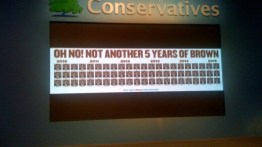
Alas, and most reluctantly, you've got to hand it to Brown: he's a scrapper. Just watching coverage of his speech in Bradford now, and he seems to be on punchy form.  The message is stridently negative, of course.  And he has entrenched himself, as David noted earlier, back behind the old "investment vs cuts" line (although now he calls it "selfish individiualism over public investment").  But this is clearly where the PM is happiest and at his most comfortable.  Aggressive clunk is simply what he does best. The question hanging over the dying stages of the campaign is this: will the negativity cut through?

EU revises British economic forecasts up

From our UK edition

Faisal Islam has the story that the EU has revised Britain’s economic prospects up to 1.2 percent in 2010 from 0.9 percent. Next year, the EU predict to 2.1 percent, the highest of major European nations. Is this a crumb of comfort for Brown? Well yes, but the EU’s predictions are still someway off Alistair Darling’s forecasts. His growth prediction for 2010 is in the region of 1 percent to 1.5 percent, which is closer than his predictions for 2011, when he expects GDP to increase by 3 percent to 3.5 percent. In any event, the upgraded figures are probably too small to shift the polls at this stage.

The Tories would have to rely on the DUP in the event of a hung parliament

From our UK edition

Reg Empey may yet oust the DUP’s William McCrea in South Antrim, but the indications are that the UUP and Tory alliance will not win a seat. The Tories will have to rely on co-operation with the DUP. In truth, competition between three Unionist parties has left the Unionist cause divided. The TUV’s Jim Allister is giving the DUP’s Ian Paisley Jr a close race in North Antrim. Robinson’s DUP will emerge the largest Unionist party in Ulster, but with a point to prove to voters who are keen to protect Northern Ireland’s bloated public sector and generous funding. Conservative he may be, but Robinson is an Ulsterman first and foremost and has the most to gain by securing what's best for Northern Ireland.

Deceitful Brown returns to the old dividing line

From our UK edition

Labour’s campaign becomes ever more like The Prisoner. Every time the plot seems decided, it veers-off in the contrary direction. The Prime Minister was interviewed by The Times yesterday and I feel for those who conducted it, stuck in the vortex of what Gordon will say next. If you cast into the recesses of memory, you’ll recall that yesterday morning was tactical voting morning. They were all at it – Balls, Brown, Alexander and Hain. If you’re yellow threatened by blue, vote red; if you’re red threatened by blue, vote yellow. It was so confusing I half expected them to endorse blue if you’re red threatened by yellow. That was yesterday morning. By mid-afternoon Brown did what he does best. He changed his mind.

An economic coalition makes political sense

From our UK edition

If you believe, as most people probably do, that Robert Chote of the Institute for Fiscal Studies and Mervin King of the Bank of England should be listened to, then two conclusion emerge: one, that a new government’s budget-slashing will be far, far worse than anything the main parties have hitherto acknowledged; and that after a parliament of deficit-busting, the party in charge will be severely punished by the voters. It stands to reason, therefore, that it would be better to spread the pain, even if one party has a near-majority or an outright majority.

The campaign money game

From our UK edition

Here's a minor turn-up for the political anoraks' scrapbooks: donations to Labour outstripped those going to the Tory party in the third week of the campaign. Brown & Co. were handed £1,416,863 against the Tories' £645,250. Which is no sign of an effective campaign - after all, almost all of Labour's publicity has been heavily negative. But it is a turnaround from the first week, when the Tories received £1,455,812 to Labour's £783,159. Another thing to note is the downturn in Lib Dem donations. They jumped up to £120,000 in the second week, but have now sunk back to £64,000.  The Tories, in particular, will be hoping that that represents a slowing of the Nick Clegg bandwagon.

The Tories’ final onslaught

From our UK edition

"Where's the popcorn?" I thought, as I joined a bunch of journos to watch the Tories' final broadcast of the election campaign. It was a good nine minutes long, and might as well have been titled The Downfall of New Labour. The opening shots were of Blair and Brown in 97: "a new dawn," and all that. But Blair's image soon faded to black-and-white, and we were bombarded with a montage of headlines, quotes and images which highlighted the failures of the Labour years. 10p tax. Falling education standards. MRSA. The misdemeanours of Peter Mandelson. Defence spending. Purnell's resignation. Gillian Duffy. Even Manish Sood's comments today. Depending on your disposition, it was all gorily nostalgic stuff. Negative, yes. But quite powerful nonetheless.

How is it strange that only British citizens can vote in British elections?

From our UK edition

Michael Crick has just blogged about a ‘strange quirk in the British political system.’ Writing about a Lib Dem councillor he says ‘interestingly, because she is a Danish citizen, double-councillor Lockington isn't just disqualified from standing as a candidate in the coming general election, she can't even vote in it.’ But what seems strange to me is the idea that people who aren’t British citizens should be able to vote in a British general election. PS I should, of course, point out that Irish citizens can vote in UK elections because of a reciprocal agreement made at the time of the foundation of the Irish Republic, which the Irish then reneged on. Commonwealth citizens resident in the UK can also vote.

Osborne backs Crossrail

From our UK edition

George Osborne sounds a more confident note than most of his Tory bandmates in interview with the Standard today.  On top of the obligatory Ready for Government noises, he rattles off a list of London marginals which are winnable for the Tories, and adds that an overall majority is "within our grasp".  Pretty direct stuff for a politician, given all the uncertainty clogging the air in Westminster. To my eyes, though, the most significant passage could be this: "He gave a commitment to keep London's £16 billion Crossrail scheme, although he confirmed he will look for savings. 'I think Londoners would expect me to get good value for their money.

The Ulster effect

From our UK edition

The electoral map that most of the broadcasters use misses off Northern Ireland entirely. But if the election is as close as people expect, then those 18 seats across the Irish Sea could become vital.   The first thing to note is that Sinn Fein remains committed to its policy of not taking its seats at Westminster. So every Sinn Fein MP elected reduces the number that a party needs to have an effective majority in the Commons. Iris Robinson, expenses and the rise of Traditional Unionist Voice have all rather dented the DUP, the largest party in Northern Ireland at the last election. But it should still send back a fair few MPs.

Will the tactical voting plea work?

From our UK edition

There's only one question which matters when it comes to Labour's tactical voting plea: will it work?  You can certainly see Brown & Co's thinking on this.  This is the election, after all, where the Lib Dems have become a viable option for a lot more people - so they might act as a speed bump for people rushing away from Labour and towards the Tories.  And anything which depresses the Tory vote gives Labour a greater chance of holding the most seats in the House, and of making some kind of post-election pact with Nick Clegg. But as David said earlier, Labour's osciallating stance towards the Lib Dems - lofty sneers one minute, sickly grins the next - is hardly convincing.  And neither is the timing.

Labour PPC: Gordon Brown is the worst Prime Minister ever

From our UK edition

At last, the election has thrown up a real character. Manish Sood, Labour PPC for North-West Norfolk, has told the Lynn Newspaper: ‘Immigration has gone up which is creating friction within communities. The country is getting bigger and messier. The role of ministers has gone bureaucratic and the action of ministers has gone downhill – it is corrupt. The loss of social values is the basic problem and this is not what the Labour Party is about. I believe Gordon Brown has been the worst Prime Minister we have had in this country. It is a disgrace and he owes an apology to the people and the Queen.’ There is a further act in the farce. Mr Sood campaigns on the imaginative ticket of 'taking Britain back to the 1970s.

From carpet-bombing to love-bombing

From our UK edition

Labour’s relationship with the Lib Dems gets more like Dallas’s JR and Sue Ellen with each passing day. Contemptuous and contemptible one day to lisping breathless compliments the next.  Gordon Brown snarled at Nick Clegg during last week’s debate. Clegg would, Brown argued, leap gaily into bed with the Tories on Friday morning - a departure from the previous ‘we must form a progressive coalition’ line pushed by Andrew Adonis. This morning brings another volte face: Brown and several cabinet ministers urge ‘progressives’ to vote tactically. Writing in the Guardian, Gordon Brown pitches for Lib Dems to vote Labour in 100 Tory/Labour marginals.