Uk politics

Don’t forget the Party, David

From our UK edition

Days, perhaps only hours away from the expected announcement of a Con-Lib deal, the Tory party rank-and-file is getting increasingly restive. Many MPs and party activists do not feel that Team Cameron has been sufficiently attentive to them and their concerns. They look longingly at the Lib Dems, whose democratic set-up enables MPs and party members to make their views known to Nick Clegg and the leadership. In a Tory party that has always favoured single-minded leadership, the options for representing rank-and-file views are few, particularly as the chairmanship of the 1922 committee remains vacant. As a result, many senior MPs have been reduced to calling hacks to find out what is actually going on.

A long day’s journey into night

From our UK edition

Sky News are reporting that Brown is to hold a meeting with Cabinet ministers tonight. Lord Ashdown made it pretty clear on Andrew Marr this morning that there would be no 'progressive coalition' with a Labour party that has been comprehensively rejected at the polls, and which would rely on backroom deals with celtic nationalist parties prepared to sell their support for a measure of protection from necessary spending cuts. You'd have thought that tonight's meeting is the beginning of the end for the Labour government.

Swords around a throne

From our UK edition

The Sunday Times reports that the Cabinet is suggesting to Gordon Brown that he resign as Prime Minister, and that Labour goes into opposition against a weak Conservative government facing an unenviable economic task. The ‘Caretaker Prime Minister’ did not fly to Scotland to consider a re-shuffle, though that would have provided some light entertainment. And his swift return to London this afternoon suggests that Brown’s premiership is gasping its dying breaths. With the exception of a brief lapse on the telephone, Brown’s conduct has been dignified in recent days. For once, he has led. Will he remain as Labour leader if he resigns as PM? He might; he's stubborn whilst the pretenders to his crown are lachrymose. Tactical considerations also favour Brown.

Cameron’s Clause 4 moment

From our UK edition

David Cameron never really had a Clause 4 moment. True, the Conservatives never believed anything so absurd as socialist economics. But the fact that he never had a genuine dust-up with his party made many voters think that he had rebranded but not reoriented them. In the end, it made many would-be supporters wary of voting Tory. Now, the Tory leader may have a Clause 4 moment thrust upon him by virtue of the Lib Dem talks. For if a Con-Lib pact is to be made, it will include a lot of things the party finds unpalatable. Like Tony Blair's experience with the Labour Party over the Clause 4 discussions, some in the Conservative party will try to hold out against a coalition agreement and any compromise on Tory policies.

Where are Labour’s manners?

From our UK edition

For all the feverish political activity in Westiminster today – and beyond the occasional voting reform protest – there's a strange, impermeable calm to the situation.  Everything is going on behind closed doors, and everyone is remaining relatively tight-lipped.  Signs are, we may have to wait a couple of days before any light breaks through the fog of discussion and counter-discussion.   One thing, though, is already becoming increasingly clear: 13 years of tribalism haven't done Labour much good when it comes to cross-party negotiations.  There are, of course, the rumours that Gordon Brown had an – ahem – "unconstructive" meeting with Clegg last night.

It’s obvious that Brown’s the impediment, why doesn’t Labour strike?

From our UK edition

Well, Brown the Statesman was a short-lived incarnation. The BBC reports that Brown and Clegg exchanged ‘angry words’ yesterday evening and that Brown delivered a characteristic private political conversation: ‘a diatribe laced with threats’. Clegg and Brown simply cannot work together. This inability to put aside personal differences is far from magnanimous of both men, but it is plain that Brown no longer commands the authority to shape the nation’s future. If there’s no hope of a Lib-Lab coalition with Brown at the helm, then the knives will be sharpening - again. From Labour’s perspective, delaying the inevitable would be fatal as it gives Cameron more time to negotiate with Clegg knowing that he is Clegg’s only option.

Electoral reform is the deal maker

From our UK edition

Former Tory MP and current associate editor of Conservative Home, Paul Goodman, has analysed where Cameron and Clegg can accommodate one another. It’s a must-read and gives enough hope that Cameron and Clegg may ally to keep a thoroughly discredited Labour party from office. The Tories and Lib Dems share common ground on the bland areas of policy; and, as one expects, they diverge over more contentious issues. Much is made of Clegg and Cameron’s passion for all things green and renewable. This encompasses such thrilling pastures as home insulation, carbon capture and emissions targets. The grander aspects of energy policy will necessitate accommodation through compromise. Does Britain’s energy security lie in nuclear power or a European supergrid?

The need for speed

From our UK edition

The markets have spoken, and they’ve done so with menace. The FTSE 100 closed down 138 points, which, though not a complete disaster, is far from encouraging. You might argue that the multinationals that comprise the FTSE 100 are more affected by the fortunes of international markets and commerce. Whilst that’s true it must be conceded that there is little comfort in the FTSE 250, a figure that provides a closer expression of domestic economic confidence, which closed down by 410 points. At the time of writing, Sterling, another bellweather indicator, is mired. The Pound is worth $1.47, and at one point it was at its lowest level against the dollar for more than a year. The Pound is also at a 6 month low against the imploding euro.

A deal that would kill Gove’s agenda at birth

From our UK edition

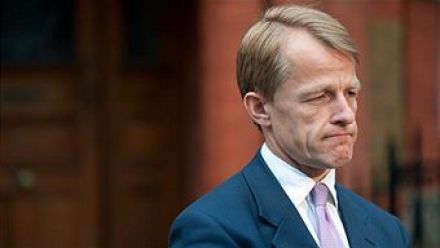
While both the Conservatives and LibDems support the idea of Swedish schools, a Lib-Con deal could kill the agenda stone dead. David Laws is proposing to allow local authorities to have the power to veto new schools – which would, in effect, mean no rollout. As we all know, this could strangle the Gove school agenda at birth. Local authorities, whether Labour or Tory, will hate the idea of competition in the provision of education. The local authorities and teachers’ unions are incredibly powerful, and defeated Thatcher, Adonis and Blair. They have also nobbled the LibDems to the extent that, I understand, David Laws believes that he could not get rid of the local authority veto. His party, and the special interests it represents, would not let him.

Cameron offers the hand of coalition to the Lib Dems

From our UK edition

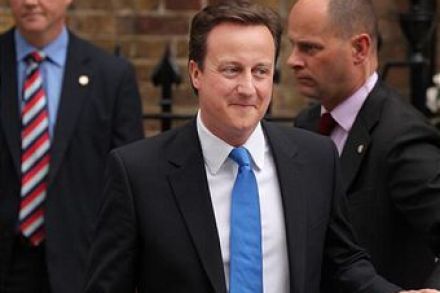
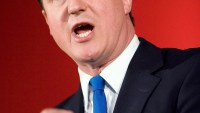
Woah, I didn't think Cameron would go that far.  In his statement just now, the Tory leader started off by talking about minority government, as one might expect.  But he soon skipped past that, and onto what sounded like a more formal coalition with the Lib Dems.  He called it the Tories' "Big Comprehensive Offer". This offer trumped the one that Brown put forward ealier by virtue of its clarity.  Where Brown had hints and innuendo, Cameron had an itemised list of policies and specifications.  And so the Tory leader set out the areas where he wasn't willing to compromise with the Lib Dems: Europe, cutting the deficit and immgration.

Brown sets out his stall for the Lib Dems

From our UK edition

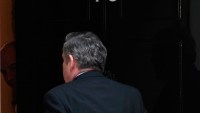
Gordon Brown's statement outside Number 10 just now was a strange mix of statesmanship and salesmanship.  He began by trying to sound as reasonable as possible: claiming that he "understands" why Nick Clegg would like to meet with David Cameron first, and adding that he would happliy wait for them to finish their negotiations.  He claimed that he is keen to "resolve the situation for the good of the country."  And he mentioned that Alistair Darling would be attending various meetings about the spreading fiscal crisis in Europe. But then, about halfway through, he flipped into used car salesman mode – hawking his rusty party to a sceptical Nick Clegg.

The situation is ominous for Gordon Brown

From our UK edition

Let's just consider three of today's events: i) Gordon Brown has led his party to Michael Foot-era levels of support. ii) Peter Mandelson has very publicly knifed his boss on national televsion. And, iii) Nick Clegg has said that the Tories have the "first right" to form a government. Senior Labour figures are suggesting that a deal with the Lib Dems remains possible – but Brown's fingernail grip on the premiership looks to be weakening by the minute.

Nick Clegg gives the Tories the go-ahead

From our UK edition

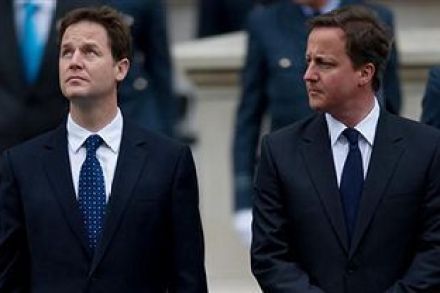
So Nick Clegg has finally spoken – and his words will be welcomed by the Tories.  In an address outside of the Lib Dem HQ on Cowley St, he reiterated his previous argument that "whichever party gets the most votes and the most seats, without gaining a majority, has the first right to form a government."  But added that "it seems this morning that the Conservative Party have the most votes and the most seats ... it is for the Conservative Party to prove that it is capable of governing in the national interest." What this means in practice isn't 100 percent certain – although it doesn't sound good for Labour.

There may be Tory trouble ahead

From our UK edition

Will the 1922 Committee of Tory MPs elect an emergency chairman today? If so, the mission would be to warn Cameron off doing any deal with the LibDems. Most Conservatives will wake up today judging the Cameron campaign to have failed. In the view of many, he will have failed to honour his "change to win" promise: they all changed, as he asked, but he didn't win. There will be a price to pay, and perhaps one of the heads around Cameron will have to roll to assuage the discontent. Any Lib-Con deal over voting reform will be anathema to many recently-elected as well as existing  Tory MPs. A new chairman of the 1922 Committee will want to make this point to Cameron before any damage is done. A deal with Northern Irish MPs would probably be as much as the party would wear.

Peter Mandelson is open to the idea of Brown going

From our UK edition

Peter Mandelson has just tossed a firecracker in to the arena.  Asked on the Beeb whether Labour might get rid of Brown to accommodate the Lib Dems, he replied: "There will be a number of permutations ... I'm not ruling anything in, or anything out." So, in other words: yes.

Let the recriminations begin

From our UK edition

Let's rewind to 10pm yesterday evening, when the exit poll was released.  Most politicos - myself included - were incredulous.  We could just about believe that there might be a hung Parliament with the Tories as the largest party, but a reduced number of Lib Dem seats?  After Cleggmania and all those recent opinion polls?  Gedouttahere. But, this morning, that exit poll is looking a good deal more prescient.  After an evening of erratic results, Sky's projection matches it almost exactly: 309 seats for the Tories, 259 for Labour, and 54 for the Lib Dems.  So we're on for a hung parliament, and all the backroom discussion and subterfuge that that entails. Already, the dividing lines have been traced across Westminster.

Election Night live blog

From our UK edition

0843, JGF: The result in Hampstead and Kilburn is remarkable. The local Lib Dems were convinced that they would win. But Glenda Jackson survives by 42 votes with the Tories in second. 0639, PH: A dejected sounding speech from Nick Clegg. 0638, PH: Clegg says "this has been a disappointing night for the Lib Dems - and we obviously didn't achieve what we hoped to achieve." 0637, PH: In his acceptance speech, Nick Clegg is going big on the voting problems of last night. 0634, PH: Some good news for the Lib Dems: erm, Nick Clegg holds in Sheffield Hallam. With an increased majority. 0620, JGF: Jon Cruddas holds on, he'll have a big role to play in the Labour party machinations of the last few days.