Uk politics

Will Osborne be vindicated in 2015?

From our UK edition

VAT, VAT, VAT – but what's this? The main headline on today's FT doesn't mention the sales tax at all, and the piece below it only does so in passing. Instead, a declaration that "UK austerity measures [are] expected to pay off," based on a survey of economists conducted by the paper. Although those polled have concerns about inflation and the eurozone, only 13 percent say that George Osborne needs a Plan B for dealing with the public finances. As always, we shouldn't place too much stock in this kind of thing. Some economists will back the coalition, others will back Labour; some will be right, others will be wrong. But, today of all days, the coalition will appreciate a presentational leg-up such as this.
There is no reason to raise VAT

From our UK edition

It is very clear that the government cannot carry on borrowing at current rates and the coalition’s proposals for reducing government borrowing are prudent. However, today’s VAT rise is unnecessary. As has been said before, we did not get into this situation because the government taxes us too little. Ever since Gordon Brown abandoned his self-imposed restraint in 2000, government spending, financed mainly by stealth taxes and increased borrowing, has expanded rapidly to its current level of over 50 percent of national income. As such the whole of the balance of fiscal adjustment should come through spending cuts. The coalition’s spending reductions have reflected political expediency, not sound economics.

Boles beats his old drum

From our UK edition

To accompany Fraser’s suggestion that Cameron and Clegg are planning a merger, it is notable that the ubiquitous Nick Boles has renewed his calls for a formal pact. Previously, Boles averred that Liberal Democrat ministers should be protected in three-way or Conservative-Liberal marginals. This time round, his argument is more philosophical. He told Radio 4’s PM: ‘The Coalition has enabled the Conservative party to be more radical than it would have been able to had it formed a government on its own with a small majority... Jacob Rees Mogg who’s a fellow MP who’s certainly not a sort of liberal Tory like I am in the sort of modernizing sense.

Wrong to be too Right

From our UK edition

From a right-wing perspective, there are several things wrong with David Cameron's leadership - not least the fact that he did not win the 2010 election outright. As an unassailable report by Lord Ashcroft showed, the Tory campaign squandered a historic lead over Labour. The policy disagreements - over the EU, civil liberties, and the AV referendum - are compounded by personal grievances. The Prime Minister, despite investing quite a lot of time placating quarrelsome  MPs - calling them, writing them letters, inviting them to No 10 - cannot shake the impression of a man who is buoyed by confidence verging on arrogance, and someone who is reliant on - indeed most comfortable with - a small, largely unelected group of friends.

Miliband swings into action by warning of inflation

From our UK edition

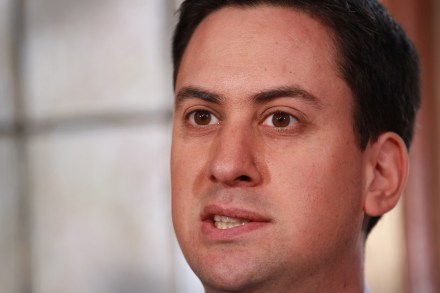
The seasonal interlude has ended and Ed Miliband is sallying north to Oldham East. He will resuscitate old favourites from 2010: progressive cuts, fairness and a government bent of an ideological mission: but he will illustrate his point with reference to tomorrow’s VAT rise. Miliband will say: ‘Today we start to see the Tory-led agenda move from Downing Street to your street. At midnight VAT goes up, hitting people's living standards, small businesses and jobs. The VAT rise is the most visible example of what we mean when we say the government is going too far and too fast, because it's clear that it will slow growth and hit jobs.’ And he will add that the ordinary voter’s wallet will be £389 lighter by the end of the year, courtesy of the rise.

Is it a merger?

From our UK edition

When a Conservative leader wishes the LibDems well in a three-way marginal by-election, then what is going on? Andrew Gilligan’s piece today shows that the Conservative campaign there is muted, and my colleague Melissa Kite reported earlier that Cameron personally called off  the hunt supporters, Vote OK, who were planning to boost the Tory campaign. Little wonder that Conservative MPs are beginning to smell a rat. They are being told this is the cohabitation of rival parties; in the Daily Telegraph tomorrow, I ask if this is actually a merger.   From the start of this coalition, I’ve been struck by the differences between the coalition in Westminster, and that I witnessed during my tour of duty in the Scottish Parliament.

Control Orders: a pyrrhic victory for the Lib Dems?

From our UK edition

Coalition is a tricky business, full of compromise and connivance. Emblazoned across the front page of the Sunday Times (£) is the news that Control Orders are to be scrapped. A victory for Nick Clegg, we are told, won to nurture wounded Liberal Democrats and preserve the coalition. The Liberal Democrat 2010 manifesto maintained that Control Orders would be abolished and many senior Liberal Democrats have been volubly opposed to Lord Carlisle’s report into Control Orders, which was understood to propose their retention. Certainly, Nick Clegg needs an outright victory on policy.

Ed by numbers

From our UK edition

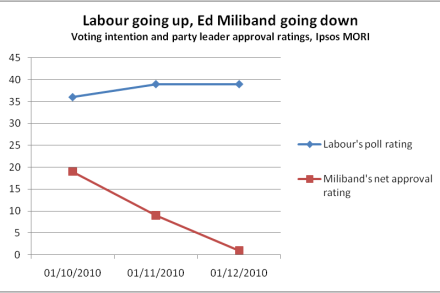
Ed Miliband’s leadership trundles on past the hundred day milestone tomorrow – so more on that, erm, then. But, in the meantime, here’s a quick graph transcribed from Ipsos MORI’s latest research. It depicts what, for want of a proper policy prospectus, is one of the most striking features of the Miliband era so far: that Labour’s support has risen while their leader’s personal ratings have slumped, reaching what today’s Mail describes as the “lowest of any new party leader at the same stage since former Tory leader Iain Duncan Smith,” and lower even than his biggest fan, Neil Kinnock. Here it is:   To be fair, that still puts Miliband ahead of Nick Clegg.

Rising costs: a problem for the public and the coalition in 2011

From our UK edition

Ne’er mistake correlation with cause, I know. But, during the Brown premiership, the correlation between petrol prices and poll ratings was still pretty striking. Mike Smithson graphed it early last year, but the basic story was this: the Tories enjoyed their biggest poll lead over Labour when petrol prices were at their highest, and Labour closed the gap to only 1 percent when petrol prices were at their lowest. At the very least, it gives us a hypothesis to work from: prices up, the government suffers; prices down, the government recovers. And it looks as though we’ll be able to test that hypothesis soon enough. Today’s Express reports that – thanks to rising VAT, fuel duty and oil prices – petrol may soon soar to £1.40 a litre.

A handful of predictions

From our UK edition

Here we go. Spurred on by Pete earlier, it's time for that essential, although often regrettable, end-of-year ritual. Not the prosecco-fuelled partying, but rather something with far more embarrassment potential: predictions for next year. That's right, amateur guesswork dressed up as serious-ish journalism. Some scribes are better at this than others. Ex-blogger Iain Dale hit the nail on the head by predicting the election of Ed Miliband as Labour leader. In a German aquarium, Paul the Octopus nailed all eight of his predictions for the 2010 World Cup in South Africa. By contrast, Mike Adams from NaturalNews probably ought to stop trying to channel Nostradamus. Last year, he predicted that nuclear weapons would be unleashed in the Middle East.

Cameron and Miliband’s New Year message: 2011 will be like 2010 

From our UK edition

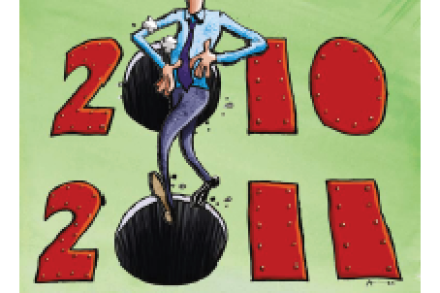
If you want to know what British politics will sound like in 2011, then just read David Cameron’s and Ed Miliband’s New Year messages one after the other. They share a lot of the same words, but bounce along to different, if familiar, drumbeats. According to Cameron, next year will be “very difficult,” due to the effort of “putting our economy ... on the right path”. According to Miliband, next year will be more difficult than it needs to be, due to “the decision taken to reduce the deficit at what I believe to be an irresponsible pace and scale.” In other words, cuts versus fewer cuts. Just like 2010 all over again.

What are your predictions for 2011?

From our UK edition

New Year’s Eve, a time to dwell upon Things to Come – so I thought I’d mine CoffeeHousers for their predictions for 2011. We went through the same process with some friends of The Spectator for the recent Christmas issue, and I’ve pasted their responses below to get you started. And that’s not all: the most amusing prediction, to be chosen next week, will win its author a bottle of Pol Roger. The comment section is, as always, yours. Dame Eileen Atkins I hope we start getting education right. Michael Gove is correct when he says we should go back to an emphasis on five basic subjects: English, maths, geography, history and a foreign language. These should not be purely the province of the naturally academic.

A debt-filled New Year

From our UK edition

The Spectator is out today, with a cover story that I would commend to CoffeeHousers. Failure to learn from history usually condemns a nation to repeating its mistakes. That's why we should be nervous that no one seems to have worked out what caused the crash. Little wonder: the guys doing the analysis are the same guys who failed to spot the crisis building up, so it suits everyone to blame the banks. "How was I to know," says everyone from Gordon Brown to Joe the Pundit, "that they were doing all these complex debt swap thingies? They deceived everyone, the bounders." There is another analysis – and it's our cover story, written by Johan Norberg.

In Cote D’Ivoire, New Year may bring a new Africa

From our UK edition

The situation in Cote D'Ivoire is heating up. It has the potential either to herald a new future for West Africa, based on democracy, regional cooperation and a rejection of ethnic mobilisation; or to showcase the continent's violent and undemocratic past. Hitherto there have been signposts pointing in both directions. On the one hand, Laurent Gbagbo is clinging on to presidential power, after having been in office for ten years on a questionable mandate. Willing to politicise the army and exploit ethnic differences, his strategy is straight out of the continent's "big man" playbook of politics. On the other hand, Alassane Ouattara, the country's rightful leader, has refrained from using playing the ethnic card.

The momentum shifts

From our UK edition

Yesterday’s announcement that 114 Labour MPs, including 5 shadow cabinet ministers, will be voting ‘No’ in next year’s Alternative Vote referendum isn’t exactly a ‘game changer’. But it has certainly shifted the terms of debate within the Labour party. Over the past few weeks a perception had been developing that adoption of the AV system, whilst not generating unparalleled excitement and passion within Labour ranks, was at least becoming the line to take. That perception has now changed. Labour’s internal stance on the issue is important. Labour supporters effectively represent the referendum’s ‘floating voters’.

This year’s biggest story

From our UK edition

This year was so rich in stories - Expensesgate, the election and historic coalition, the Icelandic volcano, General McChrystal's dismissal, the Pakistani floods, Haiti's earthquake, Greece's near-collapse, the Will n' Kate engagement, Wikileaks, the Chilean miners and so on - that it is hard to pick just one story. Looking back over the year, however, I think two stories stand out - because they may herald a seismic change.  The first is, of course, the establishment of coalition. By now, the novelty of government by cross-party compromise has worn off. But, despite the gossipy complaints of a few Lib Dem ministers, a new kind of politics is being forged.

Ed Miliband’s party reforms are purely presentational

From our UK edition

Ed Miliband’s proposal to cap party donations at £500 – thereby restraining the huge one-off union payments that sustain Labour – certainly looks radical enough. But, as any fule kno, surface appearances can be deceptive. As Jim Pickard explains in an insightful post over at the FT, the result would be a system that affects the other parties far more than it does Labour and their union support. The trick is crystallised by this passage from the original Independent report: “One reform option would be to treat Labour’s income from union members who pay the political levy as individual donations. This helps to fund the party’s day-to-day spending.

David Miliband’s options

From our UK edition

Downing Street may  have dismissed as “complete nonsense” a newspaper report that the coalition was considering inviting David Miliband to become British ambassador to Washington. But the former foreign secretary is one of a few younger British politicians with international standing and while it would be odd to appoint him to a government job – and stranger still for him to accept -- the coalition should consider putting him forward for a number of international assignments. Potential jobs include the international community’s “high representative” in Bosnia; as a UN envoy to Yemen; or as the representative of the Friends of Democratic Pakistan.

Government by signature

From our UK edition

Remember this petition to have Gordon Brown resign as Prime Minister? It secured 72,222 signatures in the end: not quite enough to have it debated in Parliament under the coalition’s new plans, but enough to make you think. I mean, will we see parliamentary debates about whether Dave and Nick should step down at the public’s request? Not going to happen, I’d say. But these latest ideas for involving voters in the legislative process could certainly provoke one or two embarrassments for our political class. Take the obvious example of withdrawing from the EU: that petition could probably attract any number of votes, but is unlikely to be met positively by Parliament. Ditto an entire spectrum of political matters, from MPs’ pay to immigration.

Labour’s first manifesto commitment for 2015

From our UK edition

Courtesy of Alan Johnson's interview in the Independent today: "Both [Ed Miliband and Johnson] have accepted that it is 'inconceivable' that the 50p tax rate won't be needed at the time of the next election." Or, in other words, Johnson and Miliband have reached compromise over their divergent positions on the 50p rate.