Uk politics

Clegg turns his attention from the students to the banks

From our UK edition

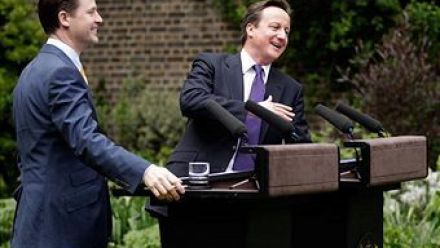
'Tis the season to bash a banker – or it is if you're a Lib Dem, at least. After the stresses of last week, Nick Clegg lets off steam with an aggressive interview in the FT. "They don't operate in a social vacuum," he says of the City's moneymen, before seething that, "it is wholly untenable to have millions of people making sacrifices in their living standards, only to see the banks getting away scot-free." He even suggests that the government should consider a one-off bonus tax, like that introduced by Labour last year.   Will anything come of it? On the evidence so far, probably not. The coalition – from Vince Cable to George Osborne – has certainly not shied away from tough rhetoric on lending and bankers' bonuses.

MPs’ February fear

From our UK edition

When you talk to MPs about the new expenses’ regime there are a whole variety of grumbles you’ll hear, many of them reasonable. For example, it does seem silly that all MPs buy their own printer ink cartridges rather than the Commons buying a job lot and using bulk ordering to obtain a discount. But one of the things that really bothers them is that IPSA will publish all the refused expenses’ requests in February. Now, I expect that most of you think this is reasonable. But MPs do have a point that the way IPSA logs these things means that any enquiry about what you are or are not allowed to claim comes across as an attempt to claim.  David Cameron is being pulled two ways on expenses. His MPs wanted the system changed—and fast.

Johnson’s economic education

From our UK edition

When he took on being shadow Chancellor, Alan Johnson said that he would need to get hold of an economics primer. Judging by his comments in yesterday’s debate about the bi-lateral loan to Ireland, he hasn’t got that far into it. Johnson told the House, ‘The euro had nothing to do with the [Irish] property boom and bust’. This is a bizarre statement. If Ireland had been able to set its own interest rates, they would have been far higher and thus dampened down the property boom.

Miliband’s Oldham dilemma

From our UK edition

Joy. It will be a campaigning Christmas, now that the Oldham by-election is likely to be held on 13th January. The Labour party is much exercised. The permanently outraged Chris Bryant says it is a ‘disgrace’ that politics will sully the ‘major Christian festival of the year’ – the lapsed cleric seems to have forgotten the election’s proximity to Easter. More importantly, fewer students will be in Oldham on 13th January to serve ‘judgement’ on the government, as Hilary Benn put it in the Commons this morning before adding that the government is ‘running scared’. By-elections are determined by local issues, as one would expect.

Keep the central planners away from energy policy

From our UK edition

Today, the government publishes its consultation proposals for reform of the electricity generation market. The key debate over the next few months will be whether Britain continues to have a competitive market, or reverts to central planning of the power generation sector. New Labour paid lip-service to a competitive electricity market, while chipping away at its ability to operate effectively – through a constant accretion of new policies, typically promoting renewables. The effect has been to salami-slice the market into technology-specific segments, to increase political and regulatory uncertainty, to encourage lobbying and rent-seeking, and to increase financing costs.

Ainsworth has a point

From our UK edition

Much ado about Bob Ainsworth this morning, and his views on drug policy. The former defence secretary, and a junior Home Office minister under Tony Blair, has become the most high profile political figure to call for the legalisation of drugs. Or, as he put it: "It is time to replace our failed war on drugs with a strict system of legal regulation, to make the world a safer, healthier place, especially for our children. We must take the trade away from organised criminals and hand it to the control of doctors and pharmacists." To my mind, this is a welcome intervention. It's not that the case for legalising drugs is completely watertight – it isn't.

Miliband out of the danger zone

From our UK edition

Up, up, up! It was the only way he could go. For the last couple of months Ed Miliband has arrived at PMQs like a hapless fag with his bottom ready-stripped for a ritual flogging from Flashman. Today he made a proper fight of it. This was his best PMQs performance since his debut. He’s been studying the old masters. Long-term followers of PMQs will have recognised William Hague’s favourite battle-plan today. In football it would be called ‘pass-and-go’. You ask a question. Then dismiss the answer as inadequate. Ask a second question. Dismiss the second answer as inadequate. Move to a third question while pointing out, in parenthesis, that your interviewee is making a habit of not giving proper answers.

The Spectator’s Christmas interview with George Osborne

From our UK edition

The Christmas Special of The Spectator is out today, and George Osborne kindly agreed to an interview. We have printed 1,500 words in the magazine, but James and I thought CoffeeHousers may like a fuller version, where he has more space to speak for himself.  We have gone into way more detail on tax policy here than in the magazine, for example, as Osborne is seldom pressed on this point and his thoughts are very interesting. We have divided it up by subject headings, so CoffeeHousers can skip the chunks they’re not interested in.   Liberty, paternity and Treasury It is an exciting day for Liberty Osborne, the Chancellor’s daughter, to join him at work.

Why education should be for profit

From our UK edition

Michael Gove’s free schools programme has been heralded as the cutting edge of the coalition’s structural reform programme. Removing the dead hand of the state and allowing new schools to emerge makes the Big Society project tangible at least. But already – and unsurprisingly – the reforms are running into difficulty. By the end of the summer, only 62 schools had applied for “free school” status. They will all be run on a not-for-profit basis. Perhaps, just perhaps, this is the start of a cascade. But it’s doubtful. If you want real innovation and improvement in the educational sector, people need to be able to make money out of it. That would surely bring about a flood of exciting, new entrants to the market.

The anti-Clarke campaign is gaining momentum

From our UK edition

After months of whispered asides, Theresa May cut loose yesterday and expressed what may on the Tory right (not to mention Labour’s authoritarian elements) feel: Ken Clarke’s prison proposals are potentially disastrous. Prison works. Tension has built to its combustion point, but there is no apparent reason why May chose this moment. Perhaps she was inspired by the persistent rumours of Cameron’s displeasure with Clarke? Or maybe the cause was Michael Howard’s smirking syntax as he denounced Clarke’s ‘flawed ideology’ in yesterday’s Times? Either way, the campaign to move Clarke sideways in a Christmas reshuffle is gaining momentum.

Talking point: the West Lothian question

From our UK edition

Political Betting carries this table on the breakdown of the tuition fees vote. English Lib Dems were noticeably more loyal than their Celtic counter-parts (only 16 of 43 voted against the bill), which reflects the left-wing political focus in those regions and perhaps the divide in the Liberal Democrat party itself. But, clearly, the West Lothian question is at issue here. Personally, I’m swayed by the argument that the new fees arrangement will affect applications to Scottish universities and therefore it is the business of Scottish MPs. That higher education was devolved in the first place is another, more interesting debating point. The comments section is yours...

Reid: essentially, Miliband’s not fit for purpose

From our UK edition

John Reid made a bruising and quite extraordinary appearance on the Daily Politics earlier today. He demolished the Labour leader. Reid’s analysis was concise: there has been a vacuum at the heart of Labour since Tony Blair’s departure. Gordon Brown was divisive, at best, and clearly not up to the demands of leadership. And, Reid intimated, Brown's child shares his father’s foibles. Ed Miliband has not impressed so far, having failed to understand the cause of New Labour's success. Case in point, his support for the coalition’s very liberal policies on crime, and his inability to perceive that New Labour’s sustained dominance was due to constant policy renewal, not ideological trauma.

Keeping the troops happy

From our UK edition

A media narrative is rapidly emerging that the Tories are taking advantage of the Liberal Democrats, using them to defend the coalition’s most unpopular polices. On the Today Programme this morning, Justin Webb pressed Paul Burtstow, the Lib Dem health minister, on whose idea it was that he, the Lib Dem, come on the programme to defend the government against the Health Select Committee’s critical report. The implication was clear, that Burstow had been sent on because it was bad news. I think this narrative is a bit shonky. Yes, the Liberal Democrats took the brunt of the criticism over the fees hike but that was because they were breaking an election pledge and because they chose to be out there defending it.

The clot at the heart of the MoD

From our UK edition

Gibbon wrote that the Roman Empire collapsed under the weight of its own stupendous fabric. So too is the Ministry of Defence. An investigation by the Times (£) has revealed that bureaucratic intransigence has cost the taxpayer £6bn and several servicemen their lives. We have been here before with the Nimrod disaster and the subsequent Gray and Haddon-Cave reports. ‘A culture of optimism’ in procurement and maintenance leads to unsustainable costs, expensive delays, and, occasionally, the indefensible loss of life. At last, the Commons Public Accounts Committee is volubly shocked and has called for urgent reform.

Who are the government’s regulation busters?

From our UK edition

Each time politicians fight regulation, regulation normally wins. So far it seems like this coalition government is no different. John Redwood has been busy tabling parliamentary questions asking each department how many regulations have been introduced, and how many repealed. Rather than “one in, one out” in turns out that two regulations have been introduced for every one revoked. Eric Pickles emerges as the star, having revoked twice as many as he introduced. But the rest? Here’s the league table: I don’t think that the “guilty” ministers have been lax. It’s just that the system is out of control.

Eric Pickles kickstarts the local blame game

From our UK edition

We've got lots of power – please take some. That's the central message of today's localism bill, and of Eric Pickles' article in the Telegraph to accompany it. Indeed, the government's 15-page document to explain the bill features the word "power" (in the context of shifting power away from the centre) over 50 times. Eight of those come in Nick Clegg's short, Lib Dem-friendly foreword. The specifics of the bill are, on the whole, already familiar. It's all about elected mayors, local referendums and greater budgetary control for councils. But just because we've heard this drumbeat before, it doesn't make it any less radical. As the BBC's Mark Easton notes, some of the measures are utterly totemic.

And a comprehensive rejection?

From our UK edition

After Ed Miliband's buttery overtures to the Lib Dems earlier, a response courtesy of the party president, Tim Farron. It offers, on the surface at least, a vicious rebuke to the Labour leader – and a staunch defence of what the coalition has achieved. Here it is in full: "Labour have just spent 13 years sucking up to Rupert Murdoch and George Bush - why would any sane progressive even give them a second glance? As part of the coalition government, Liberal Democrats have started fixing Labour's economic mess, taking millions of people out of Income Tax and reforming British politics. Things Labour had 13 years to do but failed to deliver.

A comprehensive offer to Liberal Democrats

From our UK edition

It seems strange for Ed Miliband to veer from offensive to charm quite so quickly, but it's a decent ruse nonetheless. Miliband deliberately cites David Cameron’s famous 'comprehensive offer' and many disenchanted Lib Dems will be swayed by his three point-plan, especially after the recent Grayson intervention. Disingenuous? Yes. Opportunistic? Very. Coherent and well-defined opposition to trebling tuition fees? Certainly. Now for some policies, perchance...