Uk politics

Winning in 2015

From our UK edition

Danny Finkelstein’s column in The Times today (£) is well worth reading. Finkelstein sets out two worries, first that the Tories do not have enough of a strategy for winning re-election and second that the NHS reforms might compromise Cameron’s standing as a different kind of Tory. On the latter point, Finkelstein is echoing the views of an increasing number of Tory MPs and ministers. They worry that these poorly understood reforms have put the NHS back on the political table and that, as is so often the case when this happens, the Tories will suffer. Finkelstein’s first worry is that if the government sets out deficit reduction as its raison d’etre then, when that is achieved, as it should be by the next election, it loses its purpose.


PMQs live blog | 26 January 2011

From our UK edition

VERDICT: Ed Miliband had it all, going into today's PMQs: weak growth figures, the uncertain demise of control orders, rising youth unemployment, and more. And yet, somehow, he let most of it go to waste. Barely any of his attacks stuck – or, for that matter, stick in the mind – and Cameron rebuffed them with surprising ease. It helped that the Prime Minister seemed more comprehensively briefed than usual, with a decent compliment of statistics, and one or two sharp lines, at his disposal. (Although, measuring by the Labour cheers, I doubt he will thank Jacob Rees-Mogg for invoking Thatcher immediately after his exchange with the Labour leader.) In the end, a victory for Cameron – although that won't defuse the issues that Miliband should have detonated.

From control to surveillance

From our UK edition

Like husband, like wife. Yvette Cooper has begun shadowing Theresa May where Ed Balls stopped: by lacerating Nick Clegg’s naïveté in believing that control orders should be abolished. There is a faint note of animus in her politicking too. ‘National security,’ she said, ‘should not be about keeping Nick Clegg safe in his job.’ The government invited Cooper's charge with its own crass political calculation. Spinning the new measures as a Liberal Democrat victory could only elicit that response from an opposition that is intent on exploiting the government’s broad weakness on law and order. In fact, as Lord West has remarked, the government has not even come close to rescinding the substance of New Labour's control orders.

Why our national debt went up by £1,300 billion today

From our UK edition

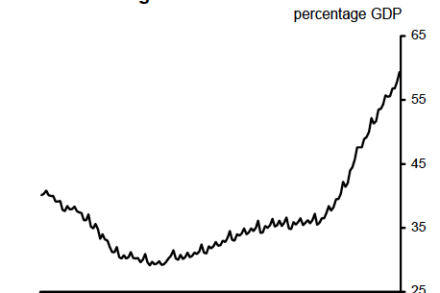
It's not just the growth figures, you know. Today, the Office for National Statistics also released its latest estimates for the state of the public finances. Among the headline findings was a crumb of consolation for the Treasury: it is on track to meet its borrowing target for the financial year. But that's by the by when compared to this other snippet from the ONS release: our national debt went up by £1,300 billion in December. Don't worry, though – it's not really as terrible as all that sounds. What's happened is that the human calculators have finally worked out how to account for Lloyds and RBS on the public balance sheet. This isn't new debt. It's simply a grand liability that wasn't included in the official statistics until now.

Everyone got the invitation, but the Tories had omitted the dress code

From our UK edition

ConHome has published its latest members’ survey. Its (admittedly unscientific) findings into respondents’ recollections of floating voters at the last election have reopened the debate about why the Conservatives didn’t win. In a combative piece, Janet Daley insists that the results ‘stand the modernising argument on its head’. These findings look more inconclusive to me. 85 percent of respondents were told that the party and its leadership were ignorant of ordinary concerns, supporting David Davis’ insinuations that the party is out of touch with the common man.

Call in a bulldozer for growth

From our UK edition

As the coalition considers how to develop a growth strategy, it would do well to call in Paddy Ashdown and hear about the 'Bulldozer Initiative' he launched while in Bosnia working for the United Nations. Not a highway programme, the Bulldozer Initiative was instead one of the smartest pro-business schemes I have seen. And something like it is now needed here. The brainchild of a French businessmen and based on the ideas of Peruvian economist Hernando de Soto, it involved building a partnership between politicians and businessmen to identify specific legislation and regulations that prevented companies from expanding their businesses and creating more jobs.

Ed Balls: I don’t think a double dip is the most likely outcome

From our UK edition

And this, folks, is a day where Ed Balls is having his cake and eating it too. Not only is he basking in the grim light of the growth figures, but he is using the opportunity to recast his own stance on the economy. Speaking on the Daily Politics just now, he de-emphasised the argument that in-year cuts were to blame for today's numbers, instead claiming that people have "changed their behaviour in anticipation of what's coming in the future." And, more ear-catching still, he added: "I don't think [a double dip] is the most likely outcome." This, as Fraser suggested earlier, is surely necessary caution on Balls's part. He can't go too far with the dread warnings, lest the economy pick up again next quarter.

What to make of the GDP fall?

From our UK edition

"Recession here we come, a snow-dabbed double-dip" tweeted Faisal Islam, Channel Four's economics editor. He summed up much of the hysterical reaction. It may spoil a good story, but here is what I suspect the broadcasters won't tell you today. 1. Erratic GDP swings are common when recovering from a recession. Remember how stunned everyone was with the surging quarter three data? Now, we're all shocked by plunging quarter four figures. I'd advise CoffeeHousers to treat these two imposters just the same. After the 80s recession, quarterly growth rates swung between -0.7 percent and 1.5 percent. Following the ERM-induced recession in the 90s, growth rates swung between -0.2 percent and 0.5 percent. A swallow does not make a summer.

The pressing need to redefine poverty

From our UK edition

What is ‘poverty’? It might sound a basic question but, when we hear about x percent of people ‘living in poverty’, what does that actually mean? The policy review conducted by Frank Field last year offered a number of insights into the issues of life chances and their determinants. But it failed to address that fundamental question: what is poverty? Until we know what we are measuring, it is impossible to attempt to tackle it. Poverty continues to preoccupy us. According to the British Social Attitude Survey, the majority view is that there is “quite a lot” of poverty in Britain today, and many expect it to increase over the next ten years.

Does it matter what the government is called?

From our UK edition

Danny Finkelstein has written an interesting post objecting to Channel 4 referring to the ‘Conservative-led coalition’ last night. Finkelstein’s objection, and a valid one to my mind, is that ‘Conservative-led’ makes a judgment about the nature of the coalition. Of course, this whole spat has been set off by a clever letter from Ed Miliband’s communications director Tom Baldwin to broadcasters objecting to their use of the word ‘coalition’ to describe the government on the grounds that it implies that the government is a collaborative enterprise. I suspect that this whole row will rumble on for a while yet. It is tempting to dismiss the whole thing as absurd, as only of interest to a few journalists and spin doctors.

The government must continue to liberalise Europe’s market

From our UK edition

For a long time, the terms of Britain's Europe debate has been about the merits - or otherwise - of membership. This has occluded discussion about the need to promote a deregulated and economically liberal single market, for which the Conservatives have fought so successfully since Britain joined the then EEC in 1973.   Now Lord Brittan has shown the way. In a speech to Business for New Europe, he takes aim at the many illiberal practices that hamper economic development across Europe and hurt British business: “Portugal still has rules governing the minimum distance requirements between driving schools; and in Greece, directors of dancing schools need to live within a set distance of the school!

The coalition needs to address bonuses

From our UK edition

Much ado about bankers’ bonuses this afternoon. Tim Montgomerie reports that the proposed banking deal has run aground in Whitehall. The timing is inconvenient: Cameron and Clegg are due to fly to Davos to attend the World Economic Forum. The government hopes to allay public resentment by coercing banks into increasing their lending; which is also a crucial part of its nascent growth strategy. It adds to the impression that the government is failing to make progress in any other realm than cuts. For the time being, Tory spinners are content to distract attention by telling anyone that will listen about Ed Balls’ record on bank regulation and boundless enthusiasm for spending other people’s money.

Sexism is a red-herring; it’s family that matters

From our UK edition

I'm afraid that women have been faking it, having us men on. You see they understand the offside rule and always have done. How could they not? It’s so simple that even a brace of abject football pundits know that an actively involved player is offside when he is closer to the opponent's goal line than both the ball and the second-to-last defender, but only if he is in his opponent's half of the pitch. Messrs Keys and Gray may not be too sharp on interpretation – unlike the ‘young lady’ (£) they berated - but they’re smoking hot on the theory. So do me a favour love and drop the act. We’ve busted your ditzily saccharine ruse and now you must live Saturday’s trials and tribulations with me.

DD’s classy intervention

From our UK edition

David Davis’ interview on Jon Pienaar’s show this evening has revived the debate about whether or not it matters how posh the Cameron top table is. Andy Coulson was the most senior person there who understood what it is actually like to work your way up the ladder and with him gone that experience is missing. But what matters far more than the personalities involved is the policy outcomes. As I said in the Mail on Sunday, the most important thing for Cameron to do is to deliver for these voters. To cut their taxes and give them public services that offer them value for money.

The Irish government folds

From our UK edition

Yesterday, Brian Cowen resigned; today his government has imploded. The Green Party, which was bolstering Cowen’s ruling coalition (if such a phrase is applicable in this instance), have left the government. The Fianna Fail-led coalition is now two votes short of a majority, and therefore the finance bill may not pass in its current form. If that is so, Ireland may return to the precipice on which it found itself a couple of months ago, and its principal creditors and trading partners with it. But there is more to this than balance sheets. In his statement, the leader of the Greens said that the people had lost confidence in the political process. It’s hard to demur.

Sizing up the runners and riders to replace Coulson

From our UK edition

I suspect the identity of the Prime Minister's next director of communications is of far more interest to those who work in Westminster than those in the country at large. But the identity of Coulson's successor will reveal something about the balance of power in the coalition and at the Cameron court. I'm told that the Tories are in no rush to make the appointment, they'd rather take their time and try and find the right person. Despite what Nick Clegg said on Marr this morning, I'm informed that this will be very much a Tory-run selection process. Those in the know say that as with the Coulson appointment, George Osborne will play the crucial role.

Exposing the con man

From our UK edition

  To the chagrin of CoffeeHousers, I have long rated Ed Balls and his abilities. He has a degree of brilliance, albeit tragically deployed in the services of a destructive economic agenda. But as we welcome him back, it’s worth reminding ourselves that his abilities are of a specific type. He understands economics (even though he did PPE) but his speciality is in creative accounting. His only tactic is to spend, borrow and cover both up by cooking the books. He is a trickster, not an economist. More Arthur Daley than Arthur Laffer. In my News of the World column today (£) I say he is dangerous to Labour as well as the Tories, perhaps more so. But it’s worth recapping what we’re dealing with.