Uk politics

Poll catch-up

From our UK edition

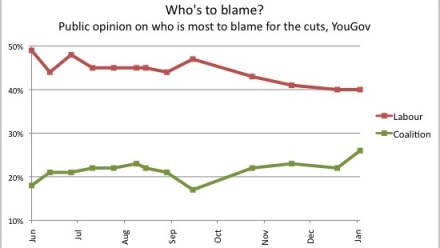
Other sites have already covered this week's opinion poll results, among them Labour's largest lead since September 2007 and the public's confusion over the Big Society. But there are a couple of findings that are worth dwelling on as we drift into the weekend: 1) Labour gaining ground in the blame game. Ok, so PoliticalBetting's Mike Smithson mentioned this a few days ago. But, here at Coffee House, we've translated the numbers into the graph below. It shows that, over recent YouGov polls, Labour have been slowly receiving less and less blame for the spending cuts, while the coalition are receiving more: Expected, perhaps – but still noteworthy, not least because of the obvious political implications. 2) Deficit deniers?

Gove entrenches his reforms

From our UK edition

In another sign of how the pace of Gove’s reforms is quickening, the education secretary has told local authorities that all new schools should be free schools or academies. This is a big step towards changing the default nature of the system from state-funded and state-run to state-funded but independent.   Local authorities will not be able to open a bureaucrat-controlled school unless they can satisfy the Secretary of State that there is no free school or academy provider willing to step in.   Gove has always argued that once free schools and academies become a significant part of the system it’ll be no more politically possible to abolish them than it would be to take sold-off council houses back into public ownership.

Cameron’s gloomy brand of optimism

From our UK edition

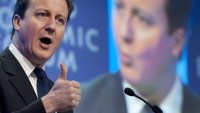
A weird, sprawling kind of speech from David Cameron in Davos this morning. It started off on an unusually, if expectedly, gloomy note: all talk of Europe's debt-induced decline in the face of competition from India, China and Brazil. And he emphasised, of course, that Britain would, and should, stick to its current trajectory of "tough" deficit reduction. But it's where it went from there that was more striking still. Cameron contrasted his position with that of "the pessimists". These people, he claimed, have a charter which includes propositions such as, "we in Europe are incapable of solving our debt and deficit problems," and, "we're attached to liberal values that are leaving us far behind the juggernaut of authoritarian capitalism".

Boris: George knows I’m right

From our UK edition

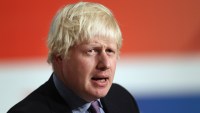
David Cameron and George Osborne must have hoped that their message from Davos today would be broadcast unimpeded. It is, after all, a blunt message, designed to smash through all the radio chatter: we must continue with deficit reduction, there is no alternative, etc. But, inconveniently for them, there are other voices saying what we must do – among them Boris Johnson. The Mayor of London's interview with the Telegraph is at once typical and quite intriguing. Typical, because he holds aloft the same standards as always. "I understand 50p tax politically," he says, "but there has got to be a sense of where we are going and where we want to be as a country.

Will Mubarak Fall?

From our UK edition

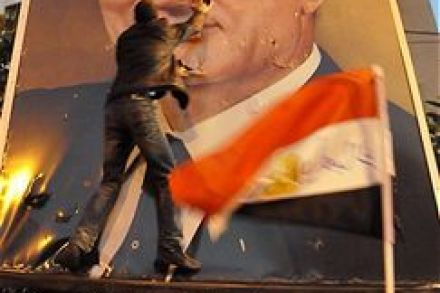
A week ago, that would have seemed a foolish question. But after thousands of Egyptians have taken to the streets for two consecutive days of protest, even Hosni Mubarak is beginning to look vulnerable. It has placed the West in a dilemma, in a way that Ben Ali's fall did not. For years, the fear has been that President Mubarak is the lesser of two evils. Though authoritarian, Mubarak's Egypt is a pro-Western state willing to live with Israel and combat Islamist terrorism. On the hand, the Muslim Brotherhood opposition, which shares an ideological wellspring with Al Qaeda, is a grave threat to Western security.

Nimrod: from a symbol of pride to one of decline

From our UK edition

There are contrasting images of Nimrod the Hunter: the mighty king of the Old Testament, and the less fearsome figure of Elmer Fudd. Through no fault of its own, the Nimrod spy plane, the most advanced and versatile aircraft of its type, seems destined to belong in the Fuddian category. Several senior officers have written to the Telegraph, urging the government to reconsider its decision to scrap the aircraft. They argue, not for the first time, that Britain’s defence capabilities are being pulverised by political calculations. (Con Coghlin adds his strategic concerns in the same paper.) The top brass have found an ally in Unite, some of whose members build and maintain the aircraft for a living.

Deregulation is the path to growth

From our UK edition

The government’s decision to increase the period which employees have to serve before they can bring a case of unfair dismissal from one to two years is welcome. But if it wants to encourage small and medium sized enterprises, the engine of the economy, to hire more people then they need to take the shears — not nail scissors — to regulation and employee protection laws. Camilla Cavendish has a cracking example of the absurdity of the current system in her column (£) today: 'A London neighbour of mine, Mr B, runs a small business that is doing well. Last year he took over an insolvent company where the staff were about to lose their jobs.

The dangers of CameronCare

From our UK edition

A consensus has formed in the commentariat that besides George Osborne's stewardship of the economy, Andrew Lansley's healthcare reforms could become the government's vote-loser. The political facts are as simple as the forms are complex. One, David Cameron ran a campaign based on a promise to protect the NHS. Many people thought that meant from cuts and culls alike. The Health Secretary's reforms look, whatever the truth may be, like they are going back on the PM's promise. Second, the reforms can only be successful if a range of stakeholders - voters, practitioners, analysts - have been brought along, and had a chance to debate the issues. What Michael Gove has done so brilliantly is to pick up a debate Tony Blair began.

Mandarined

From our UK edition

One of the greatest challenges for any minister - and, by extension, the government's programme - is to avoid being "mandarined". That is, smothered by officials in the manner of Yes Minister. But it can happen to even the most powerful and outwardly confident politicians. Here is how. Reputation Management. First, the politician is thrilled to find herself or himself in office and is keen not to rock the boat - lest the Prime Minister is told by the Cabinet Secretary that the minister is under-performing. Tony Blair is said to have toyed with the idea of having report cards for ministers. As a result, the minister opts to push officials - but not too hard. Knowledge Management.

The Lib Dems reject Ed Miliband’s overtures (again)

From our UK edition

What a joy it is to watch Ed Miliband contort and twist so that he can offer a hand of friendship to the Lib Dems. It has been a three-act show, so far. First, during the Labour leadership contest, he described the Lib Dems as a "disgrace to the traditions of liberalism," adding that, "I can see the death of the Liberal party to be honest". Then, he said that he would actually work with those dying Liberals, but only if they ditched Nick Clegg first. And then today, in an interview with the Independent, he suggests that Clegg might be able to stay on, after all. As turnarounds go, this one is predictable and sensible - but it's no less amusing for that. The Lib Dem response has once again come from Tim Farron; almost certainly for the same reasons as before.

This Ed’s no Goliath

From our UK edition

Ed Milliband took up his position at PMQs today flanked by Caroline Flint and Ed Balls. Between a rock and a hard face. His proximity to so many colleagues who wish him ill can hardly have helped his performance. He was like a stale doughnut. Layers of stodge surrounding a hole in the air.   His battle-plan wasn’t entirely useless. He wanted to tempt the prime minister into foolish speculation about the causes of last quarter’s poor growth figures. Cameron stood up and admitted that the numbers were pretty lousy whether the weather were blamed or not. And that whether-the-weather left Miliband completely stuffed.

Winning in 2015

From our UK edition

Danny Finkelstein’s column in The Times today (£) is well worth reading. Finkelstein sets out two worries, first that the Tories do not have enough of a strategy for winning re-election and second that the NHS reforms might compromise Cameron’s standing as a different kind of Tory. On the latter point, Finkelstein is echoing the views of an increasing number of Tory MPs and ministers. They worry that these poorly understood reforms have put the NHS back on the political table and that, as is so often the case when this happens, the Tories will suffer. Finkelstein’s first worry is that if the government sets out deficit reduction as its raison d’etre then, when that is achieved, as it should be by the next election, it loses its purpose.

PMQs live blog | 26 January 2011

From our UK edition

VERDICT: Ed Miliband had it all, going into today's PMQs: weak growth figures, the uncertain demise of control orders, rising youth unemployment, and more. And yet, somehow, he let most of it go to waste. Barely any of his attacks stuck – or, for that matter, stick in the mind – and Cameron rebuffed them with surprising ease. It helped that the Prime Minister seemed more comprehensively briefed than usual, with a decent compliment of statistics, and one or two sharp lines, at his disposal. (Although, measuring by the Labour cheers, I doubt he will thank Jacob Rees-Mogg for invoking Thatcher immediately after his exchange with the Labour leader.) In the end, a victory for Cameron – although that won't defuse the issues that Miliband should have detonated.

From control to surveillance

From our UK edition

Like husband, like wife. Yvette Cooper has begun shadowing Theresa May where Ed Balls stopped: by lacerating Nick Clegg’s naïveté in believing that control orders should be abolished. There is a faint note of animus in her politicking too. ‘National security,’ she said, ‘should not be about keeping Nick Clegg safe in his job.’ The government invited Cooper's charge with its own crass political calculation. Spinning the new measures as a Liberal Democrat victory could only elicit that response from an opposition that is intent on exploiting the government’s broad weakness on law and order. In fact, as Lord West has remarked, the government has not even come close to rescinding the substance of New Labour's control orders.

Why our national debt went up by £1,300 billion today

From our UK edition

It's not just the growth figures, you know. Today, the Office for National Statistics also released its latest estimates for the state of the public finances. Among the headline findings was a crumb of consolation for the Treasury: it is on track to meet its borrowing target for the financial year. But that's by the by when compared to this other snippet from the ONS release: our national debt went up by £1,300 billion in December. Don't worry, though – it's not really as terrible as all that sounds. What's happened is that the human calculators have finally worked out how to account for Lloyds and RBS on the public balance sheet. This isn't new debt. It's simply a grand liability that wasn't included in the official statistics until now.

Brown takes the opportunity to peddle his “global growth plan”

From our UK edition

As Iain Martin and Guido have noted, Ed Balls – and, for that matter, Ed Miliband – could probably have done without Gordon Brown hovering from the political graveyard to cast judgement on today's growth figures. But hover he has, as the above video of his appearance on CNBC News testifies. It's almost as though he wants to remind people that his spirit lives on in Labour's rearranged top team. As for the content of his interview, it was stodgy mix of the arguments in his recent book and the attacks that Balls was making earlier. "Europe and America, but particularly Europe," he said, "are now implementing policies that are more reminiscent of the 1930s, than reminiscent of the lessons we should have learnt from previous decades.

Everyone got the invitation, but the Tories had omitted the dress code

From our UK edition

ConHome has published its latest members’ survey. Its (admittedly unscientific) findings into respondents’ recollections of floating voters at the last election have reopened the debate about why the Conservatives didn’t win. In a combative piece, Janet Daley insists that the results ‘stand the modernising argument on its head’. These findings look more inconclusive to me. 85 percent of respondents were told that the party and its leadership were ignorant of ordinary concerns, supporting David Davis’ insinuations that the party is out of touch with the common man.

Call in a bulldozer for growth

From our UK edition

As the coalition considers how to develop a growth strategy, it would do well to call in Paddy Ashdown and hear about the 'Bulldozer Initiative' he launched while in Bosnia working for the United Nations. Not a highway programme, the Bulldozer Initiative was instead one of the smartest pro-business schemes I have seen. And something like it is now needed here. The brainchild of a French businessmen and based on the ideas of Peruvian economist Hernando de Soto, it involved building a partnership between politicians and businessmen to identify specific legislation and regulations that prevented companies from expanding their businesses and creating more jobs.