Uk politics

British foreign policy needs to promote democracy

From our UK edition

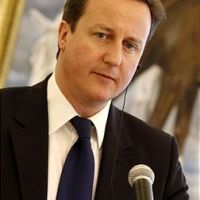
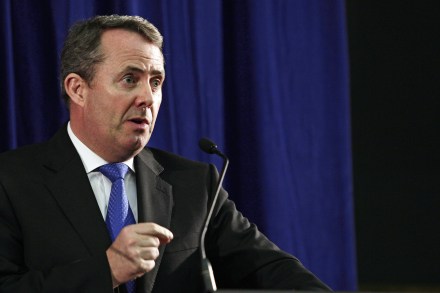
After a week of hesitation and well-publicised problems evacuating British citizens from Libya, the government has led the international community's response to the crisis. The decision to move HMS Cumberland into position was astute, as was the authorisation to rescue the people stranded in the dessert. At the UN, British diplomats have been drafting most of the key resolutions and now David Cameron has out-hawked everyone by saying he'd be willing to contemplate a no-fly zone. US lawmakers have asked the Obama administration why they have not been as swift as the UK. As a Bosnian-born friend of mine said last night: "If only David Cameron and William Hague were around in 1992, so many of my friends would have been alive today!

Clarke in the Sun’s harsh light

From our UK edition

The Sun has launched another sortie against Ken Clarke’s restorative justice programme. The paper reports: ‘SHOPLIFTERS could escape prison by just paying for what they pinch and saying "sorry". Jail sentences and tough fines will be SCRAPPED as the default punishment for nicking from stores under controversial plans soon to be unveiled by Justice Secretary Kenneth Clarke. Instead he wants thieves to make face-to-face apologies to victims and pay compensation.’ The Ministry of Justice has responded by saying that it ‘strongly believe[s] offenders should make more financial and other amends to victims and are in the process of consulting on plans for this.

Osborne goes on the offensive

From our UK edition

Attack, attack, attack. That's the temper of George Osborne's article for the Guardian this morning, which sets about Labour's economic credibility with a ferocious sort of glee. Perhaps the best passage is where he asks how many times Labour can spend their ubiquitous "bank tax," but this is more pertinent to the recent debate: "Where does all this leave Ed Miliband's newfound enthusiasm for the "squeezed middle"? Let's pass over his failure in every interview to define it – his last effort included around 90% of taxpayers. Where we can all agree is that these are difficult times for family incomes. There are two root causes. One is global: rises in food and commodity prices.

The Tories take the train to war

From our UK edition

Philip Hammond should be wary of the ladies of Cranford. The advent of the railways was met with considerable disquiet in rural England, depicted by Elizabeth Gaskell in both Cranford and North and South. High-speed rail has inspired another wave of determined conservatism in the shires. It’s a proper grassroots movement. For months now, Tory-controlled Buckinghamshire has warned the government that its councils and associations would oppose the development. Cabinet Ministers whose seats are local have supported their constituents, but the resentment is unchecked and it will damage the Conservatives to an extent.

Boris: give us a referendum on Europe

From our UK edition

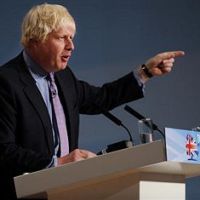
Boris kicks off his Telegraph column today by observing that Colonel Gaddafi and Gordon Brown "look vaguely similar". And yet the really provocative copy, at least so far as the government is concerned, is reserved for the final paragraph: "It is bonkers [by pushing for AV] to be pursuing the last manoeuvre of a cornered Gordon Brown. By all means let us have a referendum – the one we were promised, on the Lisbon EU Treaty. Have you noticed the EU policy on North Africa? Have you heard much from Baroness Ashton? Shouldn't we have a vote on all that?" It's hardly a secret that Boris wanted a referendum on Lisbon: he said as much in an interview before the 2009 Tory conference, and irritated the party leadership in the process.

The need to address National Pay Bargaining

From our UK edition

National Pay Bargaining is one of the major impediments to rebalancing the national economy and improving the quality of public services. But as Julian Astle, the head of the Liberal think tank Centre Forum, notes the coalition is doing little about it. It knows that the public sector unions will go to the wall for national pay bargaining and so are holding off. Gordon Brown flirted with doing something about national pay bargaining, announcing a review of it in the 2003 Budget. But he then backed away from the issue. One area where the coalition is chipping away at national pay bargaining is schools. Academies and free schools have the right to set their own pay and conditions. But, interestingly, academies tend not to use these freedoms.

Miliband’s latest break with the past

From our UK edition

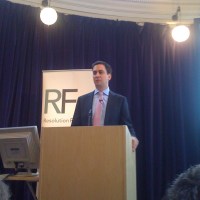
As an independent creature, the Resolution Foundation's new Commission on Living Standards isn't doing Ed Miliband's work for him. But, boy, must the Labour leader be glad that they exist. At their launch event this morning, the "squeezed middle" – aka low-to-middle earners – suddenly took shape. There were graphs, such as those in James Plunkett's post for us earlier, setting out the very real problems facing a segment of British society. And there were even definitions explaining what that segment is: 11 million adults, by the Resolution Foundation's count, too rich to benefit from measures for the least well-off, and too poor to be entirely comfortable. This was a decent platform for Miliband's speech, and he used it to make a fairly important leap forward.

Three charts that complicate a simple focus on growth

From our UK edition

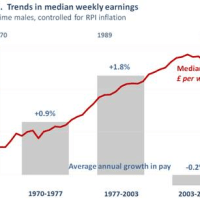
GDP growth figures have become the barometer of choice for commentators trying to tell the political weather – a good measure of how the public will eventually fall in the faceoff between Osborne and Balls. The story goes that a return to sustained growth will mean a return to rising living standards.  That means a vindication of the government’s position, and a victory for the Chancellor. As a simple story, that makes sense if the pressures now facing Britain’s households are straightforwardly growth-related – if, in other words, we’re in a post-recession hangover that will vanish when growth returns. But there’s now mounting evidence of a deeper problem for living standards in the UK economy. Take the chart below.

Will Cameron have a Brown moment over petrol?

From our UK edition

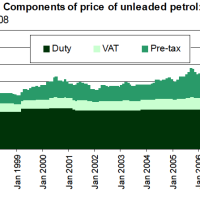
Remember when Gordon Brown came up against Fern Britton in a TV interview? I've pasted the video above to remind CoffeeHousers of two persistent truths: how tricky a subject petrol costs can be for a serving Prime Minister (watch on from around the 0:50 mark), and how Labour are hardly blameless when it comes to the current cost of fuel. As Britton asks in the interview, "How much tax do you put on the fuel?" And the answer that Brown mumbled to avoid, from a House of Commons briefing note at the time, was this: In other words, for a huge portion of the New Labour years, fuel duty accounted for over half of the petrol price at the pumps. For a typical litre of fuel, duty was 36.86 pence when Labour came to power, and 57.19 pence when they left.

Keep calm and carry on

From our UK edition

The Libya crisis looked like it would prove the critics of the government's Strategic Defence and Security Review right. Was it not the case that the HMS Cumberland, now seen as crucial for the evacuation of British nationals, would soon be decommissioned. And would the Harriers not prove useful in a potential intervention? Coupled with criticism that the government struggled to handle the evacuation of British nationals, it looked like the makings of a credibility-destroying theme: strategic misjudgement and tactical incompetence. But a week into the crisis, the government's handling of the evacuation – and response to the Libyan crisis overall – looks increasingly surefooted.

Labour sets about warning of a “cost of living crisis”

From our UK edition

Ed Balls has been warming up to this one for a while, and now it has finally come: an all-out attack over rising prices. In an interview with the Sunday Times (£), the shadow chancellor warns of Britain's "cost of living crisis," and demands that George Osborne reverse the VAT increase. Much of his pleading is made on behalf of motorists, who – as I pointed out a couple of days ago – face punishment at the petrol pumps. He doesn't even mention spending cuts once, especially not where his own party's are concerned. Rising costs, clearly, are the new weapon of choice. And it's not just Balls.

Corporatism is not an adequate foreign policy

From our UK edition

The events of the last two weeks have demonstrated that David Cameron needs a revamped foreign policy. This is not, in itself, a surprise. Foreign policies sketched out in opposition seldom survive contact with reality. Remember Bush saying he did “not do nation-building”? And who can forget the ignominious fate of Robin Cook’s “ethical foreign policy”? David Cameron sought to distinguish himself from the adventuring, idealistic Blair with what he regarded as a ‘pragmatic’ foreign policy – that is, promoting British exporters.

Why Ed Balls shouldn’t brag if the OBR downgrades its growth forecasts

From our UK edition

Some speculation (£) today that the Office for Budget Responsibility will shortly downgrade its 2011 growth forecast – and hence the growth forecast in next month's Budget. If so, then you can expect Ed Balls to crow on and on about it. He did, after all, prime the attack in his recent clash with George Osborne across the dispatch box: "With consumer confidence falling, with inflation rising, with no bank lending agreement, no plan for jobs, no plan for growth, no plan B - does he really expect us to believe he can meet this forecast for economic growth this year or will he have to stand here at the Budget in six weeks' time and downgrade his very first growth forecast?

What difference will sanctions make?

From our UK edition

Slowly, haltingly, the West decides what to do about Gaddafi. The latest news is that, having broken his silence over Libya a few days ago, Barack Obama is now imposing sanctions against its despicable regime: freezing assets, blocking transactions, that sort of thing. It follows a package of sanctions, including an arms embargo, that Britain and France have proposed to the UN. Although these sanctions are better than nothing – the West shouldn't house Gaddafi's slush funds, nor transfer weapons in his direction – they are of limited actual worth. Yesterday, the Mad Dog was parading the parapets once again, promising death for the protestors. You suspect he is unlikely to be put off by restrictions to his and his country's finances.

A landmark judgment for the security services on torture

From our UK edition

The Court of Appeal made a momentous judgment this afternoon. It was hearing the appeal of Rangzieb Ahmed, the first man to be convicted on terror-related charges in this country, for which he is serving 10 years. Ahmed’s appeal was based on the allegation that British security services had been complicit in his torture and that the evidence for his conviction, gained by Pakistan’s ISI, was obtained by a series of extreme measures culminating in the slow removal of his finger nails. The appeal judges rejected Ahmed’s suit, saying that there was no evidence that his nails had been pulled out or that British officers ordered beatings. Ahmed’s claims had been proved ‘not to have occurred’.

The case for retaining Harrier in Afghanistan

From our UK edition

Lord Owen, among others, has responded to Colonel Gaddafi’s bloodcurdling lunacy by insisting that a no-fly zone be imposed over Libya. But, as Con Coughlin has suggested, it is unlikely that Britain could support such an operation without a fixed-wing attached to an aircraft carrier. The debate about the Strategic Defence Review and Britain’s military capability has reopened. The SDSR put Afghanistan first. As armed Forces Minister Nick Harvey explained in a recent speech to RUSI: ‘Throughout the next few years, the mission in Afghanistan remains our main effort. Having made this commitment in the SDSR, this shaped many of our other decisions: the proposed changes to the Army, for example; and the preference for Tornado over Harrier.

Mandelson casts doubt on Miliband’s vision

From our UK edition

The Kindly Pussycat has returned to the fray with a revised version of his memoirs. The FT's Jim Pickard has highlighted an arresting passage about Ed Miliband’s decision to execute New Labour. 'When Ed pronounced New Labour ‘dead’, he was not only being more categorical than was wise, but quite possibly more than he really intended. (xxi) …Even allowing for the tactical choices he had made in his bid to become leader, however, I was struck by the fact that he had given no strong clue during the campaign as to what alternative to New Labour he envisaged. He was quick to say what he was against: essentially, Tory policies and Tony’s policies.

It’s the Q1 2011 growth figures that matter now

From our UK edition

The Office for National Statistics' preliminary figures for Q4 growth, released a few weeks ago, were a curious beast. They they were, suggesting that because of a snow-laden December our economy had started shrinking again, to the tune of -0.5 per cent. And yet so many other indicators were doing rather nicely: from activity in the services sector to the Exchequer's tax take. Many people, myself included, suspected it was only a matter of time before the ONS revised that -0.5 figure into more positive territory. Now time has passed, and the ONS has just revised the Q4 figure downwards, not upwards. Their preliminary figure wasn't quite right, they say. It should have been -0.6 per cent. Given that the snow was thought to reduce GDP growth by 0.