Uk politics

Osborne the Reformer is an unfinished work

From our UK edition

One interesting aspect of today’s Budget is the government’s change of tack on personal allowances. Back in June 2010, when the Chancellor committed to raise allowances from £6,475 to £7,475, he chose to cancel out the gains for higher rate taxpayers by lowering the level at which the 40p tax rate kicks in. The idea was to focus the gains of the policy on basic rate taxpayers, making things a little more efficient. The 40p threshold will therefore be lowered from April this year from £43,875 to £42,475 with the result that 700,000 people will become higher rate taxpayers. Needless to say, that’s proved unpopular, and so this time around the higher rate threshold won’t be reduced.
Giving up before the race has begun?

From our UK edition

How will history judge George Osborne’s second Budget? Once the headline writers have moved on to the next story and the longer-term consequences of the measures become apparent, will this budget be seen as doing the right thing? Unfortunately the answer is, at best, “not really.”   By sticking to the target of eliminating the structural deficit in this parliament, George Osborne got the big call right. As Andrew Haldenby has written, “It’s always easier to set a target at first but as people get tired of austerity there is a real temptation to stop before the job is done.

The big question: has Osborne done enough to deal with inflation?

From our UK edition

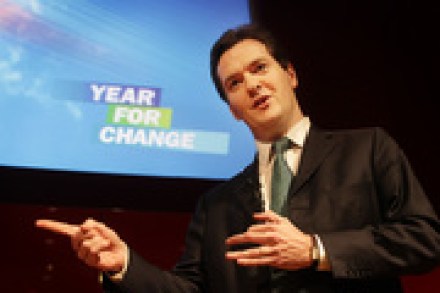
"We understand how difficult it is for so many people across our country right now." If you weren't sure which direction George Osborne's Budget was going to head in, then he clarified it right from the start of his speech. This was one to tackle the rising cost of living. And much of it — such as the raise in the personal allowance and the fuel duty cut — was welcome. But there is a nagging question hovering above Osborne's announcement today: has he done enough? The Chancellor will certainly hope so. After all, by scrapping the fuel duty escalator he has effectively encoded a tax cut into all of his Budgets from now on.

Lib Dems bringing home the bacon

From our UK edition

There are a few big Lib Dem policy wins in this Budget, most notably the rise in the personal allowance and the introduction of land auctions. But there are also a few bits of rather unseemly pork barrel politics. Nick Clegg’s Sheffield gets an enterprise zone, which is probably fair enough. But we are also told that ‘following a thorough review, the government is approving the revised Sheffield retail quarter regeneration scheme.’ The south west, which has a disproportionately large number of Lib Dem seats, gets help to keep water bills down.

Osborne’s new, softer cuts

From our UK edition

George Osborne has today done some massive juggling. It wasn't a Budget for jobs after all, but a Budget to help people cope with the soaring cost of living. North Sea oil companies and banks were stung for various income, fuel and corporation tax cuts. The Chancellor spotted — immediately — that cost of living was the No.1 issue and turned on a sixpence. His skills as a politician were again demonstrated. But let's not fool ourselves. Fiscally, today's is not a big Budget. What movement there has been is to make the cuts programme even milder than it already was. The "total cuts" figure is, oddly, not printed in the Budget. Perhaps because it's so embarrassingly small. After the Autumn Statement, it was 5 per cent over four years. Now it's back to 3.

Dave’s rave

From our UK edition

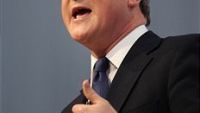
Friskier than a spaniel. That’s how Cameron seemed at today’s PMQs. The Gadaffi debacle has given him a Falklands bounce – prematurely one senses - and he was glowing like freshly made toast from the praise lavished on his performance on Monday. He seemed to want to share the good cheer with everyone else, even his opponents, and he offered thanks to Ed Miliband for his contribution, ‘which I thought was extremely powerful.’ Miliband sensed that attacking Cameron today would be like serving a writ on a man at his birthday party. He tried to pester the PM for ‘removing the mobility element from DLA’ but Cameron cut him down glibly. ‘The short answer is we haven’t,’ he said.

PMQs live blog | 23 March 2011

From our UK edition

1232: And that's it. And here's my quick verdict: a solid performance from Cameron is what was, on the whole, a sedate session. The Main Event starts now, follow our live blog here. 1228: More fire from Cameron on the NHS. "Do you want to save ... lives," he quivers," or do you want to stick with the status quo." The PM's rhetorical confidence in this area is striking, particularly given that it is one of his most criticised policy areas. 1226: Matthew Hancock questions why the Labour government used PFI contracts to build hospitals, when there were better value alternatives. The Tories have spent the past few days emphasising Labour waste, as the blame game heats up ahead of the Budget.

Osborne’s white rabbit

From our UK edition

We can expect at least one rabbit out of the hat in George Osborne’s Budget speech. The Chancellor is a canny enough operator to have held at least one big announcement back. Already this morning, we have had news that all councils will freeze or reduce their council tax next year. But I expect there is one more on fuel to come in the speech itself, possibly the suspension of the fuel duty escalator for this parliament. This move would be expensive but it would also say I feel your pain and stop Osborne having to come back to the price of petrol every year. For Ed Miliband, today will be a test of his ability to think on his feet.

The levers that Osborne might pull

From our UK edition

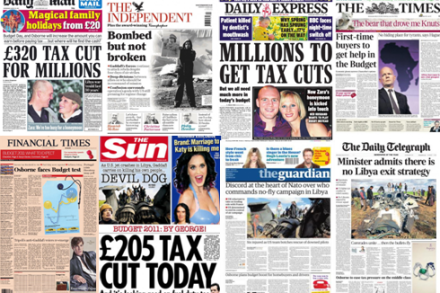
Cutting taxes for the low-paid is the most useful thing Osborne can do in what will, I suspect, be a distinctly unmemorable budget. The Mail and The Sun both have competing figures — £205 and £320 — for the annual rebate. Given that the average Brit is paying £310 more due to Osborne's VAT rise in January, one might forgive taxpayers for not punching the air. And anyone on more than £25k a year is still face a higher tax burden than they did three months ago. But the beauty of Budget day (as Osborne knows) is that you have can just present one side of the ledger. You can show the 'give', not mention the 'take' and end up with front pages similar to those which Pete mentioned earlier.

Budget morning

From our UK edition

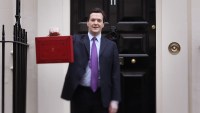
George Osborne couldn't really have expected a much better set of newspaper covers than the one before him this morning. Despite the dreary background picture – war, confusion, higher inflation, lower growth, the ruinous state of the public finances, etc – a handful of papers are leading on the goodies in his Budget, and specifically the £600 rise in the personal allowance that James mentioned last night. Judging by the movements of the grapevine, this will come into effect in April 2012, and will benefit more people than will the £1,000 rise already announced for this April.

Budget eve

From our UK edition

In stark contrast to 2003, when Gordon Brown delivered his Budget on the same day that Baghdad fell, the Treasury is phlegmatic about the Budget being overshadowed by Britain’s involvement in a conflict overseas. But the signs are that this will be, within the obvious fiscal constraints, an ambitious Budget. Tonight, we have had confirmation of a raise in the income tax allowance to £8,000, something that will please the Lib Dems . Tomorrow, we’ll almost certainly get at least one unexpected rabbit out of the hat. What we do know is that the Budget and the growth review will be built around four things: deregulation, planning reform, tax simplification and targeted investment.

The state of public opinion ahead of the Budget

From our UK edition

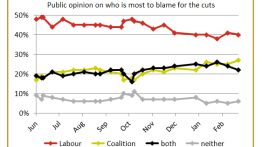
It's a point that I've made before, but here it is again: Budgets don't tend to shift opinion polls, at least not the headline numbers. But opinion polls can give some insight into how Budgetary decisions will go down with the public. So by way of a catch-up with some recent polls, and ahead of tomorrow's Main Event, I thought CoffeeHousers might appreciate a quick overview of public opinion on matters fiscal. Here goes... 1) Who's to blame? When it comes to the overall flow of British politics, the question of who's to blame for the cuts carries clear — and dangerous — implications.

Three principles that should underpin the Budget

From our UK edition

As I see it, there should be three simple principles underpinning George Osborne's Budget tomorrow. Let's take them one by one: 1) Variations in household wealth mean that policies aimed at affecting the wider economy will often have unpredictable political effects. Economists have a tendency to imply that changes in GDP affect everyone uniformly, but this isn’t the case. What’s more, journalists are quick to highlight extreme case studies that make good stories, but they can misrepresent the actual picture. Policy will do a lot to influence the economic climate, but the local economic weather will be more relevant to taxpayers. At the same time, the recovery can’t be managed through Whitehall.

Confiscation through inflation

From our UK edition

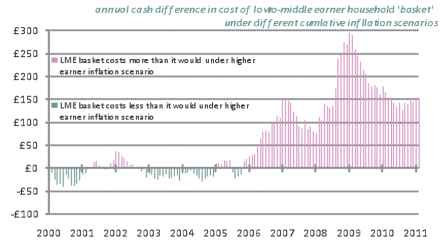
Inflation has now reached its highest level for 20 years, today’s figures reveal. But we will suffer not just because of the increased cost of living, but also because the government will penalise us by taxing our illusory gains. The Adam Smith Institute has calculated that about half of the £3.3 billion that the government plans to raise through capital gains tax (CGT) next year (2011-12) will come from taxing purely inflationary gains.   “Fairness” is said to be an attribute of the coalition’s fiscal policy. But it is difficult to see how this can be seen as anything other than extremely unfair.

Allowing growth, not forcing it

From our UK edition

What is a “Budget for Growth,” and how can one be delivered? These questions have been preoccupying civil servants across Whitehall, policy folk in think tanks, and the press since the coalition announced in November that it would be reporting back on its “Growth Review” in the 2011 Budget. While foreign events rightly moved discussion of the impending Budget further back in last weekend’s papers, there was extensive coverage of the potential for targeted tax cuts and reliefs and incentives targeted at particular industries or sectors. The obvious problem with a number of these is that they cost money, and this is something the coalition does not have in spades. However, even if it did, should it be spending money trying to deliver growth to the economy?

Your five-point guide to tomorrow’s Budget

From our UK edition

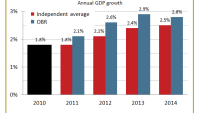
From rescue to recovery — that's how George Osborne is selling his Budget ahead of its release tomorrow. But what might we see beyond the rhetoric? Here's a five-point guide for CoffeeHousers:   1) Growth. It almost feels like a tradition now: a new Budget, and a new set of forecasts from the Office for Budget Responsibility. Chief among them will be what the OBR says about growth. Its previous forecast for 2011, made last November, was for 2.1 per cent growth in 2011 — but that will almost certainly be downgraded after the mini-slump in the fourth quarter of last year. As this graph shows, the average of the 39 forecasts collected by the Treasury is now at 1.

Inflationary troubles ahead of Osborne’s Budget

From our UK edition

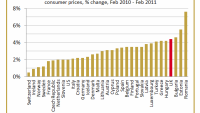
Unwelcome news for George Osborne: he will tomorrow present his Budget against a backdrop of the highest inflation for 20 years. The RPI index — what the nation called “inflation” until Brown changed the definition — is 5.5 per cent. It hasn't been this bad since the aftermath of the ERM crisis, an unhappy comparison for the Tories. The CPI index is up to 4.4 per. And those who deploy the usual arguments about global food prices are spiking might wonder: why is Britain now even worse off than Greece?     Even the Zimbabwean media is laughing at us (their inflation is now considerably lower than ours). It's shocking, but not surprising.

Here’s how Osborne should reduce the tax gap

From our UK edition

Some commentators have argued that the right way to reduce the deficit is to take on large scale tax avoidance rather than public spending. The argument goes that large companies are shirking their responsibilities, while families and small businesses carry the burden of rescuing the public finances.  Yet the evidence on who is actually avoiding tax does not support this. For example, HMRC data show that three-quarters of the £40 billion tax gap (the difference between the amount collected and the amount that should be collected) is due to VAT, Income Tax, National Insurance and Capital Gains Tax. Reducing the tax gap not only requires a focus on the big end of town but on the activities of many families and small to medium enterprises.