Uk politics

Back to the start on a military covenant

I suppose you could call it an O-turn. First, the Prime Minister declared, in a speech aboard HMS Ark Royal last year, that a new military covenant would be enshrined "into the law of our land." Then, there seemed to be a U-turn, with the government committing only to review the covenant annually, not to lend it legal force. Yet, now, a U-turn on the U-turn, with the news that it will be etched into the staute books after all. The defence minister Andrew Robathan tells today's Telegraph that, "we are putting the military covenant on a statutory basis for the first time." The formal announcement is expected in the House on Monday, pending the outcome of some "final discussions".

Gove takes the attack to ailing Burnham

There are intriguing manoeuvres on the education front today. Michael Gove has written a letter to Andy Burnham, calling on his counterpart to guarantee to protect the Academies programme. There’s nothing unusual in this: politicians are always writing pointless letters to each other. But the timing of this one is quite significant, coinciding as it does with former Blair spinner Peter Hyman’s decision to create a free school, with, it is understood, the tacit support of Andrew Adonis. As I’ve written before, Burnham has forsaken his reforming instincts. Convinced that Gove is a weak link, he has not seen the need to leave ‘old Labour’s’ comfort zone on education. Now the mood seems to be turning against him.

Another European squabble looms

There is much excitement in Westminster at the moment about Hugh Fearnley-Whittingstall’s campaign to end ‘discards’ under the Common Fisheries Policy. DEFRA and non-governmental organisations estimate that perhaps as much as 60 per cent of a catch will be returned dead to the sea because the CFP’s controversial quota system is based on the amount of fish caught. DEFRA has been pressing the European Commission to reform the quota system for years. At last, they seem to have succeeded. The commission is due to announce in July that the quota system will now be based on the amount of fish landed in port. With that apparently comes a concession to reduce discards significantly.

Mixed news from the Eurozone

France and Germany’s better than expected growth numbers are making news today. But the divergence within the Eurozone — Estonia grew at 2.1 percent in the first quarter, Portugal shrank by 0.7 per cent — highlights one of the single currency’s biggest problems: how can one interest rate fit all? Economists expect Germany, whose GDP is now larger than before the financial crisis, to continue to outperform the rest of the Eurozone. Given that Germany and France together make up half of the Eurozone economy, interest rates will have to be set with this in mind. But, on the other hand, the Iberian countries and Greece are struggling with austerity and need a continued monetary stimulus.

Eh?

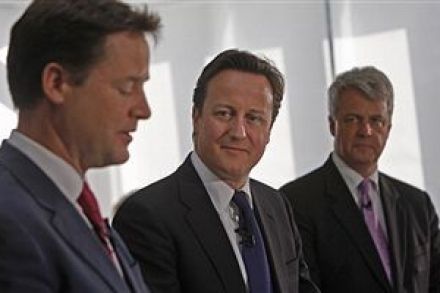
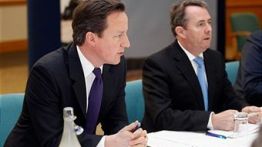
This photograph adorns the homepage of the Labour Party's website. It's rather odd to show the PM and his deputy looking quite so soigné as the starting point for a critique. The New Statesman's Dan Hodges descibes it as 'insanity'.

MacShane’s contradictory testimony to the Iraq Inquiry

A trickle of documents from the Chilcot Inquiry have been released today, among which is the written witness statement of former Europe Minister Denis MacShane. It's rather intriguing. MacShane told the inquiry that it was his understanding that France 'would not leave the US, Britain and other allies alone in any action against Saddam' and that President Chirac then vetoed military action in the UN at the stroke of the twelfth hour, apparently against the wishes of his colleagues and France's political establishment. MacShane says he gained this impression after speaking to a senior French official at the Anglo-French summit at Le Touquet on 4 February 2003, six weeks before the invasion.

The challenge of demographic change

There may be a lot of debate about what the “big society” means, but there’s one thing we should all be able to agree on: we live in a big society – and it’s getting bigger. 62 million today. 64 million in five year’s time. And then on up to 70 million by 2028, according to the government.  (No, I’m not doing my bit, as my wife is about to have our third child.) What’s odd is how little debate there’s been at Westminster about all this. Why? Partly because it means you have to talk about immigration (still seen as toxic by many in SW1); partly because it is one of those issues that is just so big that it almost saps the will to live.

Remaking Laws

David Laws has just apologised to the House of Commons in a short statement listened to in sombre silence. Laws stressed that he was glad that the commissioner and the committee had accepted that his motivation had been to protect his privacy not to enrich himself. Indeed, Laws pointed out — somewhat boldly — that there had been ‘no adverse effect’ for the taxpayer from his arrangements as he could have claimed more. The report and the punishment are harsher on Laws than many expected. But given that the coalition needs him and, as David has noted, that Laws’ own explanation for why he broke the rules has been accepted, I think Laws is a contender to return in the March 2012 reshuffle.

Laws punished but in the clear

The Parliamentary Commissioner for Standards, Sir John Lyon, has delivered his report on David Laws’ expenses claims. The headline is as expected: ‘Mr Laws was guilty of a series of serious breaches of the rules', and it is recommended that he be suspended for 7 days from 7 June. It is a stern punishment for a serious transgression. However, nothing has really changed since Laws resigned from the government last May, because Lyon has not disinterred anything new. Crucially, the report accepts Laws’ explanation that he was conniving to protect his privacy, not to increase his personal wealth. For example, in paragraph 36 Lyon says that Laws would have been paid more in expenses had he followed the rules.

The Lords punish Cameron over policing

In Number 10, they are already concerned that they are losing public support on crime and punishment. David Cameron is planning to give a speech on the subject that will, in the words of one senior coalition figure, ‘throw a lot of bones to his party’s right.’   But Cameron’s words will mean little if he can’t rescue the elected police commissioners policy from its defeat in the Lords last night. By introducing police commissioners who are accountable to the public, this policy will make the police concentrate on the crimes that have the greatest impact on peoples’ quality of life rather than form filling.

Garnering third party support

Third party support is an important political asset. Nobody trusts politicians any longer (when did they ever?) and so it’s useful to draft in supposedly apolitical backers to support your plans. Yesterday’s PMQs was a case in point, with David Cameron and Ed Miliband competing for support from GPs. As Jim Pickard writes over on the FT blog, having 42 GPs on side is a little less impressive than having support from the Royal College of GPs, which has 42,000 members. So the PM is seen to have emerged from the exchange as the loser. Therein lies a problem for the government. Since the general election, the Tories seem to have become decidedly worse at garnering third party support for their policies. Before the poll they did excellently.

The Coffee House A-Z of the Coalition: T-Z

Here are letters T to Z in our A-Z guide the coalition's first year. A-F are here. G-M are here. And N-S are here. T is for Tuition fees "Broken promises, there have been too many in the last few years." So said Nick Clegg in a Liberal Democrat video during the last election campaign. It was favourite theme of his — and one that he deployed both during the TV debates and in signing a pledge to scrap tuition fees. This was to be a New Politics. Clegg was to be its champion. Shame it didn't quite work like that. The coalition agreement was damaging enough to Clegg's aura: it didn't guarantee that tuition fees wouldn't rise, only that the Lib Dems wouldn't have to vote for such a rise.

The Coffee House A-Z of the Coalition: N-S

Here are letters N to S in our A-Z guide the coalition's first year. A-F are here. G-M are here. N is for No Nothing has frayed coalition relations quite like the AV referendum has. This was always going to be the case, but the viciousness it inspired has still been fairly shocking. Need we remind you of Chris Huhne's outburst in Cabinet last week? Or of George Osborne's stinging riposte? Even David Cameron seems to have relished taking it out on his coalition stablemates, trashing their pet policies with a vigour that would have been unthinkable only a few months ago. As Tim Montgomerie reveals in his exhaustive guide to the No campaign, Cameron's firmer stance coincided with a realisation of just what he was risking.

Exclusive: Gove’s free school policy gets Labour support, finally

This week's Spectator reveals the rather tantalizing fact that Peter Hyman, Tony Blair's former director of strategy, is setting up a Free School in East London. This – I kid you not – is a very good thing. Newham School 21 will teach kids between the ages of 4 and 18 – an ambitious span of ages – and will open its gates in September 2012 if all goes to plan. Whatever you think about Blair, Hyman is a quietly impressive figure, coining the phrase "Education, Education, Education" and then leaving Downing Street in 2003 to become a teaching assistant. Now, as the deputy head of a school in Ealing, Hyman could not be better placed to start a "free school" and his plans have the blessing of those at the very highest levels of Labour politics, I'm told.

The Coffee House A-Z of the Coalition: G-M

Here are letters G to M in our alphabetical guide to the Coalition's first year. A-F were covered here. G is for Gaffes The coalition, happily, has not endured anything like a Gillian Duffy moment. But there has been a decent smattering of embarrassments and gaffes. Below is a brief selection, but CoffeeHousers can nominate others in the comments section: https://www.youtube.com/watch?v=0nOhqo-47P8 https://www.youtube.com/watch?v=6_bFjZ27_ug https://www.youtube.com/watch?v=1wgZFb0Ycmg H is for Hidden talents A brief mention for those ministers who have exceeded expectations, or who have been quietly effective in their roles. Foremost among them has to be Theresa May, the Home Secretary.

Lib Dem polarity

For the Lib Dems this was the first day of the afterlife. Booted off the AV-train which was supposed to fast-track them to power, the minority party now looks politically homeless. Everyone in parliament makes jokes about them but the gags never raise a laugh. Pity intervenes. At today’s session Ed Miliband was haranguing Cameron for ‘dumping on’ his ministers as soon as their policies run into trouble when he broke off to indulge in a Lib Dem-kicking moment which he felt would cheer his troops. ‘And the poor deputy prime minister,’ chortled Miliband, ‘gets dumped on every day of the week!’ Sad laughter followed. No one’s heart was in it. Mocking Clegg is like throwing a wet sponge at a man with a fractured skull.

A mixed bag for the coalition at PMQs 

So much for the de-Flashmaning project. At PMQs, a tetchy Cameron doled out his usual number of insults, comparing Ed Miliband to Eddie the Eagle Edwards. Frankly, I don’t think this really matters as long as Cameron appears to be in control of his temper, which isn’t always the case. But Ed Miliband definitely raised a chuckle when he told Cameron to ‘calm down, dear.’ But, perhaps, the most noticeable thing about today’s PMQs was the behaviour of the Liberal Democrats. Nick Clegg joined in with all the jeering at the Labour front bench, something which he very conspicuously didn’t do in the last few weeks. Chris Huhne happily chatted away to Michael Gove and two Lib Dem MPs asked patsy questions of the PM.