Uk politics

Cameron and Obama’s mutual appreciation has its limits

From our UK edition

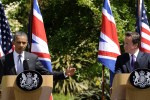
And the Word of the Day is "we". Both David Cameron and Barack Obama deployed it liberally in their joint press conference just now, as they ran through all the mutual pleasantries and backslapping that attends these events. "We have discussed the two things we care about the most," flushed Cameron, "getting our people jobs, and keeping our people safe." From there on in it was first name terms — "thank you, David" — and claims about the strength of our two countries' special, essential, unique relationship, etc. With the sun blazing down on the garden of Lancaster House, I'm sure the photos will turn out nice. Cameron appeared to be the more eager of the two men, however.

A good day for Cameron

From our UK edition

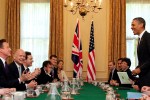
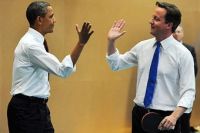
Today is one of those days when David Cameron gets full political benefit from being Prime Minister. He is basking in the president of the United States’ reflected glory. The papers this morning are full of him playing table tennis with Barack Obama and tonight’s news bulletins will lead on their joint press conference at lunchtime. As Cameron stands next to Obama, he’ll look both a statesman and a centrist. It’ll be hard for Labour to attack Cameron as an extremist on deficit reduction when he keeps stressing how he and Obama agree on a sensible level and pace to get their budgets heading back into balance. There are, obviously, substantive foreign policy issues for the two men to discuss. Both Libya and Afghanistan are in need of urgent attention.

The state of the NHS

From our UK edition

I know most CoffeeHousers aren't particularly enamoured of paywalls, but the Times has given you a persuasive reason (£) to dive behind theirs today. (Or least to borrow a copy of the paper.) It's the first of three reports by Camilla Cavendish on the NHS, this one concentrating on the Way Things Are Now. It is both a disheartening read and a powerful reminder of how taxpayers' cash is being funnelled into a system that is dysfunctional in the extreme. Here is one snippet for your displeasure: "Care in Britain ranges from world-class to shocking. Between 1998 and 2006, 1.6 per cent of bowel cancer sufferers died within a month at the Manchester Royal Infirmary, compared with 15.6 per cent at Queen’s Hospital, Burton upon Trent.

The Tory divide over European bail-outs

From our UK edition

As Obama and Cameron played table tennis yesterday, a considerably more furious game was being waged between the government and Tory backbenchers. It related to a Parliamentary motion tabled by Mark Reckless – and described here – that sought to stem UK involvement in any future bailouts for eurozone countries. All well and good, you'd think, until a rival amendment percolated down from on high to dilute Reckless's proposals. This new amendment would only go so far as to "urge the Government to raise the issue of the [bailout mechanism] at the next meeting of the Council of Ministers of the European Council". The green benches were set for a violent back-and-forth 'tween one side and the other. The outcome of all this was revealed yesterday evening.

A good time to go

From our UK edition

Today is, as the saying has it, a good day to bury bad news. With President Obama on the ground and an ash cloud in the air, not much else is going to get a look in on the news’ bulletins. But it is worth noting that Nat Wei, the government’s big society advisor, has quit his role today having scaled back his involvement in February. Wei has been pretty detached from Downing Street for the last few months, his role rather usurped by Cameron’s big society ambassadors, Shaun Bailey and Charlotte Leslie. So his departure won’t make much difference to the government. But it is still rather embarrassing as it gives the press another chance to dredge up all the political problems with the whole Big Society agenda.

Choppers add to the Libyan fog of war

From our UK edition

There was much ado about choppers in Westminster earlier today. Yesterday, French Defence Minister Gerard Longuet told reporters that Britain and France were to deploy attack helicopters to Libya; and that the British had instigated this move. The fog of war then descended. Labour’s defence spokesman Jim Murphy called on the British government to explain why the conflict is escalating. Armed Forces Minister Nick Harvey contradicted Longuet's account; and a source at the Ministry of Defence told me that this was the first he’d heard of helicopters being deployed to Libya in that role. The implication was that the French were trying to force the issue. Then again, a separate MoD source has told the Guardian that the “chances are it is going to happen”.

A coup for the Tories?

From our UK edition

The Tories are cock-a-hoop about the defection of UKIP MEP David Campbell Bannerman – positively crowing, in fact. “There’s nothing more satisfying,” said one CCHQer, “than UKIP suffering.” Activists and MPs alike reckon that the Conservatives could have won a majority last May if it weren’t for UKIP in the south-west. Vengeance is sweet, but is it of lasting importance? Campbell Bannerman has used a blog post to justify his action: David Cameron is an inspiring leader and an avowed eurosceptic. Perhaps it will become a salve for the right, increasingly seen as Cameron’s blind spot. Equally, the answers Campbell Bannerman gave to Total Politics’ Amber Elliott could be used in the tussle for wavering eurosceptics.

Clegg: No MP is above the law

From our UK edition

The sun shone on the deputy prime minister at DPMQs earlier today. Nick Clegg usually wears a grimace at the despatch box; but he was assured this morning, successfully defending a Labour onslaught on the NHS reforms. There were even flashes of, well, Flashman. He replied to a question from Chris Bryant by quipping, “Every time the Honourable member asks a question, I wonder why anyone bugged his phone.” Clegg also rebuked John Hemming for breaking the Giggs super-injunction yesterday; a popular move among those MPs who think Hemming degraded parliamentary privilege. Clegg said: “I don’t think anyone should be above the rule of law. And if we don’t like the law in this place then we should act as legislators to change the law, not flout it.

The austerity hasn’t started yet

From our UK edition

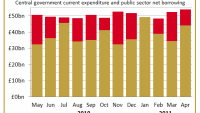
Another month, and another all-time record for state spending in Britain. The government splurged £1.8 billion a day in April — of which £332 million a day was borrowed. Up goes the national debt. All of which leaves us with the question: where is this austerity that George Osborne keeps talking about? He's been in No.11 a year now, and each month state spending has been — on average — 4.9 per cent higher than the same month under Gordon Brown. He seems to be taking the St Augustine approach to fiscal conservatism: Lord, give me spending restraint. But not yet. The below graph shows state spending, per month. The amount in red is how much the government had to bum from the City: This does not look so much different to Labour's plans.

Gove strikes to ease the removal of bad teachers

From our UK edition

The quality of teaching in schools is one of the main determinants of how well a child does. But, shockingly, in almost half the local authorities in England a teacher hasn’t been sacked for being incompetent in the last five years. Retaining sub-standard teachers has harmed the life chances of goodness knows how many children. So the news that Michael Gove is now consulting on rules that will make it far easier to fire bad teachers is welcome. The Gove proposals give heads much more control and enable them to get rid of a poor teacher in a term; at the moment it takes at least a year and is a bureaucratic minefield which is why so many schools shy away from taking action against those who aren’t up to the job.

Stop Gordon Brown

From our UK edition

Gordon Brown's friends have launched a shameless effort to compel the government into nominating him for the IMF post. The government would be mad if they did. Mad. This is not about petty score-settling, as yesterday's Evening Standard would have it. This is about qualifications to lead, and the former Prime Minister, despite his intellect, does not have those skills. He led the country to ruin and remains in denial about it: he saved the world, don't cha know. The UK should be smarter about using talent from across the House, but there are limits. And it is a bit rich for the ex-PM's friends to argue that David Cameron should back him. This is the man who gave lukewarm support to Paddy Ashdown's candidacy to run the UN in Kabul back in 2008.

Cutting through the BS

From our UK edition

If the Big Society were a horse, it would be shot. The wounds are too deep, the contamination too great, its legs are broken. And, worse, the Big Society is giving a good idea a bad name. David Cameron tried manfully today, but we only ever hear about the BS (as most Tory MPs call it) when he’s trying to relaunch it. No agenda can be sustained with such thin support. It has become hopelessly confused as an issue. Myths have crept in that volunteering relies on heavy state spending, so Cameron is talking out of his hat. It ain’t so — Jonathan Jones did the digging — but people still believe it. Cameron gives multiple definitions of the BS, confusing the issue further. Does it mean families? Diversity of public service providers? More volunteering?

What the attorney general needs to do

From our UK edition

I’m sure that all CoffeeHousers know who the footballer is with the super injunction preventing newspapers from publishing anything about his affair with the Big Brother contestant Imogen Thomas. But if you didn’t, the papers would have made pretty odd reading over the past few days because the press keeps making little in jokes that are only funny if you know the player’s identity. David Cameron this morning announced that he knew the identity of the player.  This highlights one of many ironies of the situation, which is that far more people are now aware of who the errant footballer is than would have been if the news had just come out and been a two day tabloid story.

Why Miliband needs to be more specific — and quick

From our UK edition

Ed Miliband owes Coffee House contributor Ed Howker a drink. In his speech today, the Labour leader borrows the central idea — and the title — of the stunningly insightful book that Ed wrote with Shiv Malik last year, Jilted Generation: How Britain Bankrupted its Youth. It is, basically speaking, the idea that the current generation of twenty-somethings is, in many respects, disadvantaged in comparison their baby-boomer forbears. From the burden of dealing with debt, both personal and national, to the fluctuations of the housing and labour markets, young people are up against it. And it may get worse. As Miliband puts it, "I am worried — and every parent should be worried — about what will happen to our children in the coming decades.

Going big on the Big Society

From our UK edition

You certainly can't fault David Cameron for his perseverance. Six years after pushing the thinking behind the Big Society in his pitch for the Tory leadership, and three relaunches of the idea later, he is still at it in a speech today. He will, apparently, stress that the Big Society is not some nebulous nothingness — but, rather, "as gritty and as important as it gets". And as if to underline the point, the PM will announce some solid new measures to bolster his grand projet, such as £40 million of extra funding for volunteering. Cameron is, I suspect, making this case for two main reasons: to counter criticism of his Big Idea and to present a sunny flipside to the cuts, cuts, cuts. But an accident of timing adds to the resonance of this speech.

More thoughts on Cameron’s Cabinet of the undead

From our UK edition

CoffeeHousers raised some very good points about my post on Cameron’s undead ministers. I thought I’d reply in a post, rather than the comments thread. 1. About the ‘undead’. Cameron leads a radical government of surprisingly competent people: the ambitious tasks of welfare and school reform are testimony to how far he is moving. Cameron’s policy is to delay a reshuffle for as long as he can. While Blair did reshuffle a lot, he tried his best not to do so to satisfy the media headlines. This is when the concept of undead ministers first arose. You’d have people like Geoff Hoon in defence and Stephen Byers in transport, who obviously had to go — but Blair would wait until the media stopped saying so.

Cathy Ashton beats UK ministers to Bengazi

From our UK edition

EU foreign policy Tsar Catherine Ashton has come under a lot of criticism, much of it unfair and/or put forward by those who want the EU to supplant the member-states. In this piece, I have tried to defend her. I argue that her realistic take on the EU’s role is in the UK’s interest: the last thing London needs is someone who ignores member-states to build an independent foreign policy. And she has managed to get Europe’s SAHEL policy in a better shape, worked closely with William Hague and Guido Westerwelle to coax Serbia into negotiations with Kosovo and helped to solve, at least for the moment, a crisis in Bosnia. For these reasons, she retains the support of David Cameron and William Hague.