Uk politics

Who’s right on public v private employment?

If you listened to PMQs yesterday, then you'll have heard two very different accounts of what's happening in the labour market right now. Had Ed Miliband been able to get anyone's attention, they'd have heard him say: 'over the last three months, for every job being created in the private sector, thirteen are being lost in the public sector.' Cameron's response: 'Since the election, in the private sector there have been 581,000 extra jobs. In the public sector, he's right, we have lost 336,000 jobs.' According to the Labour leader's figures, public sector losses are far greater than private sector growth. But according to Cameron's, the private sector is more than filling the gap. Why the difference? It comes down to the timescale you chose.

The growth script still needs writing

The Times is being a bit harsh on Cameron in its leader this morning. 'On the economy', it says, 'Cameron has contracted out policy to George Osborne and then followed the usual (although not invariable) practice of postwar prime ministers of supporting his Chancellor's decisions. But he has not added to this a convincing contribution of his own.' Yes, Cameron has not done very well articulating his government's growth policy. I've also noticed that he is not much good at describing the Loch Ness Monster and for the same reason. Unconfirmed rumours of its existence whirl around now and again. Grainy photos of something supposed to be a UK growth agenda surface. But when expeditions are sent out to prove its existence, they invariably fail.

Cameron targets his resources at problem families

The Prime Minister's message today is, basically, that he hasn't forgotten about the riots. In a speech this morning, he's going to announce his biggest new policy in response to them so far: a network of 'troubleshooters' who will work with 120,000 of the country's most unstable families, with the aim, of course, of stabilising them. The idea is that the troubleshooters can help coordinate various services — from police to Job Centres –— to focus on these people. According to the Sun, the families will, in turn, face 'tough penalties' if they don't cooperate. Some of you may be wary of this scheme — and it's easy to see why. I mean, yet more local authority lackeys swarming through the streets?

Cameron’s warning to his applauding backbenchers

David Cameron was greeted with a full-on, desk banging reception at the 1922 Committee. The applause only stopped when the chief whip told the assembled backbenchers to sit down. The Prime Minister’s message was that the next year is going to be even tougher than the 1979-81 period. He argued that the government needed to be even bolder to show that it wasn’t just a technocratic government but one motivated by a desire to help families who do the right thing, but sadly no MP pressed him on how that fitted with the coalition decision to increase out of work benefits by more than 5 per cent. One other interesting thing was that Cameron stressed to his party that they had to reach 2015 with the coalition in good order.

Miliband crumples to a new low in PMQs

Inept, useless, incompetent, maladroit, hopeless, clumsy, crap. With thesaurus-rifling regularity Ed Miliband comes to PMQs and delivers a performance which is inept, useless, incompetent, maladroit, hopeless, clumsy and crap. The only virtue the Labour leader has is consistency. He’s consistently worse than last week. In theory he should have scored some damage today. Unemployment is soaring. Growth seems grounded. Cabinet ‘partners’ scuffle in public whenever they get the chance, and Nick Clegg changes his mind as often as he changes his socks. And Miliband’s tactics had some merit too. By disinterring the PM’s New Year Statement from January 2011 he was able to open up the Coalition’s wounds and have some seasonal fun at their expense.

Cameron pummels Miliband in PMQs

Today, was yet another reminder that David Cameron knows just where to hit Ed Miliband to make it hurt. After a few questions on the economy, Miliband moved to Europe — the coalition’s greatest vulnerability. Miliband joked that it was ‘good to see the deputy Prime Minister back in his place’, before mocking the coalition’s divisions over Europe. Cameron began his reply by saying it was no surprise Tories and Lib Dems don’t agree on Europe before saying that the split on the issue could be exaggerated: ‘it’s not like we’re brothers or anything,’ Cameron said in his most mocking tone. At this line you could see the Labour benches deflate and one of his aides visibly winced.

Clegg in the spotlight

All eyes at PMQs will be on a man who isn’t speaking, Nick Clegg. His refusal to attend the Prime Minister’s statement on the European Council means that today he will be the centre of attention. Labour will attempt to embarrass him as much as possible, trying to highlight both the divisions in the coalition and the impotence of the deputy PM. For its part, the press will read an awful lot into his body language every time Cameron mentions the E or V words.   The worry for the coalition is that this split over Europe is just going to keep repeating. There are going to be many more European summits where Britain will be in the minority between now and 2015.

Lansley stakes his claim on the post-2015 budget

Look slightly to the left, CoffeeHousers, and what you'll see is the cover image to this week's Christmas double issue of The Spectator — a brilliant send-up of Bruegel's ‘The Hunters in the Snow’ by Peter Brookes. You're now able to buy your own copy, but we thought we'd pull out an intriguing little snippet from James Forsyth's interview with Andrew Lansley, by way of a taster. The Health Secretary, it seems, isn't just determined to see health spending rise in real terms in this parliament, but beyond that too: ‘I ask him whether, despite the ramifications of the autumn statement, the NHS budget will still be immune from cuts.

Who will say sorry to Rupert?

Welcome to the world of journalism, Nick Davies. So the cops in Surrey told you the story was true — or so you claim. The cops at the Yard told you it was true — or so you claim. Every aching bone in your reporter’s anti-Murdoch body told you it was true. But there was a problem — as we all now know today. The Milly Dowler story that led The Guardian on that fateful day back in July was untrue: there is no evidence to show that the News of the World deleted Milly's voicemails. So what price has Nick Davies paid since he tried to slip his deliberately unintelligible apology into Page 10 of The Guardian on Saturday? None at all. Not suspended. Not sacked. What price has Alan Rusbridger, the paper’s ho-hum £500,000-a-year Editor paid?

Was the PM reasonable?

As the effects of last week's European Council become clear, debate about the rights and wrongs of David Cameron's diplomacy hinge on one question: were his demands ‘reasonable and modestly expressed’, as a source in No 10 put it to me? Everyone knows that there were chronic failures in the run-up to the meeting itself. I laid a few of them out in an earlier post, but, basically, they amount to a failure of prioritisation: the UK eroded the goodwill it needed by fighting tooth-and-nail on every issue beforehand, thereby blocking things that other EU states care about but which are not important, except symbolically, to the British. International — and especially European — cooperation is about give-and-take. It cannot just be take.

Inflation down, but the squeeze goes on

Has Mervyn King's downwards trend in inflation, promised for over a year now, finally arrived? After all, going by today's figures, inflation has now dropped for two months running. CPI inflation is at 4.8 per cent, and RPI is at 5.2 per cent. What's more, we can expect them to fall even further once the effect the VAT rise is removed in January: But I wouldn't get too excited just yet, CoffeeHousers. Sure, most forecasters have inflation going down from here into the foreseeable future — but, don't forgot, we're still being subjected to pretty high inflation, with CPI over double its target level. And, crucially, even by the OBR's forecasts, inflation is set to outpace wages until at least the end of next year.

Where we are now

Reading through the paper's this morning, it's even clearer that we didn't learn much from that marathon Europe debate yesterday. But here are my thoughts, anyway, on where it leaves us: 1) Ed Miliband lacked credibility from the outset. As Malcolm Rifkind put it, he’s had three days to work out whether he’d have signed that Treaty or not — and he still can’t make his mind up. God knows Cameron is vulnerable on this, but he won’t be hurt being attacked for indecision by a man who still cant make any decisions. 2) Clegg’s misjudgment, cont? First, Clegg backed Cameron after the veto. Now, he says he disagrees with Cameron.

Whatever Chris Huhne says, Durban hasn’t changed anything

This morning the Department of Energy and Climate Change (DECC) told us that the climate summit in Durban, which concluded over the weekend, has been ‘heralded a success’. As they say, the ‘talks resulted in a decision to adopt the second commitment period of the Kyoto Protocol next year in return for a roadmap to a global legal agreement covering all parties for the first time’. Should anyone be heralding that as some kind of step forward? Was I wrong to be sceptical last week? As it happens, the various parties were actually trying to secure that ‘global legal agreement’, covering all of them, two years ago in Copenhagen — not just talking about securing it in the future.

Good news from Brussels

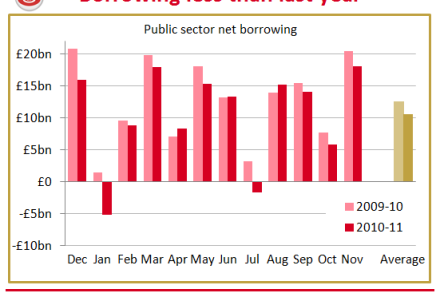
While the debate over Europe rumbles on, it's worth highlighting one bright spot in the OBR's recent document of doom which has largely slipped past Westminster's radar: by their forecasts, we will pay the EU £2 billion less this year than we were expecting to in March. Instead of the £9 billion 'net contribution to the EU budget' forecast for 2011-12 nine months ago, the OBR now estimates it'll be £6.9 billion. That represents a 17 per cent real terms cut on the £8.1 billion we paid last year, instead of an 8 per cent increase: Why the reduction? The OBR gives a few reasons:  By themselves, each of these factors means just a few hundred million less sent to the EU.

Your three-point guide to today’s RBS report

After months of delay, and much hounding by The Spectator's Select Committee Chairman of the Year, Andrew Tyrie, the Financial Services Authority has finally released its report into the wheezing collapse of RBS in 2008. At 452 pages it is a behemoth of a document, and too much for me to have fully digested yet. But a few points stand out at first glance: 1) Don't blame us, blame Gordon. The Tories are making much of the fact that only three politicians are mentioned in the report: Tony Blair, Gordon Brown and, most relevantly, Ed Balls. And they're not mentioned in a particularly flattering context, either. All three are quoted to partially justify the FSA's regulatory approach in the run-up to the RBS debacle.

Expect today’s eurosceptic celebrations to be muted

The real Tory celebration of David Cameron's veto will be on Wednesday. Then, behind closed doors, Cameron will address the 1922 Committee of Tory backbenchers. With no Lib Dems present, the Tories will be able to thump the desks and be rude about the EU without worrying about what their coalition partners might think. But in the chamber today, Tory MPs are being urged to be calm and forensic. The whips keep pointing out to ambitious MPs that a question on what Labour's position is would be most helpful. Eurosceptics, though, should be in good cheer today even if Cameron's statement is more downbeat than they would like.