Uk politics

How serious is Miliband?

From our UK edition

The Tories reckon that Ed Miliband’s proposed donation cap of £5,000 is a con that will hit their funding every year, while preserving Labour's funds except at election time thanks to the union levy being exempt. Housing minister and regular attack-dog Grant Shapps laid out the party's position on Andrew Neil’s BBC Sunday Politics show earlier today. Here is the transcript of their exchange: Shapps: Well I watched the interview and I thought this sounds big and important, so to a quick look afterwards and discovered that of the £10m Labour got from the unions last year, they still get 9.9 million of it, so this is a complete wheeze, one of the most disingenuous interviews I think I’ve seen all year.” Andrew Neil: Really?

The politics of taking big money out of politics

From our UK edition

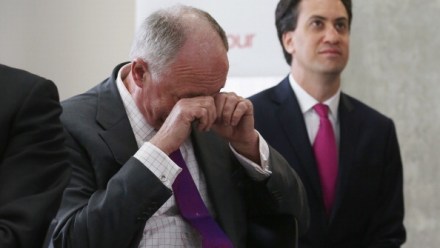
Ed Miliband is nothing if not persistent. Party funding has been a running theme of his leadership, necessitated by his cosy relationship with the unions. He has returned to the subject today, with a blog post and an appearance on the Andrew Marr Show. The news is that Miliband wants to cap donations from individuals, organisations and companies at £5,000. That is £5,000 less than was recommended by Sir Christopher Kelly, and £45,000 less than the Conservatives propose. Miliband claimed that this would dramatically reduce Labour's funding from the trade unions, forcing his party to diversify its revenue sources. Obviously, it would also reduce the Tories' funding sources.

The charity row intensifies

From our UK edition

David Cameron finds himself in the midst of a blue-on-blue barney over the charity tax, which has prompted rumours that ministers may dilute the current proposals by adopting an American-style legacy deal. Tory party treasurer Lord Fink has said that the proposed changes would ‘put people off giving’, and some boisterous Conservative MPs are openly challenging the leadership. Zac Goldsmith has penned a diatribe in the Mail on Sunday in which he says: ‘I am ashamed that a Conservative Chancellor has not only announced measures that will undoubtedly depress giving in this country; he has spun a narrative in which philanthropists are now the enemy.

Downfall

From our UK edition

It did not take long. Last month, Matt Ridley argued in a Spectator cover story that the wind farm agenda is in effect dead, having collapsed under the weight of its own contradictions. The only question is when our ministers would realise. In an interview with the Sunday Times (£), climate change minister Greg Barker admits that his department has adopted an ‘unbalanced’ approach to wind farms and will now look at other options. ‘Far from wanting thousands more, actually for most of the wind we need… they are either being built, being developed or in planning. The notion that there’s some new wave of wind [farms] is somewhat exaggerated.

An independent Scotland could pay its own way<a id="fck_paste_padding"></a>

From our UK edition

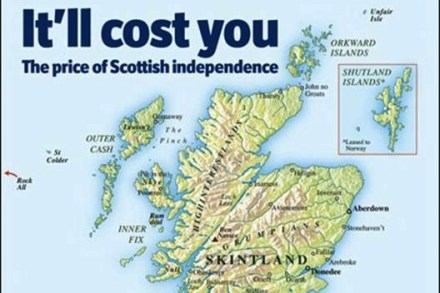
The Economist has some fun with Scotland this week, running a cover suggesting my motherland would go bust if it was independent. The map has lots of gags: the Outer Hebrides is renamed ‘Outer Cash’, ‘Edinborrow’ twinned with Athens etc. But it suffers from one central defect: the thesis is nonsense. Saying that Scotland would go bust without English subsidy is the clichéd unionist attack line, which has lost force over the decades because it is demonstrably untrue.

Why Lansley might hang on

From our UK edition

Perhaps, the biggest question about the post-Olympics reshuffle is what happens to Andrew Lansley. In an interview with The Times (£) today, he makes it abundantly clear that he expects to stay at Health. Now, there are certainly those in Downing Street who would like to see him moved. But I suspect that he’s got a better chance of staying in post than most people realise. There are three reasons for this. First, Lansley is the person who understands best what the bill actually does. Anyone else on the Tory side would face a steep learning curve. Second, it is far from certain that a slicker communicator would actually fare better than Lansley has.

The Blair-Brown wars continue

From our UK edition

It took the Tory party 15 years to recover from the bad blood created by Margaret Thatcher’s forced resignation. So it is, perhaps, unsurprising that five years on, the bitterness from Tony Blair’s being pushed out of office has not yet subsided. Phil Collins, who was a speechwriter to Blair, has today written a scathing piece about Tom Watson, the leader of the so-called curry house coup against Blair. Collins accuses Watson of putting the ‘occupation of internal power’ in the party by his faction above the interests of the Labour party.

How Mitt Romney inspired the British charity tax debacle

From our UK edition

How is Mitt Romney linked to the charity tax debacle? I thought I'd pass on to CoffeeHousers an explanation which passed on to me about the origins of this latest mess. It dates back to the point in the Budget negotiations where Nick Clegg had finally persuaded Osborne to introduce a Mansion Tax. A major coup for his party — but Cameron vetoed, thinking it'd hurt Boris in London. Clegg is annoyed, tells Osborne he can't have his 40p tax, but he still has a problem. A Lib Dem spring conference is coming up — so what will he announce? He hunts for a new idea. The Thursday before the Lib Dem conference, he’s having a late-night brainstorming session in the Cabinet Office with his aides — fuelled by a drop of whisky.

Cameron meets Aung San Suu Kyi

From our UK edition

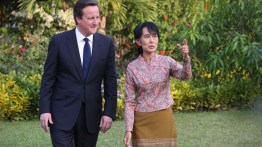
There aren't many countries where meeting the leader of the opposition would rank above meeting the head of government — certainly this country isn't one of them. But Burma is, because the leader of the opposition is pro-democracy campaigner and Nobel Peace Prize winner Aung San Suu Kyi, who spent 15 years under house arrest between 1989 and November 2010. And Suu Kyi's stature is now higher than ever, with her National League of Democracy party having won 43 of the 44 seats they contested in the by-elections a fortnight ago. As Clarissa reported then, there's even speculation that she may be offered a position in President Thein Sein's new Cabinet.

Another case of Big Government trumping the Big Society

From our UK edition

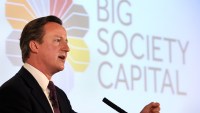
Exactly two years ago today, David Cameron launched the Conservative Manifesto — one of those rare moments in the Tory campaign where it all seemed to make sense. Cameron begged for a hearing: he was serious, he said, about changing government. It was about realizing that ‘Big Government isn’t the answer to the problems’ and that people outside government — like charities — were. This is why the charities debacle today is not just another Budget blunder. As I say in my Telegraph column, if Cameron tolerates the taxman’s proposed assault on philanthropy, he’ll be admitting defeat on what he described that day as his ‘fundamental tenet’.

Planet London

From our UK edition

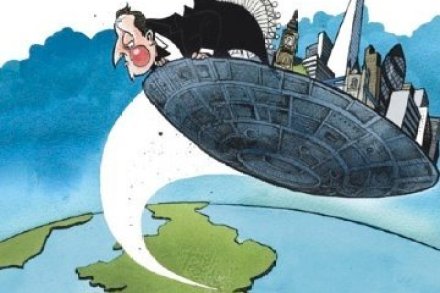
In his cover piece for this week's magazine, Neil O'Brien describes the great divide between London and the rest of the UK. One of the main differences he highlights is in their economies. He says: 'In inner west London, economic output per head is £110,000 a year. In an important sense, these people are not living in the same country as the inhabitants of Gwent or the Wirral, whose output is just a tenth of this.' In fact, London is set apart not just from those two poorest areas, but every other area in the country. You see, the second richest area — Edinburgh — has an output per head of £35,000 — just a third of inner west London's. And the third richest area? Inner east London.

The resistance to elected mayors shows how badly they’re needed

From our UK edition

The old political establishment in the cities is fighting back against the idea of city mayors. They know that a directly elected mayor threatens their traditional power base. As Jill Sherman reports in The Times today, ‘In Nottingham, the Labour council has put up posters around the city to demonstrate its opposition while the Labour group has sent newsletters to residents saying that a “Tory Extra Mayor” will cost £1 million.’ But it is not just Labour councils who are desperately trying to stop yes votes on May 3rd. Lib Dem-run Bristol City Council is also fiercely against the idea of a directly elected mayor.

Want to know what tax transparency looks like? Look at Norway

From our UK edition

If you take George Osborne’s plan for tax transparency to its natural conclusion, where do you end up? The answer is Norway, where details of every taxpayer’s annual income, wealth and annual tax return are publicly available — and it’s not a new thing. Norwegian tax returns have been publicly available since the 1800s, the idea being that financial transparency is seen a vital part of social democracy. Figures were traditionally released every October in a Yellow Pages-style book, available for anyone to read at the local town hall or tax office. As the internet evolved, they decided to take things online.

Hints of a U-turn on the ‘charity tax’

From our UK edition

The pressure is ramping up on the government to reverse its decision to cap tax reliefs on charitable donations. The Times is against it — their leader this morning calls the move a 'blunder'. And the Telegraph doesn't like it either, saying that 'Even from a distance of 8,000 miles, it must be apparent to David Cameron that the Government made a mistake in the Budget by capping tax relief on charitable giving'. Even Tory MPs are speaking out against the measure, including Mark Pritchard, Conor Burns and, in a piece on ConservativeHome, Chris White. And Number 10 does seem to be preparing the ground for a U-turn — or a compromise at least — with David Cameron saying yesterday that 'We will look very sympathetically at these concerns'.

Where will the disenchantment with mainstream politics lead?

From our UK edition

The big question in British politics right now is what happens when the voters are dissatisfied with all the three main parties and their leaders. According to a recent opinion poll, David Cameron’s approval rating is now down to minus 27. According to the invaluable Anthony Wells, this is the lowest it has been since Cameron became Tory leader. But the PM’s numbers look positively healthy compared to Miliband's (minus 41) and Clegg's (minus 53). Dissatisfaction with political leaders isn’t the only indicator that people aren’t happy. As I report in the column this week, senior Downing Street aides have been much struck by polling showing that more than 40 per cent of Britons would emigrate if they could.

A welcome attempt to fix the broken energy market

From our UK edition

Back in October, Ofgem produced a report exposing the failure of the UK's energy market. It showed that the supplier's profit margin on the average fuel bill had shot up from £15 to £125 in just four months. As I said at the time, ‘This wouldn't be possible in a market that was working correctly. If customers were shopping around for the best deal, suppliers would have to undercut each other – and there's plenty of room for them to reduce prices while still turning a profit (£125 of room, in fact). But Ofgem's figures show this isn't happening.’ And why isn't it happening? Because, in Ofgem's words, ‘Many consumers see the energy market as complex and hard to navigate.

Shapps has ‘deep reservations’ about the ‘conservatory tax’

From our UK edition

There is deep unease among Tory ministers about the proposals for a so-called ‘conservatory tax’. The idea, which was pushed hard by Chris Huhne when he was Energy Secretary, is that when anyone does substantial home improvement work they would be made to make other changes to make their house more energy efficient. It is estimated that this would add about 10 percent to the cost of adding a conservatory or an extension to your house. The government is currently consulting on the policy. But I understand that Grant Shapps, the housing minister, has ‘deep reservations’ about it. He fears that the proposals are anti-aspiration and could risk bolstering the impression that the coalition is out of touch.

The rise of UKIP

From our UK edition

Who represents the biggest obstacle to a Tory majority in 2015? The natural assumption is Labour, but it's looking more and more likely that the party David Cameron should be most worried about is UKIP. Tim Montgomerie has written in the Times this morning (£) about the reason behind this, the 'split of the right-wing vote': 'Team Cameron has always believed that the Tories’ right-wing voters could pretty much be taken for granted. The theory was that they had nowhere else to go and that Mr Cameron had to devote all his energy to winning swing voters.