Uk politics

Is Ken done for?

From our UK edition

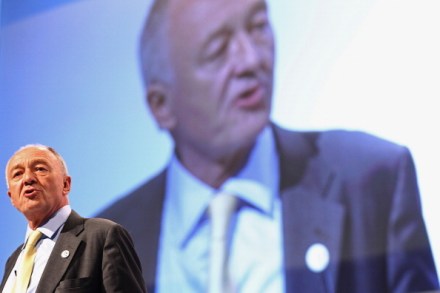
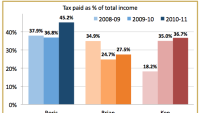
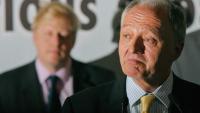
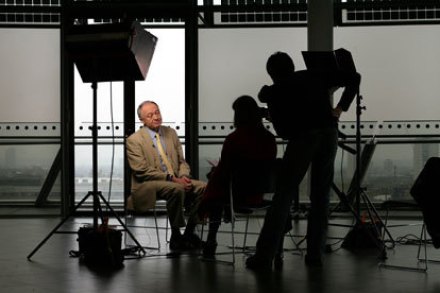
Last night, during their television debate, all four London Mayoral candidates declared they would fully disclose their tax returns. This morning, Boris, Brian Paddick and Jenny Jones have duly done so — but Ken? Nothing so far. The Labour team has put out an unpersuasive statement explaining his silence:   'We believe household publication is necessary for full disclosure as the question of Ken’s income and his wife’s income and their tax has been central the coverage of this issue. Publication of Ken’s returns alone will not address many of the questions that have been raised. The only way to answer all the questions about this issue and to move the debate on the real issues facing London is for full household income disclosure.

Balls goes on the attack over tax credits

From our UK edition

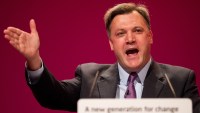
After all the commotion about various policies in last month’s Budget, the focus this morning has shifted to measures announced back in 2010. Why? Because they take effect tomorrow. So Ed Balls is taking the opportunity to hit the government hard on what he calls its ‘tax credit bombshell’ for those on middle and low incomes. Labour are pointing to figures from the IFS, which show that changes to child and working tax credits will outweigh the rise in the £630 personal allowance. In their Budget briefing a fortnight ago, the IFS calculated that the net effect of all the changes coming into force tomorrow would be an average loss of £511 for households with children.

The coalition to defeat Ken Livingstone

From our UK edition

The most striking thing about tonight’s mayoral hustings on Newsnight was how often Brian Paddick attacked Ken Livingstone. Paddick, who turned in the most assured performance of all the candidates, accused Livingstone of being like a ‘bad 1970s comedian who plays to whatever audience he’s talking to.’ He also, interestingly, sided with Boris Johnson when the discussion turned to the 50p tax rate and then the candidate’s own tax affairs. It is tempting to see Paddick’s performance tonight as testament to how keen the Liberal Democrat top brass are to see Livingstone defeated in London.

Cameron’s tragic flaw

From our UK edition

The latest issue of The Spectator is out tomorrow, of course – but we thought CoffeeHousers might like to read this piece by Ross Clark in advance. It’s about what he calls David Cameron’s ‘tragic flaw’: impoliteness. Premierships do not end in failure, as Enoch Powell once asserted, but in tragedy. They start with a beaming figure disappearing behind the door of No. 10 - even Edward Heath, immortalised now as the Incredible Sulk, entered with a radiant grin. And they end with a haunted shadow of a politician creeping out to a waiting car, his every character flaw having been chiselled to destruction. Over the past week, the tragedy of David Cameron has become apparent.

Ed Davey’s ‘pro-European’ claim has Tory ministers fuming

From our UK edition

There’s barely disguised fury among Conservative ministers about Ed Davey’s claim that the coalition may well be more pro-European than the Labour government was. One complained to me earlier that it was typical Lib Dem mischief making and that ‘if they are not going to behave like normal ministers then we shouldn’t either’. Indeed, this minister went on to suggest that William Hague should publicly slap down Davey for his comments. I doubt this is going to happen. Davey is the leading Lib Dem on the Cabinet’s European Affairs Committee and I suspect there’s little appetite in the Foreign Office for a coalition row over Europe.

The Lib Dems will relish a scrap over civil liberties

From our UK edition

They're languishing in the polls, their leader is considerably more unpopular than either David Cameron or Ed Miliband, they face a difficult set of local elections in May — and yet the Lib Dems still seem relatively upbeat at the moment. Why so? Mostly, I think, it's because they feel that asserting themselves is starting to pay off. Not in votes, perhaps, but in perceptions. They cite the Budget as a defining moment in this respect: they got the increase in the personal allowance that they wanted, the Tories got most of the blame for everything else. That's why I suspect some Lib Dems will be quietly delighted at the last couple of days of news. Yesterday, the web surveillance plan. Today, secret justice.

Boris is right, but will anyone listen?

From our UK edition

The tensions that have been bubbling away in the London mayoral contest spilt out into the open today with Boris Johnson accusing Ken Livingstone of lying about both of their tax affairs. On the facts of the matter, it looks pretty clear that Boris is right: he doesn’t use a company to reduce his tax liability. There are, though, those claiming that accusing Livingstone of being an ‘f***ing liar’ will hurt Boris. But I doubt this; it is hard to imagine Boris as an angry or mean-spirited person. What this exchange does do, though, is raise the stakes for their televised hustings tomorrow night. I expect that Livingstone will try and rile Boris.

More poll woes for the coalition

From our UK edition

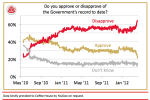
You certainly don’t need polls to tell you that it’s been a bad couple of weeks for the coalition – but we’ve got them anyway. Pete noted on Sunday that the government’s approval rating was at its lowest since the start of this Parliament, and it’s actually dropped another three points since. Today’s YouGov poll finds just 21 per cent giving the coalition the thumbs up, against 64 per cent who disapprove. That’s almost identical to the 20-64 split YouGov found for Gordon Brown’s Labour government back in January 2010. The below graph shows how public opinion has turned against the coalition over the past two years: Today’s poll also updates another important indicator: whom the public blames for the cuts we face.

Gove calls on universities to improve A-levels

From our UK edition

It may be a sleepy day in Westminster, but Michael Gove and his school reforms have lost none of their brilliant urgency. The schools secretary has today written to Ofqual — the body in charge of regulating the exams system — to ask that universities be allowed to involve themselves, much more closely than ever before, in designing and implementing A-levels. In the letter he sums up his plans thus: ‘I want to see new arrangements that allow Awarding Organisations to work with universities to develop qualifications in a way that is unconstrained — as far as possible — by centrally determined criterion.’ And he adds that this process should eventually allow ‘universities, not Awarding Organisations, to drive the system.

Boris to Ken: you’re a f***ing liar

From our UK edition

From the Guardian, reporting on this morning's Mayoral debate on LBC: ‘We've learned that things did not go well in the lift after the hustings was over. Boris went nose to nose with Ken in a small lift and told Ken three times: "You're a f***ing liar, you're a f***ing liar, you're a f***ing liar." Paddick and Jenny were also squeezed in, alongside James Rea, the LBC managing editor. Johnson's anger was due to claims made during the hustings by Livingstone about Johnson's tax arrangements, which the mayor flatly denies. He told me later that Ken's claims were "nonsense". Of course at that point we hadn't heard about the ding-dong in the lift.’ ITV’s Simon Harris reports that Boris's face was ‘red with rage’ during the confrontation.

Web surveillance plan divides the coalition

From our UK edition

The government’s under fire from members of both coalition parties over its plans to extend the state’s investigatory powers to cover new means of communication. Currently, under section 22 of the Regulation of Investigatory Powers Act 2000 (RIPA), public bodies can obtain communications data without the need of a warrant or any external authorisation. This gives them access to a wide array of information including the location, time, date and duration of a phone call or the IP address from which an email was sent.

A new Argy-bargy | 2 April 2012

From our UK edition

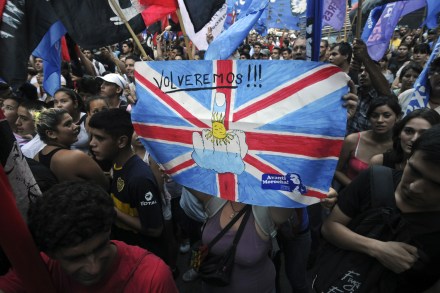
Another article to mark the 30th anniversary of the Falklands War — this one from the current issue of the magazine. It’s by John Simpson and analyses the current tensions between Britain and Argentina. Buenos Aires Buenos Aires is as exhilarating, as unpredictable, as stylish as ever. But the economic boom is over. Times are hard once again, more shops in Calle Florida are boarded up, the sales are pretty frantic. And so, as Jorge Luis Borges, the blind sage of Calle Maipu, just off the superb Plaza San Martin, once remarked: ‘When Argentina’s economy goes bad, you can be sure that nationalism will soon be beating its wings.

Cameron loyalists say his Tory critics are a small minority

From our UK edition

The drumbeat of criticism of David Cameron and George Osborne by various Tory MPs, summed up on the front page of today’s Telegraph, has drawn a reaction from those MPs loyal to the leadership. Kris Hopkins, the founder of the 301 group of Tory MPs, complains that the trouble is being whipped up by a ‘small group of disaffected people’ and that ‘the nature of their criticisms shows that this is about their egos not making the country a better place.’ At issue here is who speaks for Tory MPs.

Tory ire focuses on Dave’s uni friend

From our UK edition

The grumbling in the Conservative party at the moment is reminiscent of Tudor court politics. No one is prepared to criticise the king directly so instead various personal favourites of the monarch are targeted. At the moment, the chief proxy for discontent is Andrew Feldman. To the Cameroons’ critics, he sums up everything that is wrong with the way the PM and his team do politics. Feldman is co-chairman of the party not because of his standing in the party or the country but because he is a friend of Cameron. To further irritate their critics, their friendship dates back to them serving together on the ball committee of their Oxford college many years ago. As a friend of Cameron, Feldman has got away with errors that would have finished off others.

Now Cameron and Osborne take flak from their own side

From our UK edition

The bad headlines continue for Downing Street this morning, with the Telegraph front page declaring ‘Tory MPs round on Cameron and Osborne’. Of course, Tory backbenchers griping about their leadership is nothing new and, usually, ‘concern that Government policies are being poorly explained to voters’ or a suggestion that ‘a senior MP should be appointed as full-time Conservative Party chairman’ wouldn’t make the front page. But after the two week onslaught Downing Street has just suffered — from granny tax to cash for access to petrol panic to pasties — the disgruntled chattering reverberates that bit louder.

Cameron must take on Whitehall

From our UK edition

I doubt that, come the election in 2015, many voters will remember the row about putting VAT on pasties or Francis Maude’s advice to fill up a jerry can with petrol. But what will be on their minds is whether the government is competent and, to use that dread phrase, ‘in touch’ with their day to day struggles. It is for this reason that the key question about the last ten days is whether they make David Cameron realise that the civil service machine just doesn’t work anymore and that he needs to change the way he governs. The early indications on this front are encouraging. Those who have been involved in COBRA discussions these past few days have been shocked by how the failings identified during the fuel crisis of 2000 still exist.

Everyone’s a loser

From our UK edition

Have the opinion polls ever looked more discouraging, overall, for the Tories during this government? Not that I can remember, although I'm happy to be corrected. Not only does YouGov's poll for the Sunday Times (£) have Labour ahead by nine points, but there are also some pretty dismal supplementary findings. For YouGov, both David Cameron and the coalition score their lowest approval ratings since the start of this Parliament. For ComRes in the Independent on Sunday, 72 per cent of respondents reckon the government is ‘out of touch with ordinary voters’; 81 per cent say the government created ‘unnecessary panic’ over fuel; and so on. It's probably no surprise that Tory MPs are now telling the Indy that ‘It is a friggin' shambles’.

Cameron needs a proper solution on party funding — and soon

From our UK edition

Today's ‘cash for access’ revelations (£) are, taken individually, less perturbing than last week's. What we learn is that David Cameron (and other ministers) met with donors on occasions (and at locations) other than those already disclosed, and that Peter Cruddas was more involved with this process than Downing St would have us believe. There is very little added to the most serious allegation from a week ago: that big money donors could gain special insights in the policy process, or even involve themselves in it. But, taken as a whole, today's revelations are extremely tricky for Cameron. Not only do they keep the story going, but they also highlight how absences of transparency will often be probed and exposed.