Uk politics

Surprise? Gordon Brown sets out devolution timetable

From our UK edition

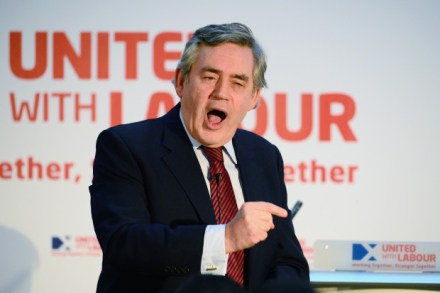
Is Gordon Brown going on a freelancing operation with his timetable for new powers for a Scotland that votes 'No'? The former Prime Minister has this afternoon released the timetable for further devolution, with the formal process beginning the day after the result, leading to a draft Scotland Bill being published by Burns Night in January 2015.
Alistair Darling: I’m still confident No campaign will win

From our UK edition

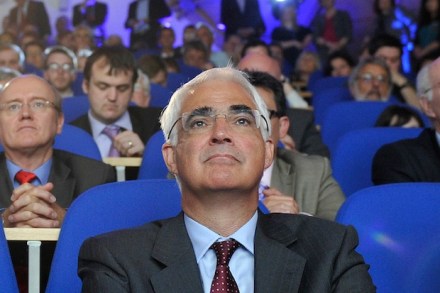
Alistair Darling continues to insist that he's confident of victory in the Scottish independence campaign, telling the Today programme this morning that 'I am confident that we will win, because we do have a very strong positive vision of what Scotland can be'. But he didn't strengthen that vision either with further promises about powers that Scotland could expect in the event of a 'No' vote, or indeed with any change of tack in his campaign rhetoric. The former Chancellor's arguments this morning were very much those he has doggedly stuck to all along that have held back wavering voters from supporting 'Yes'. But when 'Yes' has the Big Mo, surely there needs to be something else to counter it from the 'No' camp?

People power can save the Union

From our UK edition

If Scotland does vote for separation—as the latest YouGov poll suggests it will, we’ll enter the most unpredictable political period in living memory. But before we start contemplating the consequences of a Yes vote, it is worth thinking about what is giving independence momentum in Scotland. It is not just being driven by nationalist fervour but by the same anti-politics sentiment that is riling politics right across the United Kingdom. Voters who are fed up with Westminster and disappointed by politics are seeing voting Yes as a chance to rip up the whole system and start again. Breaking up the United Kingdom is, perhaps, the ultimate expression of anti-politics.

Come in Britain, your time is up

From our UK edition

How do you kill an idea? That is the Unionist quandary this weekend. For a long time now the Better Together campaign has based its hostility to Scottish independence on the risks and uncertainties that, unavoidably, come with independence. This, they say, is what tests well with their focus groups. No-one gives a stuff about all that identity crap, they say, so there's no need to talk about it. Instead, hype the unknowns - of both the known and unknown variety - and bang on and on about all that risk and all that uncertainty. Which, like, is fine. Until the point it ceases to be fine. Until the point at which it stops working. Which, like, would be right about now. YouGov's previous poll was an Oh fuck moment for Unionists.

Shock poll: Scotland’s ‘Yes’ campaign pulls into lead. It’s 51% to 49%

From our UK edition

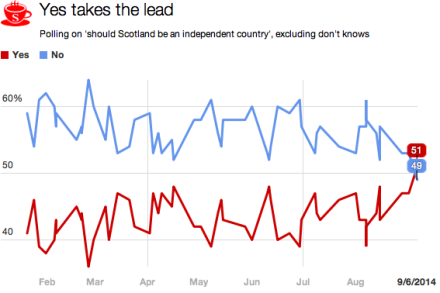
Tomorrow's Sunday Times poll by YouGov puts the Yes campaign ahead at 51 per cent, with No on 49 per cent when undecided voters are excluded (even when they're included, 'yes' are still ahead by two points: 47-45). In the space of four weeks, 'No' has blown a 22-point lead. It was only recently that the No campaign started to wonder whether this could happen: previously there was an acceptance that the polls could narrow in the last few weeks, but the narrative was that the SNP were behind and were simply trying to engineer a close enough defeat for them to argue for a significant new settlement for Scotland. Now the Yes campaign has every opportunity to gain sufficient momentum not just to get a narrow defeat, but a victory.

The theological illiteracy of Eric Pickles

From our UK edition

It is worrying that Eric Pickles is in charge of religion for this government. I first came across his footprints in Bradford, where in the Eighties he was as much responsible as any other politician for the introduction of 'multicultural' policies into English cities. He understood that there were Pakistani Muslim votes at stake, and introduced policies to gratify their sensibilities, something conveniently forgotten once he moved down to Essex. The central flaw in this policy was not that it encouraged Islam but that it locked Pakistani machine politics into the indigenous machine politics of local government. Labour turned out to be the main beneficiary of the process, though you can't fault Pickles's political astuteness in trying to make his own party benefit instead.

The irresponsibility of Andy Burnham

From our UK edition

Nothing matters more in British politics right now than keeping the country together. The polls in Scotland show that no one can be complacent about the result on the 18th of September. One thing that has helped the Nationalists to close the gap in Scotland is a serious of alarmist predictions about the NHS. They have seized on some of Andy Burnham’s overblown rhetoric to claim that the NHS south of the border is about to be privatised and that this will have a knock-on effect on Scotland. Given this, a period of silence on Mr Burnham’s part until after the referendum would be most welcome.

Government loses ‘bedroom tax’ vote

From our UK edition

The government has just lost a vote in the House of Commons on the 'bedroom tax'/removal of the spare-room subsidy/underoccupancy penalty/Size Criteria for People Renting in the Social Rented Sector (the correct, if rather clunky, name). There was a three-line whip from the Tories on the vote, but the Lib Dems had decided they would support their colleague Andrew George's bill to exempt those who cannot move to a smaller home, or who are disabled and live in an adapted property. The Bill had its second reading in the House of Commons today, and passed 306 votes to 231. Jacob Rees-Mogg moved an amendment that the Bill should be considered by a select committee, in an attempt to slow it up, but it was also defeated.

Letters: Andrew Roberts on Cameron, and a defence of Kate Bush

From our UK edition

Advice for Cameron Sir: David Cameron once saved my life from a school of Portuguese man o’ war jellyfish, so now’s the time for me to save his political life with this advice: to do nothing. The British people are a fair-minded lot; they will give him another term in office because he and George Osborne have delivered the best growth rates in Europe despite the monstrous overspending and boom-bust of the Blair-Brown years. Every newly incoming ministry since the war has been re-elected — except Ted Heath’s, which broke all the rules anyhow — and this one will be too. Douglas Carswell is an intelligent man who has made a stupid mistake.

Exclusive: Ukip offers to pay for polls for would-be defectors

From our UK edition

Ukip have been approaching potential defectors and offering to pay for a poll in their constituency that shows how well they'd do as a Ukip candidate, Coffee House has learned. Since boasting last week that they had a few more MPs who might defect to the party, Ukip have been trying again with some Conservatives they believe to be vulnerable. They approached one with what the MP describes as a 'carrot-and-stick' approach. 'The pitch was you're a great guy and we'll pay for a poll with you as hypothetical Ukip candidate if you defect,' said the MP, who didn't want to be named. 'The stick was we'll soon select a good Ukip candidate who might cost you the seat.

Support grows for British air strikes against Isis

From our UK edition

If there is a strategy buried under the 'no strategy' response by the US and the UK to Isis, it seems to be that David Cameron and Barack Obama have preferred to make the case for greater military involvement by waiting for everyone else to get frustrated that nothing is happening. Where a few weeks ago, there was plenty of muttering about the polls and the public being weary of intervention, we see today that voters are starting to push for greater UK involvement. They are not, of course, in favour of boots on the ground (one of those phrases that is as worn out now as a very old boot, along with 'knee-jerk response'): the Sun's poll finds 58 per cent of voters are against ground troops.

The surprise winners from the referendum? Scotland. Politics. Big ideas are back at last

From our UK edition

[audioplayer src="http://traffic.libsyn.com/spectator/TheViewFrom22_4_Sept_2014_v4.mp3" title="Isabel Hardman, Fraser Nelson and Hamish Macdonell discuss the referendum" startat=700] Listen [/audioplayer]Let us take a trip to America in 1976. The unelected incumbent president, Gerald Ford, is being challenged for the Republican party’s nomination by Ronald Reagan — and does not take it seriously. Sure, Reagan may have served as governor of California but, still, come on, is this Grand Old Party really going to choose a two-bit B-movie actor as its standard-bearer? And isn’t he the candidate of fruitcakes and loonies? Say what you will about Gerry Ford but you know where you stand with him. But not everyone sees it that way. Reagan is winning in places he shouldn’t have a chance.

Exclusive: Tory MP accuses Speaker of misleading House over Clerk row

From our UK edition

This story ran first in tonight's Evening Blend. Get more scoops, analysis and insight into the day's political news by signing up for free here. Speaker Bercow has been accused of misleading the House of Commons over his plan to appoint Carol Mills as Clerk of the House. In a letter to the Speaker, seen first by Coffee House, Conservative MP Michael Fabricant suggests that Bercow may have 'inadvertently misled the House' on whether the recruitment firm advising on the appointment of the Clerk was prevented from giving evidence about the suitability of Mills for the job.

Exclusive: David Cameron mocks Bercow to Tory MPs

From our UK edition

It was widely noted that the Prime Minister remained grinning in his seat after PMQs to hear a Point of Order directed to the Speaker from Tory MP Simon Burns. Burns wanted to know whether the Speaker would withdraw his letter of recommendation for Carol Mills as Clerk of the House. The letter is currently languishing in Number 10. What's more, Mr Steerpike hears that a guffawing David Cameron fired up his backbenchers for today’s skirmish at last night’s meeting of Conservative MPs in the Boothroyd Room. ‘What does he want me to do with this letter?’ quipped the PM, adding: ‘Shall I just stuff it down the side of the sofa? Put it in the bin? Or shall we just forget we ever received it?

How can Ed Miliband make the most of Tory chaos over Carswell?

From our UK edition

Ed Miliband would never have seen it coming, but he's starting his first PMQs of the autumn term in a jolly good place. Labour MPs that I've spoken to over the past few days are now panicking not about how they can convince voters to back them but what on earth they're actually going to do when they are in government. Naturally the Labour leader can attack on Douglas Carswell's defection to Ukip, but there are two reasons why he might not want to make this his first question. The first is that he would surely want to contrast some of the serious things that Labour has been talking about this week - on class sizes and deficit reduction - with the Tory party tearing itself up over Europe and Ukip. That would require the first few questions to be on schools or another serious matter.

Exclusive: Tory Clacton selection will be an open primary

From our UK edition

How do the Conservatives make the Clacton by-election more difficult for Douglas Carswell? I hear from two extremely well-placed sources that the selection for the Tory candidate will be an open primary. Carswell himself bemoaned the demise of this selection method when he announced he was leaving the party to join Ukip, and party sources have been muttering for a few days that the authority of the new Ukip candidate is rather undermined by his decision to shunt the poor, bewildered local Ukip chap, Roger Lord, out of the way. Now sources tell me that the party will revive open primaries for this election to make it more difficult for Carswell.

Alex Salmond is within sight of his promised land: Scottish independence is more than just a dream.

From our UK edition

I don't want to appear too immodest but, you know, I told you so. Back in February I wrote an article for this paper warning that Scotland's independence referendum would be a damn close run thing. That was true then and it remains true now. Today's YouGov poll reports that, once undecided voters have been removed from consideration, 47 percent of Scots intend to vote for independence while 53 percent will back the Unionist cause. If the odds remain against Alex Salmond it's also the case that the price on independence is shortening. Paddy Power's over/under calculation of a Yes vote now stands at 46.5 percent. A few weeks ago it was at 42.5 percent. It's a kind of quickening.

Nick Clegg: No agreement on TPIM measures is not an argument

From our UK edition

Nick Clegg had a stab at being René Magritte on the Today programme this morning, telling us that a disagreement between the two coalition parties over anti-terror measures that were sort-of announced yesterday was 'not some argument between two political parties'. It was clear from the way the Deputy Prime Minister described the additional measures for TPIMs that the Lib Dems accepted David Anderson's demand that the government do more, but that only the first option, the expansion of exclusion zones, is something that will wash. Relocation powers, the key power removed from control orders when the Coalition scrapped them, would prove far more controversial, even though the Tories are clearly happy to keep an open mind on introducing these if necessary.

Scottish referendum: ‘no’ lead falls to 6 points, from 22 points last month

From our UK edition

Tonight brings a reminder that the Union is in real danger. A new YouGov poll has the No camp’s lead in the Scottish referendum down to just six points. Just a month ago, No had a 22 point lead with You Gov. This poll is particularly striking as YouGov’s polling has not been as favourable to Yes as that of other pollsters; this is Yes’s highest ever score with YouGov. Particularly worrying is that undecided voters are going Yes by a margin of two to one. If this poll is right about how much the gap has narrowed and the undecideds continue to break in the same way, then this referendum could come down to who has the better ground operation. It is, obviously, only those who live in Scotland who have a vote in this referendum.