Tv

Spectator Play: The highs and the lows of what’s going on in arts this week

From our UK edition

The Tate Britain has recently undergone a ‘sorely needed’ rehang, which Andrew Lambirth explores in this week’s Spectator.  As a ‘welcome return to the great tradition of the chronological hang’ might have its detractors, but the BP Walk Through British Art is, overall, a fantastic display. Here’s the director of Tate Britain, Penelope Curtis (who was in charge of the reorganisation) talking about her highlights from the display. And here are Andrew Lambirth’s own highlights. Has sod you architecture finally ‘put on a lounge suit’ asks Stephen Bayley.  That, at least, was the dress code that Richard Rogers applied to the opening of his new retrospective, Inside Out, at the Royal Academy.

Ancient and modern: Socrates on TV election debates

From our UK edition

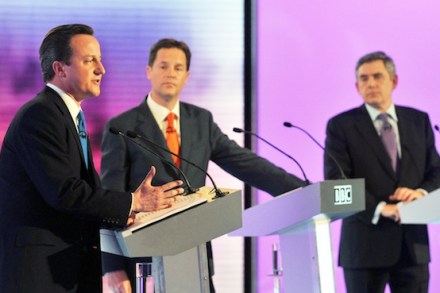
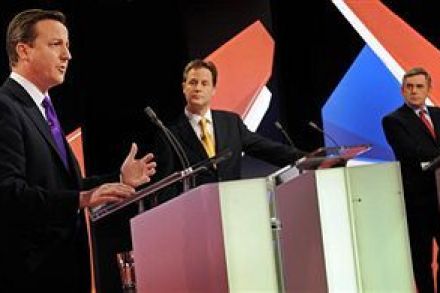
Lord Hennessy has been arguing that, as a result of TV debates between party leaders prior to elections, ‘the plausible tart bit will play too powerfully in [parties’] choice of leader and therefore rule out the decent but non-tarty people.’ It is good to see the modern world finally catching up with Socrates on the question of rhetoric and persuasion. Socrates is in conversation with Gorgias, the famous teacher of rhetoric, about what he thinks he is teaching. The skill of persuasive speech, Gorgias replies, whose purpose is to produce conviction. But, Socrates asks, conviction about what? Right, or wrong? Right, obviously, says Gorgias, which the orator will be able to teach. Socrates demurs: why should an orator, simply by being an orator, know the difference?

Katie Hopkins – this is why we have political correctness

From our UK edition

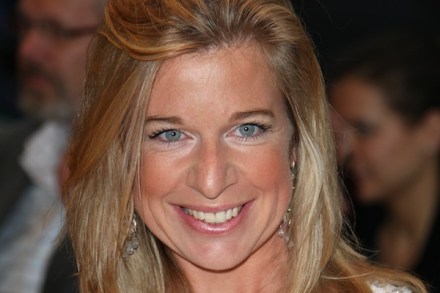
I’ve been reminded just why political correctness exists: Katie Hopkins of the Apprentice, the TV show that glorifies the entrepreneurial ideal and the psychopathic levels of self-confidence that accompany it. Hopkins is on a bit of a roll with her homespun wisdom. Late last week she criticised 'lower class' children’s names, saying: 'I think you can tell a great deal from a name… I tend to think that children who have intelligent names tend to have fairly intelligent parents and they make much better playdates for my children.' As well as also having a go at people with tattoos and fatties, she also quipped: 'Ginger babies. Like a baby. Just so much harder to love.' Her response on Twitter was: 'Dear PC brigade.

Which television chef would you most like to see throttled in a restaurant?

From our UK edition

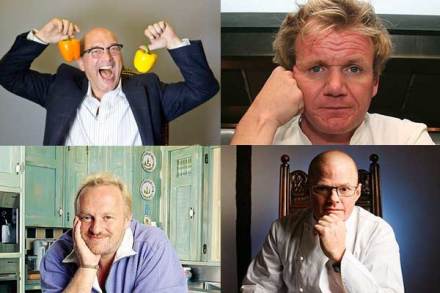
Which television chef would you most like to see throttled in a restaurant? I have to say, Nigella Lawson would be well down the list for me, as I’ve always rather liked her. It’s true that some of her recipes are a little precious, especially all that fairy cake stuff, but surely not to the point that one would wish to strangle her, or witness her being strangled? Gregg Wallace, perhaps? He’s the one from Masterchef who looks like a badly boiled egg which is permanently on the cusp of ejaculation. Obviously Gordon Ramsay — that’s a given, as they say — but I’d also like to make a case for Hugh Fearnley-Whittingstall, who once served guests a pate made of placenta.

Bluestone 42: Dad’s Army it isn’t

From our UK edition

The thing that always used to bother me about M*A*S*H as a child was the lack of combat. You’d see the realistic film of choppers at the beginning and, obviously, the plotline would quite often include casualties coming in from recent scenes of action. But the exciting stuff always seemed to happen offstage, a bit like in Shakespeare where some character strides on and tells you what a terrible battle there’s just been and you’re going, ‘Wait a second. Did we just skip past the most exciting bit?’ This clearly isn’t going to be a problem, though, with BBC3’s new sitcom about a bomb disposal unit in Afghanistan, Bluestone 42 (Tuesday).

The danger of the This Morning ‘paedophile list’

From our UK edition

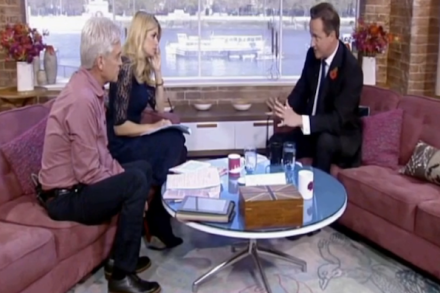
The Prime Minister goes on a mid-morning talk show and is forced to respond to a list of alleged paedophiles that the presenter has taken off the internet. If you put this in a political satire, it would be dismissed as far-fetched. But that is what happened when David Cameron went on This Morning. No-one is disputing the seriousness of the allegations involved. But does anyone really believe that the best way to uncover the truth is for the Prime Minister to be handed a list of names that a TV presenter has taken off the internet? Another concern about the coverage of this scandal is the terms that are being used. As no media organisation is confident enough to publicly name any living individual, we instead see suspicion being cast on whole groups of people.

Vice-President Biden closes the enthusiasm gap

From our UK edition

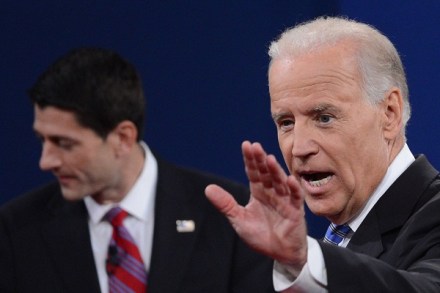
The conventional wisdom dictates that debates between VP candidates are nights that should only interest political anoraks. But the last eight days have not been good for conventional wisdom: remember how boring Mitt Romney was meant to have no chance against a man of Barack Obama’s élan? Far more than any recent presidential debate, last night’s vice-presidential one was genuinely absorbing, pitting two contrasting, combative and forthright politicians against each other. They were helped by the performance of the moderator, Martha Raddatz. She was far more willing to engage the candidates than Jim Lehrer last week, providing the best possible opportunity for a stimulating debate. And that is certainly what we got.

Boris is right, but will anyone listen?

From our UK edition

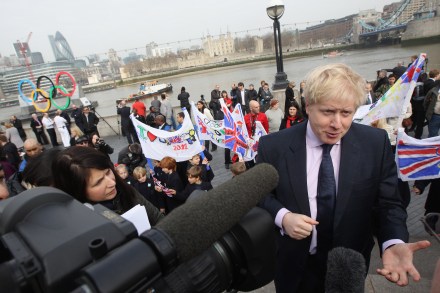
The tensions that have been bubbling away in the London mayoral contest spilt out into the open today with Boris Johnson accusing Ken Livingstone of lying about both of their tax affairs. On the facts of the matter, it looks pretty clear that Boris is right: he doesn’t use a company to reduce his tax liability. There are, though, those claiming that accusing Livingstone of being an ‘f***ing liar’ will hurt Boris. But I doubt this; it is hard to imagine Boris as an angry or mean-spirited person. What this exchange does do, though, is raise the stakes for their televised hustings tomorrow night. I expect that Livingstone will try and rile Boris.

Yes he Cain?

From our UK edition

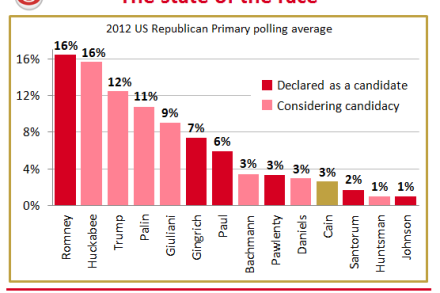
Watch the latest video at video.foxnews.com Have you ever heard of Herman Cain? Neither have most Americans. The latest Gallup polling shows that only 21 per cent of Republicans even recognise his name, despite the fact that he would like to be their candidate for the Presidency. Yet that could all be about to change for the man who used to run Godfather's Pizza, thanks to an acclaimed performance in the first debate of the primary season on Thursday night. Big names like Sarah Palin, Mike Huckabee and Donald Trump have yet to declare their candidacy, and so did not take part, while Mitt Romney and Newt Gingrich (who have announced their bids) decided to skip it.

Will there be TV debates at the next election?

From our UK edition

One might have thought that the TV debates would become an immovable fixture in British general elections. But apparently not. Speaking at the launch of a new study of the 2010 election a couple of nights ago, Adam Boulton said that it was far from certain that they will feature at the next election. Will Straw tweeted the news at the time, but it seems to have slipped through the cracks as attention has been diverted elsewhere. Apparently, broadcasters and the parties have reached an impasse at this early stage in the electoral cycle. The Conservatives are reluctant to recommit themselves to something that they believe contributed to their failure to win a majority.

In search of a character

From our UK edition

A chronicle of three young actors desperate to forge careers in the acting profession sounds like a dangerously familiar proposition. We are all now habituated to the weekly Saturday evening drama of wide- eyed dreamers drilled, mauled, culled and reculled in search of a Nancy, Dorothy or Maria. In Lucky Break, however, Esther Freud redraws the path that leads from Television Centre direct to London’s glittering West End. These young hopefuls are plunged into the maelstrom of a three-year drama school programme that stretches and befuddles them in equal measure. There is a squirm- inducing accuracy to the students’ earnest endorsement of their training, hilariously realised in the principal and the quasi-mystical movement teacher.

Grandfather’s footsteps

From our UK edition

In the good old days, when Hackney still had a proper swimming pool, I used to do lengths every morning with an old boy called Bob. And, because I recognised him as a man of a particular generation, I used to prod him in the changing room afterwards to tell me his war stories. But Bob only ever told me one and it was rather depressing. He’d served in Palestine and one day his convoy had been ambushed by Irgun or Stern gang terrorists. Among those terrorists he and his fellow soldiers had shot while defending themselves was a young pregnant woman. ‘They called us the Baby Killers, after that.’ What a terrible time to have been called up. There are your slightly older mates having all covered themselves in glory in the great heroic war to defeat the Nazi menace.

Wedding belles

From our UK edition

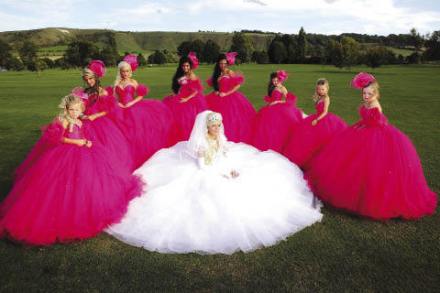
The pedants who say fly-on-the-wall documentaries are cheap, meaningless television could not be more wrong. They are the postmodernist answer to David Attenborough, the Life on Earth de nos jours. Anyone who doubts this should watch My Big Fat Gypsy Wedding on Channel 4 (Tuesdays, 9 p.m. and, if missed, on 4oD). Not since meerkats exploded on to our screens have television cameras transported us into such a rare and fascinating habitat. Those uptight commentators whingeing about the antics of the gypsies entirely miss the point. Does one watch Attenborough and afterwards complain that ‘this daft meerkat fell asleep on its feet and toppled over’? No. Personally, I felt utterly privileged to be able to witness a girl in a wedding dress inlaid with flashing light bulbs.

Grown-up viewing

From our UK edition

Sky’s new channel, Atlantic, kicked off this week with two big shows: Boardwalk Empire, which is set in 1920 and is about gangsters, and Blue Bloods, which is set in the modern day and is about a family of New York law enforcers. Sky’s new channel, Atlantic, kicked off this week with two big shows: Boardwalk Empire, which is set in 1920 and is about gangsters, and Blue Bloods, which is set in the modern day and is about a family of New York law enforcers. As in all American cop shows, there is a lot of badge-flashing, though for some reason none of the people they flash their badges at ever asks for a closer look. It would be quite easy to make one from an old credit card and a milk-bottle top, quite good enough to pass in the half-second the average flash takes.

Wasted talent

From our UK edition

‘We’ve got our main presenters,’ they explained. ‘What we need are interviewees to fill the guest slots. People with strong opinions on ...well, what are your views on the EU, for example?’ So I told them my views on the EUSSR, while swearing quite a lot. This seemed to make them happy. ‘It’s called 10 O’Clock Live,’ they said. ‘You probably saw our pilot. The one-off special with Lauren Laverne, Charlie Brooker, David Mitchell and Jimmy Carr? It got pretty good ratings.’ No, I replied. That isn’t the sort of programme I’d watch in a million years. Lefty comedians making lefty jokes to a lefty audience about politics from a relentlessly lefty perspective? No, thanks.

Reality check

From our UK edition

Horizon (BBC2, Monday) asked, ‘What is reality?’ and didn’t really have an answer. Horizon (BBC2, Monday) asked, ‘What is reality?’ and didn’t really have an answer. Well, it seems nobody does, though plenty of physicists, mathematicians and astronomers are working on it. As the voiceover told us, ‘Once you have entered their reality, your reality may never look the same.’ You can say that again. It appears that quantum particles can literally be in two places at the same time. But we are made up of quantum particles, and we are never in two places at the same time, even if that would occasionally be useful. So maybe there are more of us, all made up of the same particles but doing different things in different places.

Waste not, want not

From our UK edition

‘I want everyone to be as angry as I am,’ says Hugh Fearnley-Whittingstall, and I hope he succeeds for the thing that makes him so angry is one of the things that makes me most angry, too: the senseless eradication of the world’s fish stocks. ‘I want everyone to be as angry as I am,’ says Hugh Fearnley-Whittingstall, and I hope he succeeds for the thing that makes him so angry is one of the things that makes me most angry, too: the senseless eradication of the world’s fish stocks. All this week on Channel 4, HF-W has been campaigning in a series of programmes called Hugh’s Fish Fight. In the first episode he set the scene nicely by going out with a trawler into the fishing grounds 80 miles off the north Scottish coast.

For the love of cod

From our UK edition

Years — actually decades — ago, a gentleman from the British civil service, interviewing me as a potential candidate for a job in the European Commission, explained that ‘all the important decisions in Brussels are prepared by the chefs’. As he spoke, I had a vision of men in tall white hats stirring dishes on a large stove in the middle of the Berlaymont. ‘Chefs?’ I queried. The man quickly explained that he meant the ‘chefs de cabinet’, the Commissioners’ aides, who basically ran the show while the great men had long lunches at expensive Brussels restaurants.

Forgotten laughter

From our UK edition

The Radio Times now lists 72 channels, and that’s not all of them. The Radio Times now lists 72 channels, and that’s not all of them. No wonder television has to feed on itself, like a hungry tigress scoffing her cubs. In particular, it devours the past, so this week we had a Morecambe and Wise evening on BBC2, starting with the Christmas show from 1976, a third of a century ago. These shows got peak audiences of 28 million, inconceivable now, and just as French education ministers can allegedly tell you what every child in the country is studying at any moment, programme controllers could sigh with pleasure and know precisely what flickering image was in front of more than half the population. They riveted the nation, in Bagehot’s sense: they tied us together.

Top of the pops

From our UK edition

The most watched programme on British television this year was the special live edition of EastEnders, broadcast in February to mark the soap’s 25th anniversary. The most watched programme on British television this year was the special live edition of EastEnders, broadcast in February to mark the soap’s 25th anniversary. This was the one — I assume you’re keeping up — in which Bradley Branning plunged to his death and Stacey confessed that she had killed Archie. At the end, some 16.6 million people were watching, which is roughly 28 per cent of the population, still a fraction of the 50 per cent who watched the old Morecambe and Wise show on Christmas Day back in the 1970s. But television is no longer the glue that binds us.