Translation

Live-translation AirPods are the future

I have arrived in Naples, Italy, after an arduous flight from a chaotic London Gatwick Airport. I’m settled in a glamorous top floor apartment in the Quartieri Spagnoli – the romantic old “Spanish Quarter” – where Vespas fizz over cobbles and laundry hangs across alleys like flags of endless surrender. Most importantly, I’m clutching my Apple AirPods3 in their shiny new capsule. Because I’ve come here to do a grand, futuristic experiment using their much-heralded “live translate” function. Does it really work as smoothly as Apple says? Can I actually slot them in my ears and have them translate the Italian speaker in front of me, in real time? Is it really like the sci-fi Babel Fish from The Hitchhiker’s Guide to the Galaxy?

The marvelous Montalbano

I visited Sicily in May 2005, when the airlines were still requiring all checked luggage to be left unlocked. After the flight from Paris touched down at Palermo, my wife and I went to collect our luggage at an apparently quiet and unrushed airport to discover my suitcase opened partway and an expensive dressing gown missing. Eighteen years ago, il Commissario Salvatore Montalbano was quite unknown to me. Otherwise, I should have immediately thought of the Sinagra family at the eastern end of the island, though the word “mafia” did come to mind as I rezipped the bag.

Montalbano

Two excellent books that offer new insight into The Iliad

The Iliad, Homer’s extraordinary epic poem, begins with Apollo, the god of light, zooming down from heaven “like night,” bringing plague to the Greek camp before Troy. Many days later, after the Trojan Hector’s funeral rites, the poem ends, at dawn. The light god brings darkness; dawn brings the doom of Troy. Such are the ironies that underpin the epic, revealing it as a work of supreme artistry, probably composed by one hand alone. For decades, I have lived in the light and shadow of The Iliad, reading it at first piecemeal in Greek, then in various translations, then all the way through in Greek (an experience both taxing and exhilarating). My Loeb edition, its prim English translation opposite the raw Greek, is never far from my side.

iliad

Lost in translation

Picture the scene: a twenty-something college student, desperately trying to impress a girl he’s met for a date. He's early, but that isn’t a problem as it gives him a chance to sit nonchalantly with his ever-so-artfully-battered paperback. It’s Rimbaud’s Collected Poems: intellectual, sensual, rebellious — everything he wants to be perceived as. He props the book up so that the poet’s name is visible and waits for his delicate intellectualism to be applauded. The only thing missing from this tableau is the name of the poems’ translator, assuming that the student isn’t pretentious enough to be carrying around the original French. A smaller name on the fragile paperback, the translator is generally unmentioned, forgotten, and obscured.

translation

Aleksandr Solzhenitsyn’s masterpiece is finally appearing

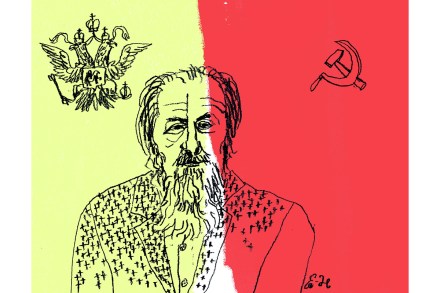
In the mid-1970s, exiled from the Soviet Union for exposing its vast crimes against humanity, and having won the Nobel Prize in Literature for that endeavor, Aleksandr Solzhenitsyn turned his back on the lionization that awaited him in New York and other cultural capitals of the West and instead settled with his family in the woods of Vermont. Avoiding visitors for the better part of the next two decades, he churned out half a dozen or so books, averaging roughly 750 pages each, that together tell the story of the Russian Revolution and its antecedents. This act of sheer energy, self-discipline and renunciation of the conventional worldly pleasures bestowed by the literary elite was in the spirit of Russia’s own eastern monasticism.

Solzhenitsyn