Theresa may

May intervenes to restore order

Theresa May has banned an EDL march in Telford tomorrow, although the organisation will be allowed into the town to conduct a static demonstration. May has been a hive of hyperactivity since she returned from holiday, and this is yet another example of the government making a decisive gesture to amend for its perceived earlier indifference. It also looks like a strategic decision to contain that other unspoken working class resentment: immigration, and the hint of racial tension that it inspires from time to time. David Cameron was at pains yesterday to insist that the riots were a cultural issue, not a racial issue. He’s right. I’ve spent the last

Justice is being done as relations between Downing Street and Sir Hugh Orde sour, again

“Busy?” I asked a friend who’s training as a criminal barrister. “You could say that.” Magistrates’ courts have sat through a second straight night. “I finished at five,” said my friend. “Back in court at 8.” The courts are determined to deliver what David Cameron described as “the full force of the law.” These are bail hearings for the 600 people charged so far. Defendants are apparently being arraigned in groups of three in some courts, an indication of the strain caused by these extraordinary circumstances. There will be little respite in the coming days. As I understand it, the overwhelming majority of applicants have been denied bail and will remain

The Met is struggling to cope — it needs support

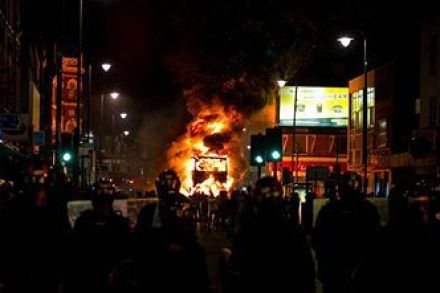
It’s a gloomy sort of morning ritual, posting on the riots of the previous night. I’m sure CoffeeHousers have seen and heard the specifics already: further burning and looting in parts of London such as Ealing, Croydon and Hackney, as well as bursts of violence in Birmingham, Liverpool and elsewhere. Businesses and livelihoods have been obliterated, areas set back years. Among the few mercies is that no-one, so far as we know, has yet been killed as a result. One thing that’s becoming clearer through the smoke is that the Met Police are overrun, unable to properly deal with criminality at hand. The arrest figures tell a story by themselves.

Cameron to return to London as the riots spread

There we have it: David Cameron is to return to London tonight, and chair a meeting of Cobra in the morning. There was an inevitability to the decision even earlier today, with the news that both Theresa May and Boris Johnson had curtailed their own holidays. But the fact that the riots have spread — starting in Hackney this evening, and erupting even in Birmingham — served to underline the point. It is the right decision, in any case. Cameron’s ability to control the situation may be limited, but his continued absence might only have inflamed things further. There are a lot of people scrabbling around for a grievance to

Syria and Libya overshadowed by London riots as Boris comes home

President Assad’s tanks are still doing murder on the streets of Syrian, but the dictator’s isolation grows. After weeks of prevarication, several Gulf States have closed ranks against the Syrian regime. Saudi Arabia, Bahrain, Jordan and Kuwait have all recalled their ambassadors from Damascus, and King Abdullah of Riyadh has led the Arab League’s condemnation of Assad’s ‘death machine’. Better late than never, the international consensus says. Compassion for the oppressed is not a familiar trait among Arabian princelings, but their reticence on this occasion was particularly surprising given that Assad’s Syria is no friend of the Arab League, preferring to side with Iran in most things. Still, today’s diplomatic gestures will add to the

From the archives – Yates had previous

As Theresa May put it in an impressive statement to the House earlier, “These allegations are not, unfortunately, the only recent example of alleged corruption and nepotism in the police.” She then vowed to open an inquiry into these matters, which will stand in addition to the two already announced by the government. The panel will have plenty to look at, as Michael White explained in the Spectator a few years back. John Yates has previous, by Michael White, 10 March 2007 When I was a young reporter on the London Evening Standard nearly 40 years ago I spent a lot of time in the press room at Scotland Yard,

Policing the Olympics

The reputation of the police may be as black as mud at the moment, but the Met has a chance to atone during the Olympics. Security forces have been making their preparations as the Olympic construction site nears completion.  In May, police officers, counter-intelligence officials and the emergency services conducted their first major security exercise. Further stress tests are being undertaken on local transport routes and waterways. And permanent surveillance of Olympic venues is being established; in future, visitors to these sites will be subject to airport-style security and a number of armed officers will patrol the area. Nothing, it seems, is being left to chance. These operations are being

Coalition’s crime worries ease, but concerns remain

The British Crime Survey is published today and the Home Office had prepared for the worst. For months now, figures close to Theresa May have been expressing their fear that the combination of Ken Clarke’s liberal prisons policy and economic hardship would cause a rise in crime for which the Home Office, graveyard for so many political careers, would be blamed. Today’s figures will have eased their disquiet somewhat, insulating them from Labour’s critique that police cuts are endangering society. The headline is that crime in England and Wales has remained stable over the last year, except for a 14 per cent spike in domestic burglaries according to the British

Policing the local and the national

Today’s announcement on a proposed new National Crime Agency (NCA) is a key element in the government’s ambitious police reform agenda.  Recent political attention has focused on changes to police pay and conditions and budget reductions, but the structural reforms that Theresa May and Nick Herbert are pursuing matter more in the long-term.  And before it is dismissed as another attempt to create a “British FBI”, the background and rationale for the NCA is worth exploring. The NCA is much more than a rebranding of the Serious Organised Crime Agency (SOCA) – the troubled organisation set up by Charles Clarke.  Instead it is one part of a major recalibration of

The need for a strong man to strong-arm the new counter-terror policy

If the counter-terrorism strategy the government is announcing today is to succeed, it will have to overcome bureaucratic opposition and institutional inertia. As Dean Godson writes in The Times today (£), senior civil servants in the Office of Security and Counter-Terrorism are highly reluctant to accept the government’s new, more muscular approach to this issue and will go back to the old, failed way of doing things if given the chance. If the Prime Minister’s writ is going to run across government on this issue, he is going to need someone working from the centre with Cameron’s explicit backing whose sole role is to supervise the implementation of the policy

Counter-terrorism means stopping dealings with extremists

The coalition’s counter-terrorism strategy will be published tomorrow. This rather delayed review has been the subject of some semi-public wrangling, Cameron and Clegg have given speeches setting out very different visions for it. But one thing to remember is that the test of the review’s robustness isn’t just whether it stops government money going to extremists groups. It also has to lead to government, at all levels, stopping dealings with these groups, denying them the oxygen of recognition. Today’s Telegraph notes that 20 groups will lose their funding because the views they espouse are antithetical to British values. This is to be welcomed. But it won’t have much of an

Off target

Target culture. It’s a pejorative phrase, and understandably so. As we discovered during the New Labour years, targets designed to encourage good public services can frequently do the opposite — replacing genuine care with box-ticking, and action with bureaucracy. I mention this now because of an article in this week’s Spectator (do subscribe, etc.) by an anonymous Metropolitan Police officer. He describes how a target culture has skewed the work of the force and, in some cases, even the law itself. Here’s one anecdote, which rather sums it all up: “I know of one instance in which a uniformed sergeant stole (or neglected to hand in) some confiscated cannabis. Instead

The Coffee House A-Z of the Coalition: G-M

Here are letters G to M in our alphabetical guide to the Coalition’s first year. A-F were covered here. G is for Gaffes The coalition, happily, has not endured anything like a Gillian Duffy moment. But there has been a decent smattering of embarrassments and gaffes. Below is a brief selection, but CoffeeHousers can nominate others in the comments section: https://www.youtube.com/watch?v=0nOhqo-47P8 H is for Hidden talents A brief mention for those ministers who have exceeded expectations, or who have been quietly effective in their roles. Foremost among them has to be Theresa May, the Home Secretary. She underwhelmed in Opposition, particularly when in charge of the Tories’ welfare brief, but

Some context for those police cuts

What’s it to be? Take a pay cut, or lose your job? That, as David suggested earlier, is the question being posed by Theresa May to police forces – and it’s a question that they cannot shirk. With the police budget being cut by 4 per cent a year, there have to be reductions of one sort or another. And if they don’t come from pay restraint – along the broad outlines of Tom Winsor’s review today – then there will no doubt have to be extra job losses. This is the argument that George Osborne set out in his 2009 conference speech, only now it’s being deployed from government.

Theresa May’s unenviable challenge

Many political careers have met a torturous end in the Home Office. And this morning, Theresa May began her struggle. She is taking on the “last great unreformed public service” and the opposition is formidable; so much so that the official opposition barely get a look in. The Peelers are marching on Downing Street. The Police Federation has declared itself ‘fed up’ with cuts – a perfunctory warning to the government. Vice Chairman Simon Reed indicated that the Federation feels the government is abrogating its duty of care to those who serve, a dextrous line forged by those opposed to personnel cuts to the armed forces. Reed told the Today

Tackling the last great unreformed public service

The Home Office has an ambitious police reform agenda and is overseeing challenging budget reductions, but they are also forging ahead with plans to introduce real workforce modernisation.  The serious and credible reviewer, Tom Winsor, will publish his independent report next Tuesday.   Winsor’s review will cover pay, conditions and other aspects of employment that will set the framework for a new settlement when the current 3-year pay deal expires. Expect police overtime and shift patterns to be another major focus of the review.   David Cameron himself, who once boldly described the police as “the last great unreformed public service” is firmly committed to this agenda. As a special

May’s change of emphasis

Theresa May has a new soundbite: police pay or police jobs. May has been asked to find cuts of 20 percent in the police budget. May insists that the frontline must and will be protected and that therefore these ‘extraordinary circumstances’ mean that the government will have to rewrite the terms and conditions of police employment. The former rail regulator, Tim Windsor, is already conducting a review into police pay and working conditions. In addition to his recommendations, May is scrutinising overtime payments, housing and travel allowances and so forth. Estimates vary but these perks are thought to cost the taxpayer more than £500million a year. She is also overseeing

Clarke rebukes May for her comments on sex offenders’ register ruling as Tory split over human rights grows

The Conservative side of the coalition is being increasingly split by the issue of the European Convention on Human Rights. After the Supreme Court in London declared that human rights legislation required that sex offenders had to be given a chance to take their names off the register, the Home Secretary and the Prime Minister were appalled. In a statement to the Commons, May made some trenchant criticisms of the court ruling. This, I understand, prompted a furious letter from Clarke, the Justice Secretary, to May reminding her that she was constitutionally obliged to accept the independence of the judiciary. The letter was copied to Downing Street as the Prime Minister

Parliament is not sovereign

Enough is enough. The British Bill of Rights is set to return: a consequence of the government’s running battle with parliament over the European Convention on Human Rights. Recent days have been filled with clues and suggestions of imminent reform: Dominic Grieve, a former advocate of the ECHR, went so far as to assert that Britain may leave the convention. Cameron let slip the news that a Bill Of Rights commission is to be convened at PMQs; at the time he was answering a question about the Supreme Court’s controversial sex offenders’ register decision. There are no details as to what the commission will consider, but Theresa May aired the

Why the government is right to look beyond ASBOs

We shouldn’t have believed the hype. For all of Tony Blair’s earnest focus on Anti-Social Behaviour Orders, this flagship policy was barely in effect at all. By the latest figures, only 18,670 ASBOs were issued between April 1999 and the start of 2010. According to this Policy Exchange report – the best on the subject that I’ve come across – that accounts for around 0.009 per cent of all incidences of anti-social behaviour. So let’s not pretend that the coalition is upending the criminal justice system by shifting away from ASBOs today. Neither, on the evidence at hand, is it doing away with an effective policy. Here’s a graph that