Theresa may

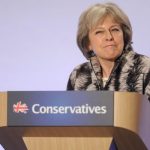
Theresa May really is acting like a Tudor monarch over Brexit

From our UK edition

Over the weekend, it emerged that Theresa May likes to compare herself to Elizabeth I (although as I argue in my Telegraph column today, she’s been behaving more like the young Queen Victoria lately). The PM clearly meant the association as a compliment to herself, but on Saturday, Labour MP Barry Gardiner went in for a far more negative comparison. Complaining about Theresa May’s proposed plan to trigger Article 50 without a new parliamentary vote on the matter, Gardiner went full Philippa Gregory on us, accusing May of acting 'to diminish parliament and assume the arrogant powers of a Tudor monarch.' Next he’ll be accusing her of throwing a tantrum over her wig.

Britain hits back over French threat to scrap Calais ‘jungle’

From our UK edition

It's no surprise that demands from French politicians to scrap the Le Touquet deal and shift the migrant 'jungle' from Calais to Dover has gone down badly in Britain. Today's front pages are full of talk of 'Le Stitch up'. And the Home Office has waded in to say these plans are a complete 'non starter'. This all sets the scene for a testy meeting for Amber Rudd as she crosses the Channel to meet her French counterpart, Bernard Cazeneuve, for talks today. Their meeting will be a private one but it isn't difficult to work out that Calais will be top of their agenda. What's difficult about finding a solution, however, is that all of this talk is something of a phoney war of words, at least for now.

Britain is ready for a mature immigration debate. Is Theresa May?

From our UK edition

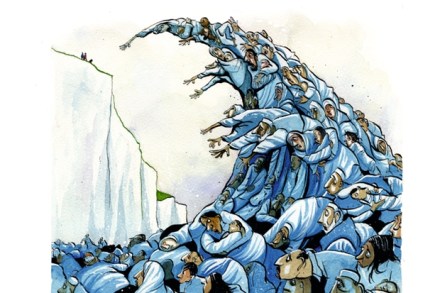
You can’t fool all of the people all of the time, said Abraham Lincoln. Theresa May faces a different question: for how long can you string along an entire electorate? She has been a defender of the pledge to cut net migration below 100,000 – a pledge that was adopted in a different era, before the Great Migration got underway. Cameron more or less got away with this – until he didn’t. During the referendum campaign, news that net migration hit 333,000 changed the debate and embodied the point under discussion. Cameron was haunted with this pledge throughout the campaign: how he’ll have regretted not dropping it when he had the chance. But will Mrs May? I look at this in my Daily Telegraph column today.

Letters | 25 August 2016

From our UK edition

Golden age problems Sir: Johan Norberg’s ‘Our golden age’ (20 August) is absolutely right — we do live in a golden age; antibiotics still work, we have less starvation, the world is open for trade, with all its benefits. But there is a fly in the ointment: human overpopulation. Global warming (if you believe in it), degradation of the environment, extinction of species, all are consequences of it. It is a result, in fact, of our success. The only country to have grasped the nettle — China — is now having second thoughts. Perhaps wind and solar power can provide for our needs when we are 70 million in these islands; but what when we are 80 million, 90, 100? And for the rest of the world? W.G.

Today’s net migration figures show the huge task facing Theresa May

From our UK edition

The good news for the Government is that net migration is down. The bad news? It's down by so little (a fall of 9,000 to a total of 327,000) that you won't hear anyone crowing about today's figures. That the 'tens of thousands' target made by the Government still hasn't been met is no surprise at all. And we can expect to see a continuation of the semantic shift from that Tory 'promise' down to a 'pledge'. So apart from telling us that, as far as net migration is concerned, it's business as usual, what do today's figures show us? For one, they make it clear that solving this issue won't be easy for the Prime Minister. Net migration from certain EU countries like Romania and Bulgaria is at a record high.

The vanity line

From our UK edition

Jeremy Corbyn may not be right about many things, but when he sat on the floor of a train, hoping to raise awareness about overcrowding, he was at least on to something. Of course, in classic Corbyn style, he proved to have ignored reality to make his point: there were plenty of seats on that particular train. It was nonetheless a point worth making. Millions of passengers jostle for standing space every day; Britain’s rail system is in urgent need of help. And there is apparently money to be spent. It just won’t be going on the most overcrowded lines. Instead, the cash is destined for High Speed 2 — one of those mysterious vanity projects that refuses to go away even though common sense begs it to. Polls show the vast majority of us are against it.

Bring back bonkbusters!

From our UK edition

Life is starting to look a lot like the 1980s: Russia is flexing its muscles, the Labour party is tearing itself apart, and there’s a woman in No. 10. Political thinkers are falling over themselves to over-analyse the geopolitical precipice upon which the world seems to be balanced. But life doesn’t have to be serious all the time, so it’s worth reflecting on another aspect of heading back in time: we’re due a revival of the-bonkbuster. Frances Robinson and Camilla Swift discuss the return of the bonkbuster: Jilly Cooper’s new book Mount! is published next month, and features the return of Rupert Campbell-Black, 30 years after he first appeared in Riders.

David Cameron’s larynx comes to his defence on childhood obesity

From our UK edition

Theresa May was once seen as the continuity candidate to succeed David Cameron. However, since becoming Prime Minister she has gone on to sideline or backtrack many of Cameron and George Osborne's pet projects. As well as delaying Hinkley Point and leaving the Northern Powerhouse's future up in the air, she has provoked anger this week over the Government's childhood obesity strategy. While Cameron made clear that childhood obesity would be a flagship issue for his government -- with Jeremy Hunt even promising to take draconian measures -- May appears to take a different approach. In the report -- pushed out in recess -- May has scrapped plans to curb junk food advertising and created confusion over Osborne's sugar tax now that it will no longer be a tax on consumers.

Brexit won’t finish the EU, insist Merkel, Hollande and Renzi

From our UK edition

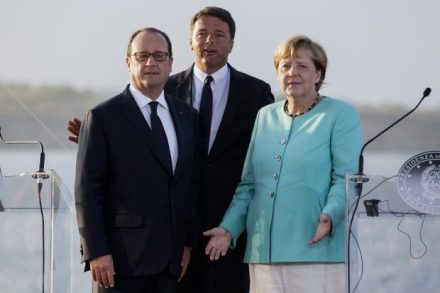
It's no surprise that Italy’s prime minister Matteo Renzi chose to host a press conference with Angela Merkel and Francois Hollande on an aircraft carrier; this was a piece of theatre designed to show the EU is fighting back. 'Many thought the EU was finished after Brexit,' said Renzi. Not so, he claimed. Instead, Britain's decision to leave the EU was the chance to 'write a future chapter' and 'relaunch the powerful ideas of unity and peace, freedom and dreams', the Italian PM insisted. All very well, you might think, but what does that mean? Defending the continent against the threat of Islamic terrorism was a key topic. Angela Merkel called for intelligence services across the continent to share more information to help fight extremism. So far, so sensible.

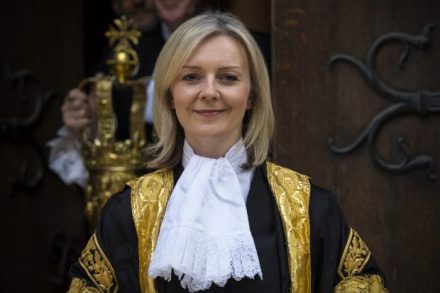
Liz Truss confirms there will be a British bill of rights. But we still don’t know when

From our UK edition

It’s been over a month since Theresa May stood on the steps of Downing Street. And yet the process of finding out what will define her government is moving slowly. We’ve had snippets of the direction in which it won’t be heading: her decision to put the brakes on Hinkley Point, at least for the time being, shows she won’t be pursuing the Osborne agenda. This has, too, been backed up by reports today that she won’t press ahead with plans for regional mayors with the same fervour as the former chancellor. Yet we’ve had only limited glimpses of what May will be aiming to implement. The catchphrase ‘Brexit means Brexit’ has already become well worn and parroted repeatedly by the PM.

Revealed: the bureaucrat who advised Theresa May to use EU nationals as bargaining chips

From our UK edition

The biggest puzzle of Theresa May’s premiership so far is why someone who pioneered laws against modern slavery and was so tough on stop-and-search should take such an extreme and heartless position on EU migrants. Her declaration – that she’d use them as bargaining chips in Brexit talks – struck many who would otherwise support her as bizarre and repugnant. The Times reveals today that this idea was dummed up, as you’d expect, by the Whitehall machine. Sir Ivan Rogers, Britain’s ambassador to the EU, advised all candidates for the Tory leadership to use Britain’s three million EU nationals as bargaining chips in Brexit talks because he thought it would be the only bargaining chip Britain had.

What should we call Theresa May’s acolytes?

From our UK edition

What, though, are we to call the followers or policies of Theresa May? Assuming, obviously, that there one day are some. At least one columnist last week used ‘Mayist’, which seems to me a terrible, boring waste. Surely we can do better than that? On Twitter, I idly suggested ‘Mayan’ which I still feel is sure to come into its own in the coming economic apocalypse. Thereafter, others weighed in. ‘Mayite’ is no better than ‘Mayist’ and makes you sound like a Geordie when you say it, anyway. ‘Mayflowers’ could work. What with Brexit, ‘Maypoles’ might confuse people. ‘Mayonnaise’, as in ‘the Mayonnaise Government’ is perhaps a bit too weird.

The 17.4 Million Committee must be launched, urgently

From our UK edition

When it was reported that Liam Fox and Boris Johnson are already squabbling about who should be in charge of what in relation to Brexit, this was taken by some to be a feather in Theresa May’s cap. Isn’t she clever to have set Leavers against one another, was the thought. Downing Street sources were quoted as saying that she took a dim view of these silly games. But if it is true that Cabinet ministers are already at loggerheads about their roles, might that not suggest that the Prime Minister who invented these roles — and entire new government departments — has not properly defined them?

Corbyn makes a half-hearted pitch to win over Tory voters

From our UK edition

Can Jeremy Corbyn reach out to - and win over - Tory voters at a general election? It sounds like an unlikely prospect but that's exactly what the Labour leader pledged to do in the party's latest hustings last night. Corbyn said that his aim is to convince people 'by the policies we put forward...(including) some people who have been tempted to vote Tory' before. It certainly sounds as if Corbyn himself isn't wholly convinced by his statement, as many of those hearing it are unlikely to be either. An Ipsos Mori poll recently gave Corbyn a woeful net approval rating of -33, so it's true he needs to broaden his support base somehow.

Defending Brexit

From our UK edition

One of the many incorrect predictions about this year’s referendum was that those who voted for Brexit would soon regret it. The theory was that these deluded souls only intended to lodge a protest vote, and would be overcome with buyers’ remorse as Britain fell headlong into a deep recession. Two months after the referendum, there is precious little regret. Polls suggest that just 5 per cent of those who backed Brexit wish they hadn’t; the same is true for those who voted Remain. However, the Remainers have moved quickly and effectively into post-campaign mode and have found a new vocabulary. Their new enemy is ‘hard Brexit’. They seize on every piece of bad economic news while rubbishing renegotiation prospects.

Portrait of the week | 18 August 2016

From our UK edition

Home Theresa May, the Prime Minister, who was supposed to be on a walking holiday in Switzerland, wrote to Xi Jinping, the Chinese President, saying that she wanted to strengthen Britain’s trading relationship with China despite uncertainty over the construction of the nuclear power station at Hinkley Point. During her absence and that of the Chancellor of the Exchequer from Britain, Boris Johnson, the Foreign Secretary, was the ‘senior minister on duty’, Downing Street conceded. Regulated rail fares in England and Wales and regulated peak-time fares in Scotland will rise by 1.9 per cent in January, that being the annual rate of inflation in July, as measured by the Retail Prices Index (up from 1.6 per cent the month before).

The best thing about Brexit? It’s not my fault

From our UK edition

Brexit Britain fills me with calm. Six weeks on, there’s no point pretending otherwise. Losing is far better than winning. I am filled with enormous serenity at the thought of this terrible, terrible idea being not my fault at all. I didn’t expect to feel this way. Although there were signs, now I think back, on the night of the vote. I was at Glastonbury, obviously. (‘Of course you were!’ cried Rod Liddle, when I saw him a few weeks later.) Of course I was. There, with the rest of the metropolitan, liberal, bien-pensant yadda yadda. I found out at about 2 a.m., after a pleasant evening doing pleasant Glastonbury things. I’d wandered backstage, to meet a journalist friend who had secured access to Wi-Fi and a television.

Forget the ‘Norway model’. Germany suggests UK could get ‘special’ EU status

From our UK edition

Britain’s decision to leave the EU sent shockwaves crashing throughout the continent. As Europe struggled to interpret the outcome of the referendum, we heard calls for Brussels to drive a hard bargain with the UK in order to contain the 'Brexit contagion'. The European Council President Donald Tusk's warning that the UK must not be allowed to 'profit' from leaving the bloc summed up this mood. But now, it seems, our neighbours in Europe are coming to terms with Brexit. And with it, the desire to punish the UK appears to be dampening. Michael Roth, Germany's European Affairs minister, has this week suggested that a 'special status' could be achieved which would take into account Britain’s size and previous commitment to the European project.

Ed Vaizey is left out in the cold

From our UK edition

As Theresa May's recently re-shuffled Cabinet get underway with the big task at hand, spare a thought for those who are having to get used to being on the sidelines. There was a cross-party outcry when Ed Vaizey was axed as culture minister with MPs from both Labour and the SNP praising his work in the role. Alas it seems that Vaizey is finding it difficult to adjust to a return to the backbench.