Theresa may

Will a Queen’s speech spell the end of May’s government?

From our UK edition

What is the maximum point of danger for the government in the coming months? After Theresa May secured a six month Article 50 extension, many MPs along with the Tory grassroots are irate and calling for her to go. However, it's still not clear how they could force the Prime Minister out before December (when she can once again face a confidence vote by her MPs). Meanwhile, the Brexit deadlock means that the majority of crunch votes result in no decision. Even if May moves to back a permanent customs union it's not clear it will pass the Commons. The answer then could lie in the Queen's speech – and whether or not the government tries to present one.

Friends and allies

From our UK edition

The European Union’s official goal — an ever-closer union of people — remains its single most attractive feature. Our continent is marked by its diversity: nowhere can you find a greater range of languages, histories and cultures. Closer co-operation is within everyone's interests, and the EU has done much to facilitating this. Its mistake was a lack of respect for the democratic traditions of its member states, and when it sought to impose a fixed set of rules over the most culturally and economically diverse club of nations it became a source of instability in Europe. The rise of populist parties in Europe is the most visible sign of the over-reach.

Emmanuel’s folly

From our UK edition

 Montpellier An embattled, incompetent leader distrusted and disliked by a vast majority of voters. A wobbly economy that might be tipped into recession by Brexit. A re-energised opposition. Huge street protests. Squabbling with European partners. The government is paralysed, the opposition is emboldened — and the nation stands humiliated, as the world looks on in horror wondering how a leader who was so popular two years ago could get things so wrong. Not Theresa May, but Emmanuel Macron, the politician who may be the greatest Brexiteer of them all. As the saga of British withdrawal enters its final chapter, Macron has emerged as the loudest advocate for pushing Britain out the door, deal or no deal, consequences be damned. Why does he behave in this way?

You win, parliament. Now revoke Article 50

From our UK edition

Dear Remainer parliament. Although we’re the voters who spurned the petition for this very course of action, we the undersigned formally request that you please revoke Article 50 at your earliest convenience. For Philip, Oliver, Dominic, Amber, Greg, et al (forgive the familiar first names, but over the last few months we’ve come to feel we know you so terribly well), this appeal from your nemeses may come as a surprise. After all, it was to appease us knuckle-draggers that you invoked the Article in the first place. Apologies for seeming so fickle. But in what Charles Moore has aptly dubbed Europe’s contemporary ‘empire’, all roads lead not to Rome but to Brussels.

What’s left for Brexiteers?

From our UK edition

My first encounter with a plan to hold not one but two referendums on Britain’s European Union membership happened more than three years ago. At least two individuals were actively entertaining the idea. Both were Leavers. Dominic Cummings had proposed it in one of his blogs. Boris Johnson had not publicly endorsed such a thing, but (I know) was discussing it with interest privately. The thinking, as I recall, was similar in both cases. The first referendum would be the one we then faced: asking voters for a yes or no to the idea that in principle we should quit. If the result was Remain, we’d remain. If Leave, there would follow two years negotiating a draft withdrawal agreement.

Britain’s liberals have fallen out of love with democracy

From our UK edition

Every now and then there is a political moment, some event or comment, that reveals just how much society has changed. This week contained one of those moments. On Tuesday it was reported that nine pro-democracy activists in Hong Kong had been found guilty of causing a public nuisance by taking to the streets five years ago to demand a greater democratic say in how their society is governed. And on the same day, the exact same day, the Guardian published an article with the headline ‘Democracy is overrated’. Most voters have ‘no idea’ about what’s going on in the world, the piece argued, and therefore it would be better if they just didn’t bother voting.

Corbyn says May still isn’t compromising on her Brexit red lines

From our UK edition

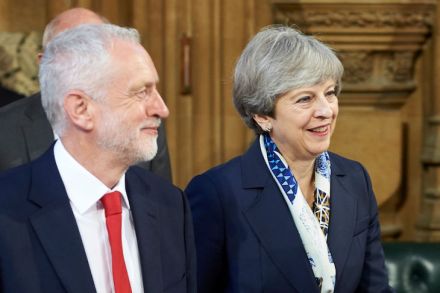
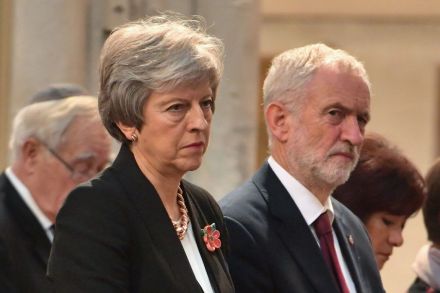
Jeremy Corbyn has insisted that Theresa May hasn't yet moved on her Brexit red lines in talks with the Labour Party. In a broadcast clip this evening, the Labour leader said: 'Well, the meetings are very long. A great deal of detail is gone into by both parties. We have people who have been on this case for several years so they're all very accustomed to it all. We've gone into it because the government at last acceded to a request I first made last September that we're prepared to talk and put forward our views, but talks have to mean a movement and so far there's been no change in those red lines.' There have been reports that the talks are moving towards an offer of a customs union, which would enrage many Conservative MPs even more.

Theresa May hints at a change in direction on Brexit

From our UK edition

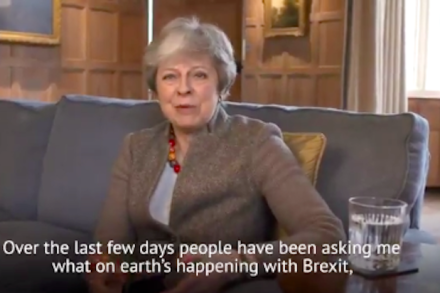
As another crunch Brexit week approaches, Theresa May has used a video message to update the public on ‘what’s happening with Brexit’. With the Sunday papers filled with angry Conservative MPs venting about her decision to enter negotiations with Jeremy Corbyn in a bid to break the Brexit deadlock, the Prime Minister uses the address to try and justify her decision. https://twitter.com/theresa_may/status/1114891046025084931?ref_src=twsrc%5Etfw Adopting a more casual tone that normal, May says that Parliament has rejected her deal three times and ‘as things stand’ there is little reason to expect MPs to back it on a fourth vote.

The Spectator’s Notes | 4 April 2019

From our UK edition

There is a logic in Mrs May’s late move to Labour. It is the same logic by which both parties, at the last general election, put forward very similar policies about Brexit. They need to stay together (while feigning disagreement for party reasons) to frustrate what people voted for. Just as they both said in 2017 that they wanted to leave the customs union, now both are working to stay in it. It is the same logic by which Mr Speaker Bercow has arranged for Sir Oliver Letwin to become prime minister on roughly alternate days. None of the main players really wants Brexit, but none can really say so.

Where Brexit failed

From our UK edition

One of the many tragedies of Theresa May’s premiership is that, having come up with a coherent policy on how to enact Brexit, she spent her prime ministerial career failing to follow it.  The words she used in her speech at Lancaster House in 2017 seemed clear enough: ‘No deal is better than a bad deal.’ It made sense to repeat this in the last Tory manifesto. She was to seek a free trade deal with the EU, but if that proved impossible, then Britain would be leaving anyway. In the event, the EU has not merely failed to offer a good deal, it has refused to offer any trade deal at all — only a withdrawal agreement that might or might not lead to a trade deal in future but which in the meantime threatens to trap Britain in the customs union indefinitely.

May finds ministers to fill resignation holes: but does it really matter?

From our UK edition

Theresa May has this evening found enough people to fill the various ministerial holes left in her government by the recent slew of resignations. Some of these holes have been gaping for rather a long time: there has been no Minister for Disabled People since 13 March, for instance. But their lack of replacements until now has excited very little attention, largely because it's not clear what else the government aspires to do at the moment other than exist. The appointments announced this evening are as follows: Justin Tomlinson MP to be a Minister of State at the Department for Work and Pensions. James Cleverly MP to be a Parliamentary Under Secretary of State at the Department for Exiting the European Union.

The losing game

From our UK edition

Iraq, the financial crisis, the expenses scandal — all of these undermined trust in politicians. They created an impression of a governing class that was devious, inept and venal. But the damage they did to public faith in politics is nothing compared with the damage that will be done by a failure to deliver Brexit. Brexit is the result not just of a referendum but of two general elections. The Tories would not have won a majority in 2015 without their pledge to hold a referendum on Britain’s EU membership. In 2017, Labour wouldn’t have been able to deny the Tories a majority if they had not been committed to respecting the result of that referendum. Yet Brexit is now in danger of being cancelled altogether.

Where it all went wrong

From our UK edition

Management books often repeat the dictum: ‘If there’s one thing worse than making mistakes, it’s not learning from them.’ So let’s apply that smug little idea to Brexit. Before I start, a couple of housekeeping points. I voted Remain, but believe we must leave the EU and honour the referendum result. Second, as a former Brexit minister, writing this is a form of therapy for me. Failure no. 1 — from which many other failures flow — was a lack of honesty. Brexit is the biggest challenge we’ve faced since 1939. It’s complex, existential and will take years. It demands a sense of national endeavour, of ‘let us go forward together’.

Are we heading for a softer Brexit?

From our UK edition

With Oliver Letwin’s amendment passing, MPs will seize control of the order paper on Wednesday afternoon to hold indicative votes. These votes will come before any third vote on May’s deal. The not-so-secret hope of many in government is that they might help the withdrawal agreement get over the line. Theory one is that they’ll show that the majority in the Commons is for a softer Brexit, and so push some reluctant ERGers into the government column. Some ministers also hope that the DUP will not be keen to go for an early election at this moment; and will be more inclined to compromise if they think that the government will go back to the country rather than accept a customs union.

Cabinet coup or not, the government is on the brink of collapse over Brexit

From our UK edition

The correct reports in Sunday Times and Mail on Sunday this morning that some ministers (not all) want Theresa May to go now, and make way for a caretaker - either David Lidington or Michael Gove - tells me NOT she will definitely go within a few days (though she may) but that the government is perilously close to collapse. Because what it shows is the underlying split in the cabinet between those ministers - Gauke, Clark, Rudd, Mundell - who want to stop a no-deal Brexit at any cost, and those who want to prevent either a referendum or a "soft" Brexit "in name only" - Leadsom, Mordaunt, Fox, Grayling - has become irreconcilable.

MPs have one shot this week to prevent a no-deal Brexit

From our UK edition

As you know, I have been banging on about the probability that the UK will leave the EU without a deal on 12 April. Having talked to very senior members of the government, and also well-placed sources in the EU, it has become clear to me that MPs have one shot to prevent that - and it will almost certainly be this week that MPs will either rise to the challenge or flunk it. How so? Well, the prime minister and the EU will be looking at the indicative votes that are due to take place on Tuesday and Wednesday – on Tuesday sponsored by the PM, on Wednesday under the backbench initiative of Sir Oliver Letwin – to see if a majority of MPs can demonstrate their support for a deliverable alternative to a no-deal Brexit.

The one way to give MV3 a chance of passing

From our UK edition

At the moment, the Brexit deal isn’t going to pass. As I say in The Sun this morning, getting it through was always going to be tough, but the errors that Mrs May has made this week have made it even more difficult. As one Secretary of State puts it, ‘She would have been much better off spending three days in bed.’ By putting no deal back on the table, she encouraged the ERG—the Brexit hardliners in her own party—to believe that voting against her deal would get them what they want. Her speech on Wednesday night criticising MPs was also ill-judged, given that they are who she needs to win over. It was particularly mistaken given that May had turned down an invitation to address her own MPs that evening.

It’s getting harder for Theresa May to pass her deal next week

From our UK edition

After eight hours of talks between EU leaders, Theresa May has been granted an Article 50 extension. If the Prime Minister can pass her deal next week, there will be technical extension until 22 May. If the deal fails to pass, Article 50 will be extended only until 12 April so that the UK can set out its next steps – and potentially apply for a longer extension. This offer appears to give backbenchers time to try and – once again – seize control of the process if May fails to pass her deal. The Prime Minister's problem is when it comes to meeting the first condition of the 22 May offer, she is going backwards rather than forwards.

MPs must not use May as an excuse to walk into Brexit disaster

From our UK edition

Theresa May has united Westminster. Right across the political spectrum, politicians and journalists agree that her televised statement from No. 10 last night was an epic misjudgement, that seeking to pin public blame on MPs for the failure to agree a Brexit outcome has made it even less likely that they will now reach such an agreement. The PM’s awful statement, it is said, has driven away the very MPs she needs to pass her Withdrawal Agreement next week. Consensus like that deserves scrutiny, because it’s often a cloak under which people can hide inconvenient facts. Consider the assertion that May has alienated MPs who will not now vote for her deal.

Jeremy Corbyn makes pointless Brexit meeting all about him

From our UK edition

This evening, Jeremy Corbyn walked out of a meeting between opposition party leaders and the Prime Minister about Brexit. The reason for his angry protest had nothing to do with what was being discussed, but his distaste for one of the attendees. Former Labour MP Chuka Umunna was there to represent the Independent Group, and this, according to those present, was too much for the Labour leader to stomach. Labour has since said the the terms of the meeting had changed and that this wasn't what Corbyn had agreed to when he said he would meet the Prime Minister in her office. But this is an impressive own goal, even by the Labour leader's standards.