Theater

Is this Tom Stoppard’s last act?

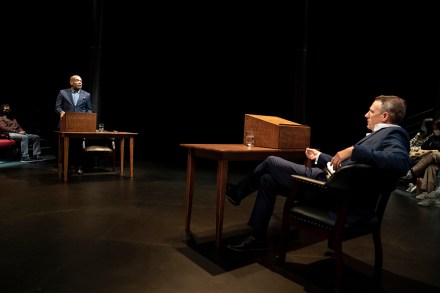
The London premiere of Leopoldstadt in 2020 made this decade the seventh in which a new Tom Stoppard play has been delivered unto the world, and since the playwright has suggested it may be his last, some words about his legacy seem to be in order. Stoppard is often regarded as the greatest English playwright of the later twentieth century. Harold Pinter is the other popular choice. Both men picked up where Pirandello, Beckett and the absurdists left off. Their respective approaches form two sides of the same post-existentialist coin. Stoppard made his name with the expanded footnote: plays in which a sidelight takes center stage, often bristling with comedy, like the metatheatrical Rosencrantz and Guildenstern Are Dead (1966) or The Real Inspector Hound (1968).

Leopoldstadt

Angela Lansbury was so much more than Murder, She Wrote

The only time I ever saw Angela Lansbury on stage was in 2014 in London, when she played the half-baked medium Madame Arcati in a revival of Noel Coward’s supernatural comedy Blithe Spirit. Although it was rumored that the then-88-year-old Lansbury was having her lines fed to her via earpieces, it did not affect her comic timing one iota. It is no exaggeration to say that Lansbury took a character who has passed into over-familiarity via decades of revivals and made her fresh and hilarious once again. For anyone to achieve this is remarkable, but to do so at an age when most actors would have long since retired is little short of phenomenal. Lansbury’s death at the age of 96 — a few days shy of her 97th birthday — has some uncanny parallels with the recent passing of the Queen.

Weighing in on the unauthorized Hamilton

It was probably inevitable that the culture wars would come for Hamilton. The show had something for everyone — parents and kids, pop-culture enthusiasts and history buffs, right and left. It was the unifying, twenty-first-century Great American Musical, if we could keep it. We couldn’t, of course, and the dustup over a rogue Hamilton production in early August at The Door Christian Fellowship Church of McAllen, Texas, gives one indication why. The non-denominational church, situated not ten miles from the Mexican border at the very southern tip of Texas, presented a modified version, censoring risqué sections and making secular bits Jesus-centric. One scene has our hero Alex repenting his sins (his capitalism?

Hamilton

Robert Icke’s smart pairing

On a Saturday in August, stuck in Manhattan  and growing less enamored of the thought, I holed up at the Park Avenue Armory to catch English director Robert Icke’s Hamlet (2015) and Oresteia (2017), playing in repertory. Icke is a darling young thing on the British theater scene, “acclaimed,” as the program informs us, “for his intelligent and accessible productions” of classic texts. Hamlet runs for three hours and forty minutes, Oresteia for three fifteen, which gives you some idea of what is meant (or not) by “accessible.” These are big, bold productions. But for what it’s worth, the cavernous Wade Thompson Drill Hall proved accessible to a packed crowd.

hamlet

Macbeth on Broadway: a Very Modern Scottish play

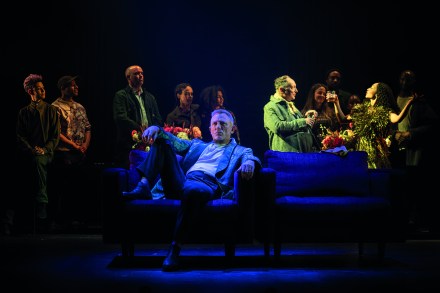
The new Macbeth on Broadway starring Daniel Craig ends up about where you’d expect: a Macbond unhinged and raving about Birnam Wood come to Dunsinane, splattering the castle walls with the gore of his enemies and pummeling Macduff mercilessly until the showstopping reveal that the latter was “of no woman born” but, in fact, “from his mother’s womb/ untimely ripped.” Omit the full-cast kumbaya circle at the end (a too-sweet cherry atop a bloody sundae), and the denouement essentially gives you Shakespearean drama at its most unimaginative — as a Hollywood action blockbuster. This isn’t to say that Shakespeare cries out for bold reimagining. Nor is there anything wrong with giving people what they came to see. It is Daniel Craig, after all.

Macbeth

Throwing curveballs

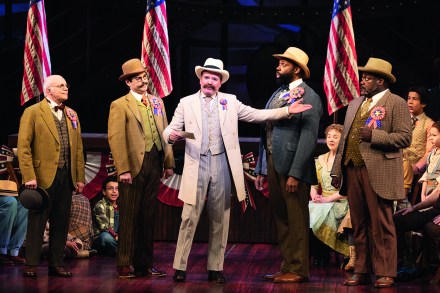
"This mob is not the people,” declared Henry J. Raymond in his paper, the New York Times, about the Draft Riots in July 1863. Blue-collar workers in New York, mostly Irish, had begun by protesting a new conscription law, but anti-war sentiment quickly became a pretext for widespread destruction, looting and racial violence. Blacks were hunted, their homes and businesses trashed, and scores of them lynched. Raymond wanted no quarter for the rioters: “Give them grape[shot] and plenty of it.” The new musical Paradise Square imagines a “little bit of Eden” in the Five Points slum of downtown Manhattan, July 1863, where, we are told, blacks and Irish did not just coexist peacefully for a time but flourished.

paradise

Midcult madness

On the same Broadway block as MJ: The Musical is the tale of another song-and-dance man hailing from Gary, Indiana: Harold Hill, doctor of music, huckster of band equipment and Meredith Willson’s titular Music Man (1957). Well, that’s not quite the case: Professor Hill is a lying crook, and his Hoosier backstory is a fabricated ruse. He claims to be a graduate of the Gary Conservatory of Music, class of ’05, but the town of Gary was only incorporated in 1906. Played by Hugh Jackman, this smooth criminal sails into River City, Iowa, promising the Ewarts and Eulalies of the town he’ll make disciplined bandspeople out of their darling Winthrops and Amarylisses.

music

Why David Mamet went right

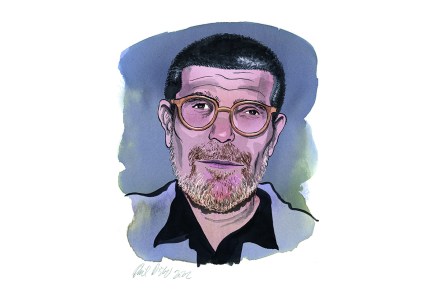
How did David Mamet spend the pandemic? The answer, as anyone familiar with the prolific, brilliant playwright and screenwriter would probably have guessed, is that he wrote. “I’ve been writing a lot of essays lately,” Mamet, seventy-four, says when we meet at his Santa Monica home on a cool January evening. “Because, you know, I don’t want to go and sit on a park bench. I’m a writer.” A collection of essays written during the tumultuous plague years is published this month by Broadside, an imprint of HarperCollins. Recessional: The Death of Free Speech and the Cost of a Free Lunch is combative, challenging, witty, and, as the title suggests, its prevailing mood is as dark as the “terrible” period in which it was written.

Mamet
Jackson

Michael Jackson on Broadway

Michael Jackson has a claim to being the most famous man in history. He is certainly the most widely seen and heard. His career straddled five decades and the heydays of radio and television. His Thriller is the best-selling album of all time. He went from playing nightclubs and The Ed Sullivan Show with the Jackson 5 to solo tours that each attracted more than four million fans. For musical celebrity, there is no comparison. The Beatles? MJ owned them, literally: he bought their entire catalogue in 1985. Elvis Presley? Lisa Marie was the King of Rock and Roll’s only daughter, but it took marrying the King of Pop to make her a star.

theater

Down with the Senate theater kids

Many failed actors work as waitstaff, or move back in with their parents. Some spiral into heroin addiction, prostitution or death. But it could be worse: a number end up in the United States Senate. This week, the Senate Judiciary Committee lent further credence to my long-held belief that anyone who declares an interest in running for political office should be committed to an asylum. The hearings for Judge Ketanji Brown Jackson bore closer resemblance to a remedial acting class than the inner democratic workings of a somewhat serious country. The right have been gorging on the clip of Democratic presidential hopeful Cory Booker giving it the full Olivier in his remarks to the judge.

Truth in Duluth

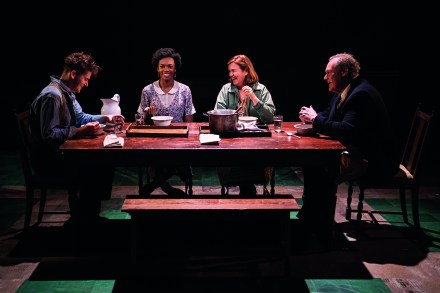
The Venerable Bede writes of a pagan priest in seventh-century England who, sizing up the meager life of man, compares it to a sparrow flying through a well-warmed dining hall on a stormy winter night. The priest admits to knowing nothing about the cold darkness before or after the brief passage. He can only speak to the time the bird spends in the light. In Girl from the North Country (open run at the Belasco Theatre), the season is the Great Depression in 1933, and the dining hall is a flophouse in Duluth, Minnesota, where down-and-outers blow through like so many birds on the wind. The innkeeper, Nick Laine (Jay O.

north country

How Covid killed grown-up movies at the theater

The box office news from earlier this December was mixed. The stupendous success of the latest Spider-Man sequel, No Way Home, indicated that fears of the Omicron variant have not deterred audiences from coming out in the millions: it grossed $260 million at the US box office and $600 million globally. But it also trampled other less franchise-friendly films. Guillermo del Toro’s new picture Nightmare Alley debuted to a dismal $3 million, and Steven Spielberg’s version of West Side Story will be one of the director’s greatest flops, having grossed a mere $18 million in the US so far. The chances of either film — expensively mounted period pieces from A-list directors — recouping their production budgets at the theater, let alone their advertising costs, is zero.

Broadway’s back(side)

Six, a British musical about the wives of Henry VIII, is a scrupulously specious masterclass in frivolity. These onetime queens, blinged and bedazzled as fabulous pop-diva Kweens, undertake a six-way singing competition to decide who had “the biggest, the firmest, the fullest... load of B.S. to deal with” from their kingly husband. Backed by a live band, the sextet’s set amounts to the love child of RuPaul’s Drag Race and the Super Bowl halftime show. Those hoping for revisionist revenge fantasy will leave disappointed. Those seeking dramatic tension, character development, tragedy — anything having to do with the second half of the phrase “musical theater” — won’t find it here.

six

Playwright at play

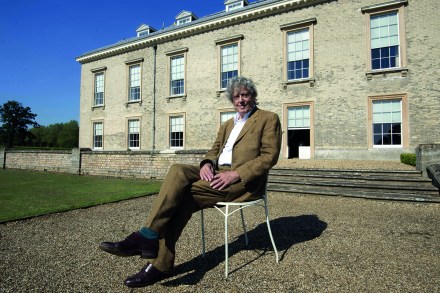
Gilbert in Oscar Wilde’s dialogue ‘The Critic as Artist’: ‘Every great man nowadays has his disciples, and it is always Judas who writes the biography.’ Not here. Hermione Lee’s immensely long Tom Stoppard: A Life is expert, engrossing, entertaining and sympathetic to its subject. At its heart is a writer steely in his determination to entertain, an inexhaustible mine of mots, a nonstop genius of jokes, capable of winning the Nobel Prize for the interview as an art form. It comprehensively replaces Ira Nadel’s Double Act (2002), a biography which Stoppard hoped would be ‘as inaccurate as possible’. (Indian Ink and Arcadia are both explicitly hostile to biography and its hubris.

stoppard

Andrei Serban and the importance of acting out

During my study in the theater division at Columbia University’s School of the Arts, Romanian emigree acting professor Andrei Serban was legend. Beloved by acting students, lauded by faculty, he was tenured, established, and had seemingly free reign over his department. Despite that, he recently resigned over the administration’s push for trans inclusivity and faculty identity diversity. In an interview with Romanian TV show Profesioniștii (The Professionals), Serban detailed the two major reasons for his departure. As head of a hiring committee, he was told by the Dean of the School of the Arts to hire a person based on their identity factors, and not the person who he thought was best for the job.

andrei serban