The spectator

Out now: the August edition of The Spectator World

From our US edition

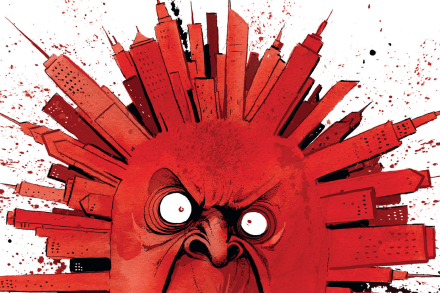
Hell hath no fury like the average American. As temperatures, tempers and crime stats rise, our August 2021 edition asks if Americans are angrier than they’ve ever been. Peter Wood examines the evolution of the right’s anger through the astute lyrics of country singer Toby Keith, from post-9/11 fury to the present despondency. Sohrab Ahmari considers the crime surge in American cities, which he claims is a consequence of anti-anti-crime policies pushed by progressives. Mary Eberstadt credits climbing crime rates to the floundering influence of fathers in American households.

august 2021 world cover

Out now: the June edition of The Spectator World

From our US edition

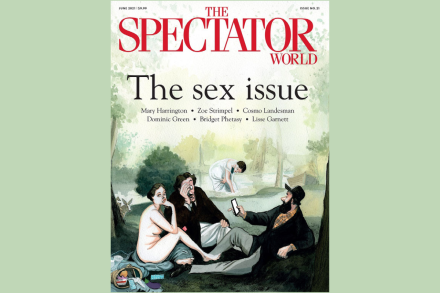
Sex sells, we’ve been told, and so — grubby hacks that we are — we have dedicated the June edition of The Spectator World to the subject. But this ain’t your average smut. On our cover, the brilliant Mary Harrington looks at how America’s young elites are turning against free love. Zoe Strimpel discusses her recent experiences on dating apps and wonders why young men seem to have lost interest in sex. Cosmo Landesman asks if women who claim to love pornography are faking it; Bridget Phetasy wonders why men’s magazines such as Playboy aren’t for men any more and Dominic Green takes a Freudian look at America’s race to the bottom. Beyond all the sex, the June edition features a variety of other subjects to arouse your curiosity.

june

Notice: The Spectator’s agreement with The American Spectator

From our US edition

The Spectator and The American Spectator are pleased to announce the settlement of the recent lawsuit between the parties. The Spectator and The American Spectator are independent publications and have been available in the United States for many decades. Historically, The Spectator has focused primarily on UK politics and affairs while The American Spectator has focused primarily on US politics and affairs. This arrangement has worked well and the publishers have even considered each other to be more friends than competitors. The Spectator has recently decided to launch new publications with a focus on US politics and affairs.

Hot off the press — what’s in the April issue

From our US edition

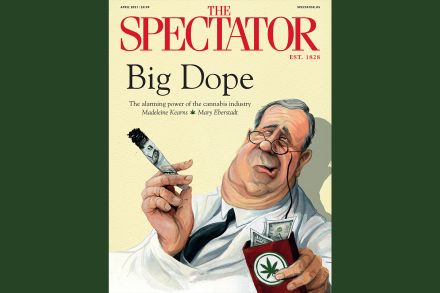
It’s perhaps no coincidence that America seems to have gone crazy right about the time that cannabis became legal. In our latest April edition, we cover Big Dope, or the alarming power of the cannabis industry. Madeleine Kearns looks at the disturbing health consequences of widespread marijuana consumption as well as the enormous profit-motives that cloud any serious discussion about the downsides. Why worry when the poor can get high and the rich can get richer? We may soon find out. Mary Eberstadt also asks if, given all the other crises plaguing American society, more drugs are what we need. That’s all strong stuff. And we have plenty more for you to put in your mental pipe and smoke. — Our lead editorial explains how the border crisis could define Biden’s presidency.

april

Tales from my private jet

Gstaad I was very sad to read of Rupert Hambro’s death. I didn’t know him well, but first met him long ago, along with his younger brother Rick, also gone. They were both quintessential English gentlemen: handsome, kind and with a great sense of humour. Rupert invited me to lunch quite a few times, but because of circumstance I was never able to reciprocate. The last one was at Wiltons, which he owned, I believe, but he never gave any indication that all was not well. In an age of crybabies and professional victims, Rupert stood out like a saint in hell. He leaves his lovely wife Robin, a Philadelphia-born beauty, and two children. Thinking of Rupert and Wiltons, I remembered a dinner I gave there long ago for my friend Nick Scott to meet some of The Spectator people.

The fakery of Martha Gellhorn

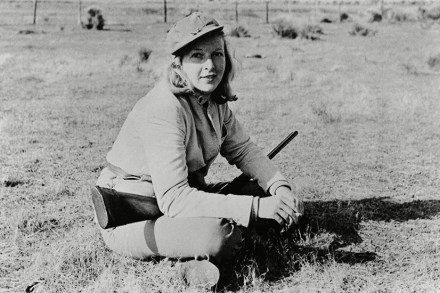
Gstaad Martha Gellhorn was a long-legged blonde American writer and journalist who became Papa Hemingway’s third and penultimate wife. She got her start when H.G. Wells, then nearly 70, fell for her rather badly, advised her on her writing, and paid her a small retainer to keep him up to date on American trends. She was 27 at the time. Wells had met Martha at the White House during the Franklin Roosevelt years before the war, Eleanor having been a friend of Martha’s mother, who was known around St Louis for having a mad crush on the First Lady. Yes, dear readers, sex existed even back then, but people didn’t tweet about it, they just did it.

It’s been a tough year for socialites

New York Here we go again, the annual holiest of holies is upon us, although to this oldie last Christmas feels as though it was only yesterday. Funny how time never seemed to pass quickly during those lazy days of long ago, but now rolls off like a movie calendar showing the days, months, years flashing by. I wrote my first Christmas column for this magazine 43 years ago, sitting in my dad’s office on Albemarle Street. I remember it well because I used every cliché known to man and then some (patter of little feet… children’s noses pressed against snowy windows). The then editor, Alexander Chancellor, said nothing to me but later told a friend that however bad it was, it was better than the Greek political stuff I had been filing.

The Spectator, war and slavery: a note on our history

From our US edition

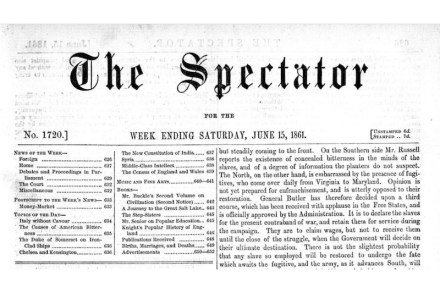
In her article about the point of protest, Tali Fraser mentions the support of Manchester in the 1860s for the North against the slave-owning South in the US civil war. At the time, this was an unpopular cause amongst the British elite. Of all the publications still around today, only one backed Abraham Lincoln then: The Spectator. The magazine almost went bust as a result. I remarked a few days ago that what sets us apart from other long-running magazines is that our values have not changed much since we were founded in 1828 – or, indeed, since the The Spectator appeared in its original form in 1711. That aroused some teasing: surely, some asked, a magazine needs to change with the times?

slavery

New York Times makes The Spectator part of the story

From our US edition

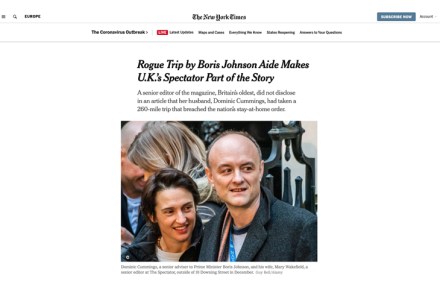
Cockburn was thrilled to see the New York Times take an interest in The Spectator last weekend, after the paper published an article about our London office’s ‘incestuous ties’ with the governing elite. Amazing that during a global pandemic and nationwide rioting, the NYT saw fit to dedicate few inches on page A8 to a political adviser on a northern European island. ‘Rogue Trip by Boris Johnson Aide Makes U.K.’s Spectator Part of the Story’, declared the headline. At least that was the revised headline — the first suggested, erroneously, that The Spectator was in ‘turmoil.’ The Spectator may be in many things, but turmoil isn’t one of them. The Gray Lady isn’t known for its fair-mindedness these days. But its coverage of the Speccie was surprisingly reasonable.

new york times spectator

The radical history of The Spectator

A newspaper – it would be more than 100 years before it became a magazine – calling itself a spectator of events, while consistently standing up for individual freedom, was bound to fall out with its readership from time to time. In the early years, under the editorship of its Scottish founder, Robert Rintoul, The Spectator’s support for the Tolpuddle Martyrs, for the Chartists and for the abolition of slavery in the colonies did not cause too many raised eyebrows. Thanks to Rintoul’s enlightened imperialism, a fund was established to settle labourers and young married couples in Australia and New Zealand.

How to buy The Spectator’s 10,000th UK edition in the US

From our US edition

The Spectator in London has this week done something no other magazine has done. We’ve just published our 10,000th edition. We’ve been producing a weekly magazine since 1828 — I’m proud to have been involved in the magazine for 10 of those 192 years. The key to our longevity is that The Spectator is unique; it dares to be different. We have pretty much stuck to the same simple editorial formula — news and comment first, book reviews after — because it works. We allow jokes and dissent. We encourage arguments. As Douglas Murray puts it in his column this week, The Spectator’s enemies are ‘Boredom. Predictability. Obviousness. Humorlessness. Dullness. Staleness.

mr spectator 10,000th

Writing my High Life column made a man of me

As Cole Porter might have said, only second-rate people go on and on about their inner lives. Self-analysis, according to Cole, is the twin of self-promotion. Yet in this 10,000th issue of the world’s oldest and best weekly, and in my 43rd year of writing High Life, I have to admit to a bit of both of the above. So before any of you retreat into laptops and mobiles, some nostalgia is called for, starting in the spring of 1977. Many of the writers back then sent in their longhand-written copy via messenger, paid for by The Spectator. I used to type mine and slip it under the door at Doughty Street before heading for Berkeley Square and Aspinall’s.

From Middlemarch to Mickey Mouse: a short history of The Spectator’s books and arts pages

The old masters: how well they understood. John Betjeman’s architecture column ran for just over three years in the mid-1950s. Yet during that short run he experienced the moment that comes, sooner or later, to every regular writer in The Spectator’s arts pages. ‘It is maddening the way people corner one and make one discuss politics at the moment,’ he wrote on 23 November 1956, clearly as bored of the Suez crisis as the rest of us were, until recently, by Brexit: Because I write in this paper, people assume that I share its Editor’s views about Suez… But I don’t know what the views of this paper about Suez are, because I never read the political stuff in front.

Vodka, kaolin and morphine: my welcome drinks at The Spectator offices

In 2001, aged 44, I was hired to write a weekly column for this august paper, and for the first time in my life there was a London door on which I could knock or ring, at any time of the day or evening, and be welcomed in. And what a door! To walk along the Regency terrace sun trap of Doughty Street in Bloomsbury on a summer evening, then breeze through the open door of number 56, and to know that the people to be found inside were the funniest, cleverest, most unsnobbish collection of individuals, and that booze was the second language, was a dream come true. I would trot up the steps beneath the stripy awning, enter the magic portal and turn left into a seedily ornate reception room. There I could take a running jump into secretary Ann Sindall’s ample bosom.

Why you should subscribe to The Spectator

From our US edition

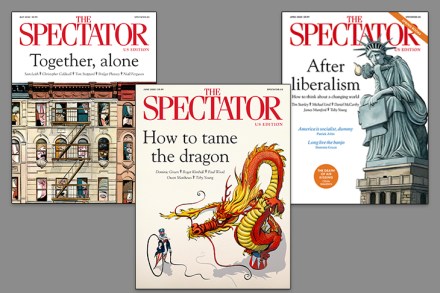
Dear Reader, There isn’t much to be cheerful about in this world of plague anxiety. Yet one comfort is that, locked down as we all are, we may have more opportunities to read. That’s where The Spectator can help. We’ve got a flash sale on, and there are many reasons you'll want to take it up: We have now put our June edition to bed and it looks great. The subject — ‘how to tame the dragon’, ie China — couldn’t be more important. Get your copy here Each month we produce a similarly stunning print issue. As well as great essays on politics, we have brilliant arts, books and life sections, edited by Dominic Green, with reviews and essays by some of the best writers in the English language.

Amber Athey joins as The Spectator’s Washington editor

From our US edition

I’m delighted to announce that Amber Athey is The Spectator’s new Washington editor, joining us from the Daily Caller next month. We’re thrilled to have her on board. Amber is a highly talented and accomplished young journalist and a very gifted writer. She’s been an excellent White House Correspondent for the Caller, where she’s broken countless great stories and regularly questioned the president, Mike Pompeo, Steve Mnuchin and other officials. She has already written some excellent stuff for us and she’ll be invaluable in giving The Spectator a presence in DC. The Spectator’s US edition goes from strength to strength. We are already on to our fifth print edition of the monthly magazine and we feel we are getting better and better.

amber athey

Facebook now jails me for sharing my own Spectator columns

From our US edition

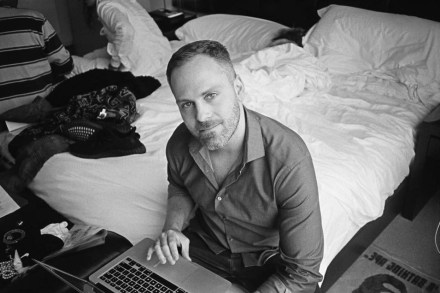
Welp, another 30 days in the gulag. How will I ever survive this time? About a year ago, I stopped using Facebook almost entirely, deleted the app from my phone, and ceased to accept new ‘friends,’ as a few thousand requests continue to pile up in my inbox. It got to a point that, even while self-censoring, nearly every time I opened my mouth on the platform I got slapped with a ban. There was nothing I could do: someone at Facebook clearly has me on a list and, really, Facebook is lame. I’m not sticking around some tyrant’s house if he doesn’t want me there. But friends encouraged me to say. I’m ‘letting them win’, my friends said, if I deleted my account, as though they haven’t already won.

chadwick moore spectator

The differences between British and American readers

From our US edition

This article is in The Spectator’s October 2019 US edition. Subscribe here. New York This feels strange. Since 1977, I have been writing the High Life column in the London Spectator and concentrating on American goings-on for a British audience. Now I am about to write the High Life for an American readership. Are American readers very different? You betcha, though they are supposed to speak the King’s, or the Queen’s, English. Never mind. Both countries take their democracies seriously, and their freedoms even more so. One difference is that, over in the Old Country, people know that democracy is rare in distant parts of the world.

new york american

Good morning, America

From our US edition

‘The Spectator is the best written paper,’ the American Whig Review said in 1851. ‘It has a place for every thing, and every thing can be found in its place.’ Not much has changed. The Spectator is still the greatest magazine in the English language. We will soon become the first magazine in history to publish a 10,000th edition. As that milestone approaches, we are expanding: this first American issue marks the beginning of an exciting New World chapter. It’s odd, perhaps, that it has taken us 191 years to come to America. The Spectator, rooted in true liberal and radical thinking, has long had an affinity for the Land of the Free. Our history is full of American connections.

magazine leader spectator

The Spectator’s first US edition is coming!

From our US edition

It’s a busy and exciting week for The Spectator in America: we are putting together our first US edition. It’s beautiful and big: an 84-page book, perfect bound, with a glossy cover. We’ve been pleased with the number of early-bird subscribers, and I’m pretty confident we will be able to reward them with a great magazine, the likes of which they haven’t read before. The Spectator’s brand of journalism is unique, and we are confident that it can thrive in America. We aren’t publishing stories in order to tell our readers how to think. We aren’t politics bores. We aren’t interested in shaping the conservative or any other movement.