Syria

Pressure grows for recall of Parliament on Syria

David Cameron and his colleagues have made fairly carefully-worded pledges on whether or not Parliament should be consulted if the government starts planning for a military intervention in Syria. They could feasibly stick to the precise wording of those pledges this week without recalling MPs for a debate, but this will be a very difficult position to maintain as pressure is growing on all sides for a recall. Labour’s Shadow Foreign Secretary Douglas Alexander said this evening: ‘If, in reality, the Prime Minister is now considering military options involving UK personnel then of course I would expect him to seek a recall of Parliament and to come to the House

Cameron and Obama warn Assad of 'serious response'

David Cameron spoke to Barack Obama yesterday about the situation in Syria. A Number 10 spokesman gave the following read-out of the call: ‘They are both gravely concerned by the attack that took place in Damascus on Wednesday and the increasing signs that this was a significant chemical weapons attack carried out by the Syrian regime against its own people. The UN Security Council has called for immediate access for UN investigators on the ground in Damascus. The fact that President Assad has failed to co-operate with the UN suggests that the regime has something to hide. ‘They reiterated that significant use of chemical weapons would merit a serious response

George Galloway blames Israel for the use of chemical weapons in Syria

Say this for George Galloway: every time you think he cannot sink any lower he finds new ways to surprise you. His latest contribution to Press TV, Iran’s propaganda station, speaks for itself. Parody is pointless. Given his history and his paymasters, we would expect him to defend the Assad regime in Syria. Even so, under-estimating his ability to sniff out the true villains is never sensible. Here’s his “analysis” of the use of chemical weapons in Syria: “If there’s been any use of nerve gas it’s the rebels that used it. […] If there has been a use of chemical weapons it was al-Qaeda who used chemical weapons. Who

The Thin Red Line

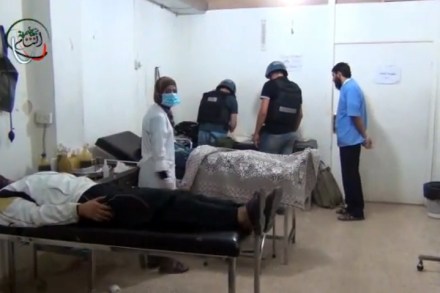
The elasticity of President Obama’s ‘Red Line’ on Syria seems to be being stretched to breaking point following this week’s chemical weapons attack by Bashar Assad in a Damascus suburb, Ghouta, where up to 1,200 people, including many women and children may have died. What we all have seen on our screens is not an episode from ‘Wag the Dog’ as Assad and his chief cheer leader Putin would have us believe. In fact this is likely to have been the worst chemical attack on civilians since Saddam Hussein gassed up to 5,000 Iraqi Kurds in Halabja 25 years ago. Fortuitously the UN has a team of chemical weapons inspectors

Syria’s war in miniature: meeting the Christians driven out of Qusayr

 Beirut Ilyas was, he told me, the very last Christian to flee Qusayr. He had been one of just a handful in the town to join the revolution — an odd thing for a Christian to do because the Free Syrian Army (FSA) were and are mostly Sunnis, and the Christians mostly sided with Assad. Still, it didn’t save him. One day he heard banging on the door and saw men with Kalashnikovs standing there. There were familiar faces, some he had known for years. He said: ‘They told me: “You’re a Christian – you’re not welcome here.”’ Qusayr is a grim little town of 30,000-40,000, a few miles into

The EU fails to ban Hezbollah

As though the sunny weather and the royal baby were not enough, here comes yet more good news. The European Union has finally banned the military wing of Hezbollah. This is something I have argued for often, including here, here, and here. After recent trials of Hezbollah operatives and Hezbollah operations – including the Bulgaria bombing – on European soil the decision did seem inevitable. Yet there is a cloud on the silver lining – which is that the EU, in somewhat characteristic fashion, has only managed to do a partly good thing. While they have banned the ‘military wing’ of Hezbollah they continue to allow the ‘political’ wing to fundraise and

The Pentagon shows that Barack Obama missed his chance to tip the balance in Syria

When General Martin Dempsey, Chairman of the Joint Chiefs of Staff, appeared before the Senate Armed Services committee last Thursday an intemperate exchange threatened to derail his bid for reappointment in the post. When Dempsey repeatedly declined to say what advice he had given President Obama on Syria, John McCain threatened to block the nomination. McCain later sent Dempsey a letter asking him to clarify what military options the Pentagon has considered in Syria. ‘The decision over whether to introduce military force is a political one that our Nation entrusts to its civilian leaders,’ Dempsey replied. ‘I also understand that you deserve my best military advice on how military force

Accidental dictators

Two flashpoints have emerged recently, threatening regional wars and pitting global powers against each other. They happen to be run by accidental dynastic heirs, each representing a new generation of dictatorship whereby sons inherited jobs which they might never have wanted. One is North Korea, which draws in the competing wills of Beijing and Washington with the balance of power in the Asia-Pacific. The other is Syria, where Russia and America are holding each other in check over influence in the Middle East. Syria’s Bashar al Assad  began his career as a competent junior ophthalmologist, training at the Western Eye Hospital in London, until he was plucked away in 2000

Why Parliament must have a say before Britain decides to arm the Syrian rebels

The uprising against President al-Assad shows little sign of reaching a conclusion. The civil war is causing huge suffering – with atrocities perpetrated on both sides. There are no easy answers. Some in Government actively push for Britain to supply weaponry to the rebels. But this would be a mistake of historic proportions, as it could tilt the conflict towards a truly regional war. This is one reason Parliament should be consulted before lethal support is provided to the rebels. Our debate next week attempts to draw this line in the sand as we head into the summer recess. So far the debate about providing lethal support has been confined

Christopher Sykes’s diary: David Hockney, Bridlington lobster, and the risks of a third martini

I began my week with a trip to Bridlington, the closest seaside town to my childhood home. ‘Brid’, as it’s known to the locals, has a special British charm, comprising miles of unspoilt beach, beach huts, a pretty little harbour, fish-and-chip shops galore, rows of guest houses and The Expanse, a splendid old-fashioned hotel. The council are, however, missing a trick. Brid’s main fishing industry these days is lobsters, as delicious as any you will ever taste. You wouldn’t know it, however, as, apart from a few expensive ones kept in tanks at the Blue Lobster on the harbour, they all go to Europe. So, come on Brid, how about

In defence of having no opinion

‘Where do you stand on Syria?’ asked my stepson. Tricky one. Clearly, the Assad regime is loathsome and the West should exert more pressure to end the bloodbath, but on the other hand I’m not convinced we should be doing anything at all to help the divided rebels, not least because the faction that takes over will have lots of scary chemical weapons at its disposal. My steppy’s eyes glazed over. I didn’t have a view at all. That’s what he was thinking as he reverted to his iPhone for a far more stimulating exchange than anything I was offering. How wrong he was. My position is as clear and

Spectator Syria debate: Should the West intervene?

Should the West intervene in Syria? This week’s Spectator debate on this topic saw an impressive swing of opinion in the audience once the speakers had made their cases for and against intervention. All agreed that the first part of the motion debated – ‘Assad is a war criminal: the West must intervene in Syria’ – wasn’t in doubt, but while Sir Malcolm Rifkind, Dr Wael Aleji and Dr Alan Mendoza argued that the West had a clear case for intervening in various ways, Sir Andrew Green, Dr Halla Diyab and Douglas Murray argued that intervention would not improve the crisis at all. Alan Mendoza, founder of the Henry Jackson

Spectator Syria intervention debate

A terrific debate last night at the Spectator: ‘Assad is a war criminal – the West must intervene in Syria.’ I don’t think there was any disagreement on the first part of the motion. But there certainly was on the second. I spoke in opposition to the motion and much of the argument I made is in a piece I’ve written for this morning’s Wall Street Journal which readers might be interested to read here.

Syria: We must arm the moderate opposition to keep out extremists

On 31st March 1854, the radical leader John Bright made the first of his great speeches opposing the Crimean War. “I am told indeed that the war is popular”, he proclaimed, “and that it is foolish and eccentric to oppose it”. A considerable number of my colleagues take a quite contrary view regarding the provision of arms to Syria’s insurgency.  Military assistance to the Syrian opposition is not popular, and it is regarded by many as foolish and eccentric to support it. Many of these reservations are sincere and well-founded.  However although I was wary of providing military assistance during the first year of the Syrian conflict, I came to the conclusion last

Lesson of Afghanistan? That you can, after all, bomb your way to the negotiating table

It’s not just soldiers who risk their lives in Afghanistan. Anyone who enters the country’s judicial service becomes an assassination target. Only last week, six Afghan judges were killed by a suicide bomb outside Kabul’s Supreme Court. A Taleban spokesman said they had been ‘sentenced to death’ for playing an ‘important role’ in ‘legalising the infidels’. Such attacks have killed over 3,000 civilians in Afghanistan so far this year, according to the United Nations. Of these, some 600 were children. Barack Obama’s administration invites us this week to welcome the prospect of peace talks between the Taleban and Hamid Karzai’s government as a sign of progress. It is hard to

If you think arming the rebels is the answer, then you don't understand Syria

The Spectator debate on Monday will no doubt pick up from Cameron’s statement to the House of Commons after the G8 meeting on Wednesday. It was wafer thin; so were his achievements. The spin generated by Number 10 in recent days has verged on the absurd. On Tuesday, according to The Times headline, Cameron was ‘leading the West to ambush Putin on Syria’. Does anyone believe that this is the way to handle the Russians, let alone Putin? Nor, of course, did it happen. By Wednesday we were being told that ‘The West tries to engineer a coup in Damascus’. No sign of that either. By the time the Prime

First Syria, then Lebanon

  Beirut On New Year’s Eve 2011, I asked a senior Swedish diplomat, who had just crossed over from Damascus and was ready to see in the New Year Beirut-style, how long he gave Bashar al-Assad as Syrian president. ‘Longer than we think, but not as long as he thinks,’ he said with a wink. That was still in the days of what we naively called the Arab Awakening; we Lebanese assumed we could sit back and wait for Syria’s hated system to fall. But the weeks have turned to years, and not only is Assad still in place, he might just be prevailing. Lebanon, meanwhile, is falling apart. Fighting

Why can’t we be honest about Syria?

Wouldn’t it be nice just once in a while to have a war in the -Middle East that wasn’t predicated on outright duplicitous nonsense? Just occasionally? There are, after all, any number of sincere reasons one could advance for intervention now in Syria. (If one thought that was a good idea, which as it happens one doesn’t.) One could say, for example, that Bashar Assad is a nasty murderous bastard, and that now he’s gained the upper hand he’s almost certain to indulge in some even nastier, more murderous murdering than he’s been enjoying hitherto. Pretty good, that. Pretty hard to argue against. Or one could argue that a Sunni-controlled

‘Jihad!’

I don’t think, so far as I can remember, that I have ever previously found any sympathy with the sayings of top Islamist cleric Sheikh Yusuf al-Qaradawi. But I do appreciate his recent sentiment that Hezbollah is in fact not the ‘Army of God’ but rather the ‘Army of Satan.’ And I can find only one fault in his recent rallying cry, backed by the Grand Mufti of Saudi Arabia, Abdul Aziz al-Asheik (with whom he has usually disagreed), that ‘every Muslim trained to fight and capable of doing that [must] make himself available’ for Jihad in Syria against Bashar al-Assad and Hezbollah. The powerful downside, of course, is the continuing

It looks like we must hope for the best in Syria

Is there not something odd about a Prime Minister talking of getting involved in the Syrian civil war on the very day that another 4,500 British service personnel had their redundancy notices handed to them? It has always been my belief that you should never even tinker in a conflict unless you are prepared to go all the way should circumstances change (as they tend to). Britain no longer has the capability to get fully involved in Syria. So I suppose that we will all have to hope that Mr Cameron and Mr Hague possess an uncanny ability for identifying moderates, arm them nicely and just hope that everything goes