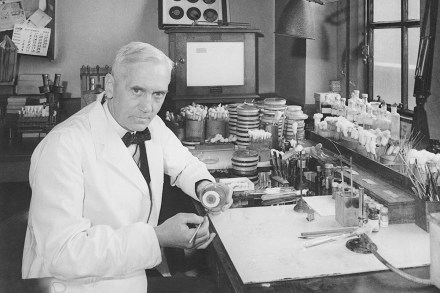
Stanford’s Marc Tessier-Lavigne and the messiness of modern science
Following a rigorous investigation, the Stanford president has resigned
Dr. George Church and Ben Lamm say they’re not creating a real-life Jurassic Park
The tech magnate is on a mission to save the world from the attack of the Killer Robots
It it is becoming plain that civilization cannot go on forever. Does this imply that it should never have existed at all?
Climate change is not the same as nuclear annihilation
Consumerism, technology, sex, drugs — these things can’t give us happiness
Is this America’s healthiest workplace?
‘White men need not apply’ is corrupting science
The Mean Girls of academia accused him of ‘erasure,’ but do their claims hold up?
There isn’t a single study with a control group that shows they work. Follow the science!
The misnamed American Association for the Advancement of Science targets the tenured professoriate under the guise of diversity
America’s politics and celebrity culture blur together yet again as a TV doctor runs for Senate
The prophets of stagnation are wrong
Much of what’s considered ‘science’ in research periodicals is nothing of the sort
The technocrats are nudging us into a dystopia
A new lovable robot joins the cast in 2020
With enemies as unhinged as this, who needs friends?
Everyone knows the real reason people like Donald Trump are sceptical of climate change is that conservatives are fundamentally anti-science. Some doubt science because it conflicts with their religious beliefs; others because its implications might mean radically shifting the global economy in an anti-growth or heavily statist direction, which goes against their free-market ideology; others because, being conservative, they are prisoners of their dogmatism, need closure and fear uncertainty. I hear this all the time from lefties on social media. And there seems to be some evidence to support it. At least there is if you believe studies like The Republican War on Science (Mooney, 2005), Politicization of Science in
It was in his play Back to Methuselah that George Bernard Shaw honoured a lesser known aspect of Charles Darwin’s originality as a thinker, when he described him as ‘an intelligent and industrious pigeon fancier’. Britain’s greatest natural scientist was indeed a keeper of fowl, with pigeons among his favourites. The habit arose from Darwin’s instinctual recognition that in the animal-rearing experiments conducted over millennia by our ancestors, we had inadvertently stored away crucial evidence about the way in which all of life can change in response to environmental stimuli. It was part of his world-changing insights that he proposed how all the 200- plus pigeon breeds recognised in Victorian
When Peregrine Worsthorne was on Desert Island Discs in 1992, he chose as his luxury item a lifetime supply of LSD. He may, according to the American journalist Michael Pollan’s fiercely interesting new book, have been on to something. Acid has a bad name these days: either a threat to the sanity of your children, or a naff 1960s throwback favoured by the sort of people who sell you healing crystals at markets in Totnes. Yet in LSD-25, psilocybin, DMT, mescaline and others we have a family of molecules with startlingly powerful effects on the human mind. They are not addictive, carry little or no physiological risk, and their association