Russia

Is a Russian invasion now imminent?

From our UK edition

Tensions on the Ukraine border are continuing to increase. Worryingly, Russian state media has gone from mocking Washington’s warnings of an invasion to ramping up the various pretexts that the Kremlin is trying to create for one. The leaders of the two self-proclaimed breakaway republics in the Donbas have been on Russian TV today asking for Russia to recognise them and offer military assistance. Moscow is also claiming that it has killed five Ukraine troops who supposedly crossed into its territory.  The Biden administration remains convinced that an attack on Ukraine is coming in the near future.

How the Ukraine crisis ends

From our UK edition

Vladimir Putin does not think in the way the West does. Of course sanctions will hurt. But so what? He may be wrong in his strategic calculations, but he is not, as Boris Johnson claimed over the weekend, irrational. Putin is an old-school strategist. This is one of the reasons that sanctions will not have the desired impact. An import ban on Russian gas would definitely hurt the Russian economy, but that seems highly unlikely. Italian President Mario Draghi said on Friday that we should not touch gas. It is now the guy who sits in Moscow, rather than Draghi, who is willing to do ‘whatever it takes’. An import ban on the latest iPhones does not have the same deterrent effect as a continental gas shortage. Don’t fool yourself about the impact of sanctions.

Can the India-US relationship last?

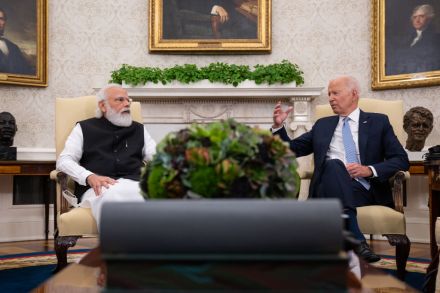
India and the United States have rediscovered each other after the cordial hostility of the Cold War. Those years of isolation have made India’s political and financial elites susceptible to flattery. America’s courtship of India, lubricated by the economics of globalization and the post-9/11 zeal to spread democracy, is now being consummated in the American search for a democratic counterweight to China. But India is a chaotic democracy in a volatile neighborhood. Can it hitch itself to America without forfeiting its autonomy? Foreign strategic experts exhort India, which is non-interventionist to its marrow, to act like a global power.

india
russian

Fall and decline

In December 1921, a twenty-two-year-old Ernest Hemingway, then the European correspondent for the Toronto Star, came across the oddest group of immigrants in history — the White Russians who had fled the Bolshevik Revolution. “Paris is full of Russians,” Hemingway told his readers. “They are drifting along in Paris in a childish sort of hopefulness that things will somehow be all right, which is quite charming when you first encounter it and rather maddening after a few months. No one knows just how they live, except by selling off jewels and gold ornaments and family heirlooms that they brought with them to France.” Hemingway neatly summarized the meat of this gripping latest book by Helen Rappaport, the author of The Romanov Sisters and Caught in the Revolution.

Sunday shows round-up: Ukraine could see ‘biggest war in Europe since 1945’

From our UK edition

The Prime Minister has been attending the annual Munich Security Conference, where the prospective Russian invasion of Ukraine is very much at the top of the agenda. The BBC’s Sophie Raworth caught up with Boris Johnson yesterday, following a speech he made warning of the disaster that war would bring. Johnson said in the interview that he believed that Vladimir Putin was ready to orchestrate such a crisis at any moment: https://twitter.com/BBCPolitics/status/1495334713057288192?ref_src=twsrc%5Etfw ‘It is important that people should feel confident again’ Tomorrow, the government is expected to announce its plans to remove all Covid restrictions for England.

skating

China’s Olympic propaganda show ends in global shame

It was only fitting that China's hopes of putting on the perfect Olympics should ultimately be dashed by its new partner in crime, Russia. The two countries started the Beijing Winter Olympics by announcing a "no-limits" partnership against the West, and ended them with one of the biggest sporting scandals in recent Olympic history. If the 2008 Beijing Summer Olympics were China's coming out party, then the 2022 Winter games would tell the world that the rising authoritarian regime was stronger — and cockier — than ever. The opening ceremony jabbed at those critical of China's human rights abuses by highlighting China's diversity and allowing a Uighur to carry the Olympic torch.

We blew our chance to befriend Putin

From our UK edition

You have the advantage over me. It may be that you are reading this now in your makeshift fallout shelter, hair falling out and bleeding from the gums as the nuclear winter descends. More likely you are saying, rather smugly, to your neighbour: ‘I knew he was taking the piss. He’s a right one, that Putin.’ Or perhaps Vlad’s forces are already in London, having swept through western Europe in about eight hours, the Germans for once outdoing the French with their alacrity to surrender. Well, that should see an end to Stonewall and the Tavistock Clinic, no? Every cloud, etc.

Taking Ukraine would finish Putin

From our UK edition

‘Never interrupt your enemy,’ said Napoleon, ‘when he is making a mistake.’ A Russian invasion and occupation of Ukraine would prove (perhaps, by the time this Spectator is published, ‘will’ prove) a terrible mistake. Were it not for the death and despoliation such a mistake would bring — an outcome one could never welcome — the response to Vladimir Putin’s implicit threats should surely be: bring it on! When we told Russia they’d only be hurting themselves, did we not mean it?

Russian roulette: is Moscow’s bluff backfiring?

From our UK edition

A bluff only works if you can carry it off convincingly. The massing of some 130,000 Russian soldiers on Ukraine’s borders has led to London and Washington declaring that a full-scale invasion is imminent, but it could still be a feint. The Russians know everything they do can be seen by satellite. On the phone from Kiev, Colonel General Ihor Smeshko says he is not inclined to read too much into the Russian army’s logistics. He was head of Ukraine’s domestic intelligence service and later a candidate for president.

China and Russia are an alliance of disruptors

From our UK edition

Four years ago, Vladimir Putin and Xi Jinping made pancakes together in Vladivostok while thousands of their military forces conducted joint exercises in Siberia. This month, as China hosted the Olympics, Putin and Xi announced that a ‘new era’ in international relations had begun, one in which the two great authoritarian powers of the 21st century will reshape the liberal international order established in 1945 and reaffirmed in 1991. Some call it Cold War II, yet the blossoming relationship between Moscow and Beijing may best be thought of as an alliance of disruptors.

Theatre of war: Putin’s deadly dramatics over Ukraine

From our UK edition

Vladimir Putin now knows that the West won’t fight for Ukraine. The past few weeks have shown that. All options are open to Moscow. Russian troops could march on Kiev or stay on the border destabilising Ukraine’s economy until its government gives way. If Putin wanted a fight, he would win — at least initially. No western military force will stop Russia from crossing the border. The main question is what punishment the West would be able to inflict on Russia after an incursion. Would Nato members be able to agree on what approach to take? Tensions within the alliance have been exposed.

How do Russian and Ukrainian military forces measure up?

From our UK edition

Facing the music Police in New Zealand played Barry Manilow records to truck drivers in an attempt to persuade them to break up their protests. One of the first uses of music as a weapon was by US forces attempting to force Panamanian military leader and drug dealer General Manuel Noriega to leave the Vatican embassy, where he had sought sanctuary in December 1989. For three days over Christmas they played an eclectic mixture of music including ‘Too Old to Rock’n’Roll, Too Young to Die’ by Jethro Tull, ‘Judgment Day’ by Van Halen, ‘Born to Run’ by Bruce Springsteen, ‘Give It Up’ by KC and the Sunshine Band, ‘We Gotta Get Out Of This Place’ by the Animals and ‘Never Gonna Give You Up’ by Rick Astley.

What would Thatcher have made of Putin?

From our UK edition

When Sir Tony Brenton writes a letter to the Times, as he frequently does, it always says at the bottom that he was British ambassador to Moscow. The uninformed reader could be forgiven for thinking the sub-editors have got it back to front and he was actually Russian ambassador to London. Sir Tony’s message in every letter is ‘It’s all Britain’s fault’. In his latest, his particular target was the Foreign Secretary, Liz Truss, after her visit to Moscow. He said she ‘might usefully recall Margaret Thatcher’s wise message to Mikhail Gorbachev sent in 1985 as perestroika began to take off: “We know that you have as much right to feel secure as we do”’. It is hard to think of a less apt comparison.

Playing until her fingers bled: the dedication of the pianist Maria Yudina

From our UK edition

The 20th century was an amazing time for Russian pianists, and the worse things got, politically and militarily, the more great pianists thrived, despite the extreme danger and discomfort in which they lived and in which some of them died. If we think immediately of Richter, the greatest of them all, and Gilels, there are at least 20 more that we could add without exaggeration. One of the most important was without question Maria Yudina, born in 1899, who astonishingly survived until 1970. She was not just a sovereign artist but an eccentric of the kind and degree that only Russia seems able and willing to supply.

How western journalists became Putin propagandists

From our UK edition

Why does Vladimir Putin need Russia Today and Sputnik News when the western media are doing such a great job on his behalf? Throughout his two decades in power, Putin has yearned for international respect. Failing that, he’ll settle for fear. And what more satisfying outcome could there be for a serial sabre-rattler like Putin to have his bluff finally taken seriously? For weeks, British papers and TV have been filled with images of scary Russian tanks, warships and artillery blasting away — mostly provided, if you check the photo credits, by Russia’s Ministry of Defence. Since November, the US and British governments have been issuing increasingly strident warnings that Putin is preparing an imminent and massive attack on Ukraine.

What would Thatcher have said about Putin?

From our UK edition

When Sir Tony Brenton writes a letter to the Times, as he frequently does, it always says at the bottom that he was British ambassador to Moscow. The uninformed reader could be forgiven for thinking the sub-editors have got it back to front and he was actually the Russian ambassador to London. Sir Tony’s message in every letter is ‘It’s all Britain’s fault’. In his latest, his particular target was the Foreign Secretary, Liz Truss, after her visit to Moscow. He said she ‘might usefully recall Margaret Thatcher’s wise message to Mikhail Gorbachev sent in 1985 as perestroika began to take off: “We know that you have as much right to feel secure as we do.

Biden’s looming energy crunch

Oil and gas prices have soared since Joe Biden took office and skyrocketed further as Russian troops surround Ukraine. Prices will get worse — much worse — if Putin invades. President Biden has promised “swift, sharp sanctions” on Russia and an end to the Nord Stream II pipeline, which will supply Germany with much-needed Russian natural gas when it’s completed. The German chancellor has said little about ending the pipeline but has not publicly contradicted Biden’s threat to stop it. European analysts are confident Germany will go along with American energy sanctions, including those on Nord Stream II. In any case, the US can stop the pipeline, if it chooses.

energy

Is Germany finally standing up to Russia and China?

From our UK edition

When German chancellor Olaf Scholz met Russian president Vladimir Putin yesterday, the visuals said it all. As he had done with Emmanuel Macron, Putin kept his visitor at arm’s length, or rather at five metres’ length. Sitting at opposite ends of the Kremlin’s infamous long table, the two men were as physically far away from each other as they were on content. But Scholz did not seem intimidated by this. On the contrary. At the press conference that followed, he was assertive, even feisty. Are we seeing the beginnings of a post-Merkel foreign policy shift in Berlin?