Religion

A prayer in Ukraine

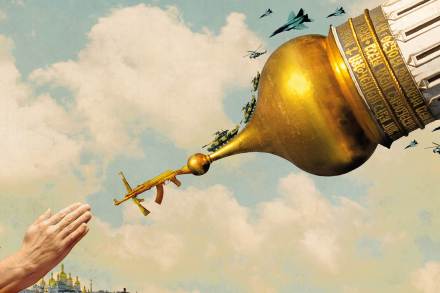
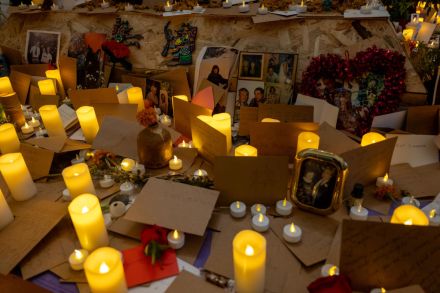
By the summer of 2024, Kyivans could joke that there was no way the Russian army could take their city now — they’d never get through the downtown traffic. The simple normality of urban congestion, crawling through grand boulevards in the shadows of buildings that, with fresh coats of paint, would suggest a Wes Anderson vision of Mitteleuropa, could lull a visitor into thinking he could be in any capital on the old Orient Express route. So, too, would the world-class Fenix restaurant, run by a celebrity chef and festooned with Chihuly-inspired decor. It was between the salmon tartare eclair and the rabbit ravioli that I heard for the first time, face-to-face, what it’s like to be persecuted for worshipping God in the wrong way.

ukraine
la varna

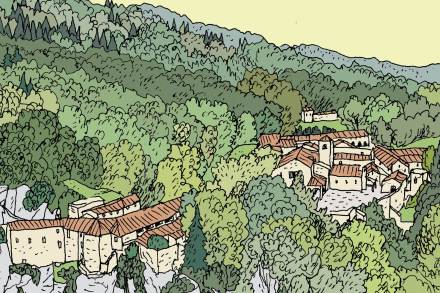
A pilgrimage to St. Francis’s holy sanctuary at La Verna

Beneath a stunning Della Robbia Crucifixion a lone candle burns on the floor of the Holy Stigmata Chapel in the sanctuary of La Verna. The immense tranquility belies the astonishing events that occurred in 1224 on this rocky outcrop in central Italy’s Umbrian hills. The chapel marks the spot where, two years before his death, Saint Francis, retreated to fast and pray with two of his brother friars. After some weeks, Francis saw a six-winged Seraphim, apparently crucified, who appeared and imposed the five wounds of Christ’s Passion on his body — in paintings the angel appears to be “lasering” St. Francis, who is often depicted as a sort of Franciscan version of Willem Dafoe getting it at the end of the film Platoon — including the nails protruding. Heady stuff.

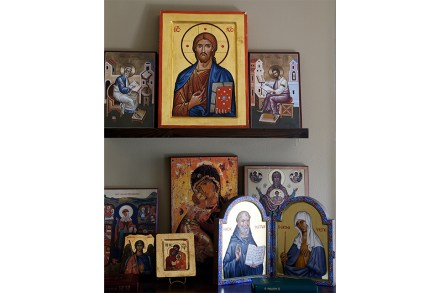
We need to learn to pray again

From our UK edition

In The Spectator’s basement kitchen a few weeks ago, I cornered a young colleague, Angus Colwell, and asked him what he made of Rod Dreher’s new book Living in Wonder. The thrust of it is that we are not in an age of enlightenment so much as ‘endarkenment’ (Dreher’s term) and that, having turned our backs on God, we have become easy pickings for demonic forces. ‘Oh Lord’, said Angus, turning wearily away, ‘I’m so sick of demons.’ This delighted me then and still delights me, both because it’s so surreal and also because it rings so true. If you’d told me ten years ago that young political types in 2024 would be talking knowingly about the ancient devil-gods of the Mesopotamian region – Moloch, Ishtar and Baal – I’d have said your vape was spiked.

Welby resigns: crisis at the Church of England

From our UK edition

18 min listen

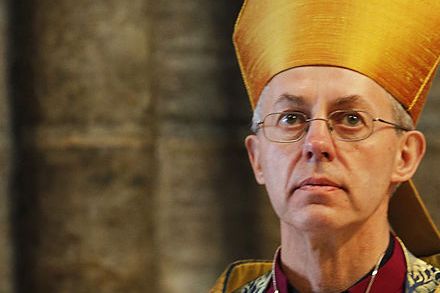
After mounting pressure, the Archbishop of Canterbury Justin Welby has resigned. His resignation comes days after a damning report into the child abuser John Smyth who was associated with the Church of England. Welby was apparently made aware of the allegations in 2013, yet Smyth died in 2018 before facing any justice. Since the report was published, Welby and the Church have faced questions about the failure to act and the lack of urgency. The Spectator’s editor Michael Gove joins Damian Thompson to discuss what Damian calls ‘not just a shocking moment in the history of the Church of England, but in the history of English Christianity’.   Produced by Patrick Gibbons and Natasha Feroze.

The strange silence around the Southport attacks

From our UK edition

There are certain rules in British public life that are worth noting. Such as this one: if someone is killed by a jihadist or someone who could plausibly be connected to immigration in any way, the British public will not be informed of the possible motive – or at least not until it becomes impossible to conceal it any longer. It was revealed that the attacker was of Rwandan heritage, at which point people said: ‘Nothing to see here’ Certain rules follow on from this. One is that ‘wise’ heads will inform anyone who does mention a likely motive that they must be exceptionally careful not to prejudice any forthcoming trial. There then comes an insistence that there will be a time and a place to debate these things. Quite often, that time and place never arrives.

Sale of the century: why is the Kirk selling off hundreds of churches so cheaply?

From our UK edition

27 min listen

In this week’s Spectator, William Finlater reveals that some of the Church of Scotland’s most precious architectural heritage is being flogged off quickly, cheaply and discreetly. Most western denominations are being forced to close churches, but the fire sale of hundreds of Scottish churches is unprecedented in British history. In this episode of Holy Smoke, Damian talks to William about the Kirk’s apparently panicky reaction to losing half its members since 2000, and asks new Spectator editor Michael Gove – once a Church of Scotland Sunday School teacher – why his former denomination is staring into the abyss. Produced by Oscar Edmondson and Patrick Gibbons.

The tragedy of Scotland’s church sell-off

From our UK edition

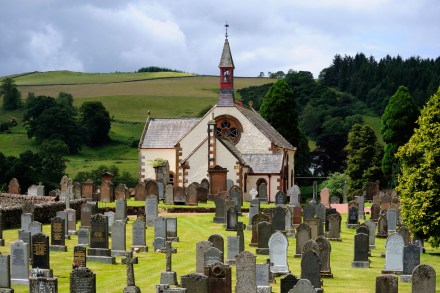
‘We are not a heritage society,’ insisted the Rev David Cameron, Convener of the Assembly Trustees of the Church of Scotland. Speaking to the BBC in January, Mr Cameron claimed the Church has a ‘surplus of buildings and large property’, and that there is a need ‘to address our estate’. A church or kirk is usually the most historically important building in any given town or village In other words, the Church of Scotland is selling off its churches. Not just one or two here or there, but a lot, and for cut-price rates. Of course, the Church insists that the move is ‘painful but essential’, aping the language of a corporate multinational’s HR department. Yet the sheer scale and decisiveness of the move belie the patronising smiles of the Church hierarchy.

Chicken soup for the souls: a feast for the dead

It’s indisputable. Food & Drink is The Spectator’s most important section. Ask yourself this: if you hadn’t eaten in days, would you have the slightest interest in perusing the deft political analysis, elevating cultural commentary and scintillating wit to be found the rest of the magazine? Without food, the only reading worth bothering with is Preparation for Death. As starvation sets in, only the two inevitables remain — Death and Taxes — and what need to worry about taxes? Tombstones have no mailboxes, shrouds no pockets. For over a millennium, November has been the month of the dead. The eleventh has been dedicated to fallen soldiers ever since World War One; but All Souls’ Day goes back much farther.

Souls

Catherine Nixey’s Heresy is a joy to read

What people tend to forget about Jesus Christ is that he killed children. As a five-year-old, Jesus was toddling through a village when a small boy ran past, knocking his shoulder. Taking it like any five-year-old would, Jesus shouted after him "you shall not go further on your way," at which point the boy fell down dead. Later, when the boy’s parents admonished Joseph and Mary for failing to raise their son properly, Jesus blinded them. Something to bear in mind next time you ask yourself: "What would Jesus do?" If this story is unfamiliar, that is because it doesn’t appear in any of the Bible’s traditional Gospels.

Heresy

The Pope announces 21 new cardinals. Is he trying to pack the conclave?

From our UK edition

26 min listen

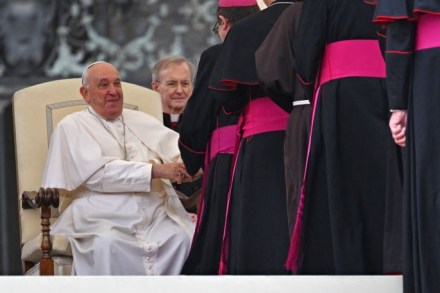
This month Pope Francis announced that he’s creating 21 cardinals, and once again his list includes unexpected names that will baffle commentators who assume that he’s determined to stack the next conclave with liberals.  For example, Australia now finally has a cardinal – but he’s a 44-year-old bishop from the Ukrainian Greek Catholic diaspora rather than the actual head of the Ukrainian Church in Kiev. There’s also a new English cardinal who isn’t even a bishop, the Dominican theologian Timothy Radcliffe. He’s nearly 80, so will soon have to step down as an elector – but, believe it or not, one of the new cardinals is 99 and therefore old enough to be his father.

Why C of E bishops are so bland

From our UK edition

Nolo episcopari. These were the words a person was expected to say on being offered an episcopal see. It basically translates as ‘Don’t bishop me!’ and goes back to at least St Ambrose, who so wanted to avoid being made a bishop that he skipped town. The Church of England has worked itself into a new position, Nemo episcopari: nobody will be bishoped. In the past year, the process for appointing new bishops to Ely and Carlisle fell apart as the Crown Nominations Commission (CNC) decided not to appoint any of the shortlisted candidates. This has created a sense of crisis in the Church, and an emergency meeting of the House of Bishops was held after a report was hastily drafted by the Bishop of London.

How pistols in St Paul’s Cathedral shaped the science of sound

From our UK edition

18 min listen

In the winter of 1951 shots from a Colt revolver rang out in St Paul’s Cathedral in an experiment designed to solve the mystery of how architecture shapes sound. In this episode of Holy Smoke, Damian Thompson talks to Dr Fiona Smyth, author of a new book on the subject, and choral musician Philip Fryer, about the perfect acoustic – an increasingly important topic for churches, since many of them rely on the income from hiring themselves out as concert and recording venues. And it raises the question: should we think of a church as a musical instrument?

A chillingly seductive glimpse of assisted dying

From our UK edition

A few weeks ago, I was present when my aunt, a Canadian citizen born in the UK, chose to die through euthanasia, or as it is euphemistically called in Canada, Medical Assistance in Dying or MAiD. Being British, I wasn’t familiar with the process. What I saw horrified me, but it was also chillingly seductive. My aunt was 72 and in the early stages of motor neurone disease. She had lost the use of one arm but though frail, was living independently and had perfect mental acuity. She was an artist who had worked in the theatre for 40 years designing beautiful and elaborate costumes. For several decades following her divorce she had lived determinedly alone and was not prepared to become an invalid. She made the decision to die freely and against the wishes of her family.

The C of E’s raving madness

From our UK edition

In February there was a commotion at Canterbury Cathedral. Or, to be more precise, there was a silent commotion. The cause was a ‘silent disco’ which took place in the nave over two nights. For anyone above the age of 12, a silent disco is where everybody has headphones on and is in their own world. Like the London Underground but with more legroom. There is a DJ as well and so I think (if I’ve got this right) everybody is listening to the same music. In any case, over two nights thousands of revellers came to the cathedral, put on headphones, bought drinks in the side aisles, brushed past the tomb of Thomas Becket and then waved neon lightsabers and danced around to their heart’s content.

Losing faith: will Labour’s VAT policy hit religious schools hardest?

From our UK edition

25 min listen

In this week’s copy of The Spectator, Dan Hitchens argues that a lesser reported aspect of Labour’s decision to impose VAT on private schools is who it could hit hardest: faith schools. Hundreds of independent religious schools charge modest, means-tested fees. Could a hike in costs make these schools unviable? And, with uncertainty about how ideological a decision this is, does the government even care? Dan joins Damian on the podcast to discuss.  Raisel Freedman from the Partnerships for Jewish Schools also joins later, to discuss how the measure could threaten Jewish independent schools, when they provide a haven for students from a climate of rising antisemitism. Produced by Patrick Gibbons.

From the archives: An atheist goes on a Christian pilgrimage. Why?

From our UK edition

23 min listen

Writer Guy Stagg threw in his job to undertake a pilgrimage to Jerusalem via Rome - choosing a hazardous medieval route across the Alps. It nearly killed him: at one stage, trying to cross a broken bridge in Switzerland, he ended up partially submerged in the water, held up only by his rucksack.  On this episode of Holy Smoke, from the archives, Guy explains why his journey was a pilgrimage, not just travels. And Damian Thompson talks to Harry Mount, editor of The Oldie, about why he’s irresistibly drawn to church buildings while remaining an unbeliever - albeit an agnostic rather than an atheist.

Welcome to the new global theocracy

From our UK edition

I had a revelation while watching the Olympics opening ceremony. It was during the infamous section that I (and almost everyone else) understood to be a reference to Leonardo da Vinci’s ‘The Last Supper’. A large woman in a halo-like headdress was flanked by various avant-garde performance artists, including three drag queens. These, presumably, were the disciples. The table then turned into a catwalk and we were treated to a fashion show featuring representatives of the LGBT community, culminating in a naked man covered in sparkly blue paint. Sacré bleu! ‘This is France,’ tweeted Emmanuel Macron afterwards, apparently satisfied that this performance, like the rest of the opening ceremony, had epitomised everything worth celebrating about La Belle France.

The plotting to find the next Pope

From our UK edition

The Hollywood adaptation of Conclave, Robert Harris’s thriller about a conspiracy to rig a papal election, won’t be in cinemas until November. But judging by the trailer released last week, its starry cast, crafty plot and spectacular cinematography – jets of smoke scattering cardinals as an explosion shatters the Sistine Chapel – will instantly erase memories of The Two Popes, Netflix’s risible Oscar-nominated fantasy in which Benedict XVI secretly chooses Cardinal Bergoglio as his successor.

A new and compelling study of the life of the iconic rebel Nat Turner

In 1831, while the slave rebel leader Nat Turner sat in jail awaiting trial in Southampton County, Virginia, he was visited by a local lawyer named Thomas Gray. Turner spoke at length to Gray, who subsequently published his record of their conversations. At one point Turner said he had been visited many years before by the spirit. “What do you mean by the spirit?” Gray asked. “The Spirit that spoke to the prophets in former days,” Turner replied. Gray was unmoved by Turner’s claims of divine inspiration and concluded that he was a “gloomy fanatic” moved to mass murder by religious delusions.

Turner
devil

Devil in the detail

When I was offered the chance to review two new books about the Devil, I thought, “what fun!” I wouldn’t describe myself as a particularly diabolical person, but as someone whose deep love of Paradise Lost has made me, as good old William Blake didn’t quite put it, “of the devil’s party while very much knowing it,” I rubbed my hands together in glee at the prospect of getting down and dirty with Old Nick. Not, you understand, that my purely literary interest can begin to compare to the “Satanic Panic” outbreak that gripped the imaginations of middle America in the late 1980s and 1990s. “Satanic cults! Every hour, every day, their ranks are growing!