Religion

Sins of the fathers | 26 March 2011

From our UK edition

The trouble about writing a history of the popes is that there are so many of them. Usually elderly when elected, most of them have only lasted a few years. The longest reign was that of the mid-19th-century pope, Pius IX, Pio Nono, who clung on for 31 years. In our own times, Pius XII did 19 years, Paul VI 15 and John Paul II 18. But all were unusual. Closer to the average was poor John Paul I, who lasted 34 days. As a result there have been 264 popes. About some we know nothing and one or two may have been fictitious. ‘Pope Joan’ certainly was. So taking on the task of a comprehensive survey requires courage. Lord Norwich is a battle-hardened veteran of many popular histories. The Hon.

So farewell, John Bull

From our UK edition

His Grace the Archbishop of Canterbury, Dr Fisher, keen to counter the dreadful spectre of the atomic bomb in the 1950s, observed that the very worst it could do would be to sweep a vast number of people at one moment from this world into the other, more vital world, into which anyhow they must all pass at one time. His Grace the Archbishop of Canterbury, Dr Fisher, keen to counter the dreadful spectre of the atomic bomb in the 1950s, observed that the very worst it could do would be to sweep a vast number of people at one moment from this world into the other, more vital world, into which anyhow they must all pass at one time. Simon Green notes that such an opinion had already become unacceptable by that time, even though it was not, and still is not, unorthodox theology.

Coffee House Exclusive: McBride joins CAFOD

From our UK edition

                  The penance of Damian McBride continues. After being ejected from No10, and disowned by his mentor Ed Balls, I can reveal that our antihero now has a new job – head of media at the Catholic overseas aid charity CAFOD. He will be doubtless be brilliantly effective at briefing against its enemies (in CAFOD's case, hunger and the devil). I imagine the pay is several leagues below what he'd get from cashing in on his notoriety and publishing a hit man's confessions. The weird thing is that McBride could have done so well, had he steered clear of Balls. He was a Treasury civil servant, specialising in VAT, before Balls trained him up in the art of character assassination.

The battle for the holy city

From our UK edition

In a tour de force of 500 pages of text Simon Sebag Montefiore, historian of Stalin and Potemkin, turns to a totally different subject: the city of Jerusalem. Founded around 1000 BC by Jews on Canaanite foundations, it has been, in turn, capital of the Kingdom of Judah; scene of the crucifixion of Jesus and of Mohammed’s night ride to heaven; a provincial city in the Persian, Hellenistic, Roman, Arab, Ottoman and British empires; and finally the capital of Israel. Using the latest archaeological evidence, Montefiore recounts with verve the manias and massacres of the different dynasties which ruled the city. The line of David, the blood of the Prophet, the Crusader dynasties of Flanders and Lusignan dominated the city as well as competing religions.

Eastern promises | 18 February 2011

From our UK edition

Events in Bahrain are yet another reminder of why the supposed choice between stability and democracy is a false one. The idea that in the medium to long term backing a Sunni monarchy in a Shiite majority country is a recipe for stability is absurd. If this was not enough, by backing the minority monarchy the West is ensuring that, for obvious reasons, the opposition to it will become radicalised and anti-Western. The West is where it is. It, sadly, cannot start again from scratch in the Middle East. But it cannot allow itself to continue being the allies of those who brutally repress the aspirations of their own peoples - a policy that would ensure this troubled part of the world grows even more hostile to Western interests.

Can it be described?

From our UK edition

Where was God in the Holocaust? This question confounds even learned rabbis, so let’s not linger there. Where was God in the Holocaust? This question confounds even learned rabbis, so let’s not linger there. Was there a Holocaust? Until I began preparing this notice I had never looked into the claims of Holocaust deniers. What I found was a volume of assertions that the Holocaust never happened that might make Hitler and David Irving blanch. Very difficult in a different way is how to write about one of the greatest crimes ever and still tell the truth. Can an author who witnessed terrible things write about them while adhering to truth or fact? Here’s a tough example.

From the archives: Ratzinger’s vision

From our UK edition

A propos of nothing – except perhaps the religious time of year – here's The Spectator's report on one Cardinal Ratzinger setting out his "cautious and conservative" vision for Catholicism at the Extraordinary Synod of 1985: Ratzinger’s synod, The Spectator, Vera Buchanan, 7 December 1985
 Rome – Well, the Extraordinary Synod is nearly over – it has been a well planned, well executed flop. Thus it was conceived and thus it has borne fruit – bland, musty fruit. In Rome no one expected anything else. While foreign presses tried to titillate the public with dramatic tales of clocks being turned back, rivers of modernism dammed, the spirit of Vatican II laID, here in the cynical Eternal City we knew better.

Christmas cheer, Spectator style

From our UK edition

It was the Spectator’s Carol Concert last night, in the Fleet St church of St Bride’s – and one of my favourite nights of the year. The choir is amazing: if you’re a sucker for John Rutter-style choral arrangements (which I very much am), then it was heaven. The choir’s first piece was Harold Darke’s stunning arrangement of In The Bleak Midwinter, perhaps my second-favourite piece of Christmas music.* I was up for the first reading, Isaiah Ch9, predicting the birth of Christ. It was weirdly short, so I looked up the Good Book to see if I could beef it up a little – and it was one of those moments when you’re reminded just how brutal the Old Testament can be.

The strange case of Turkey, Islamic history and V.S. Naipaul

From our UK edition

Nobel laureate V.S. Naipaul has pulled out of the European Writers’ Parliament in Istanbul, following pressure from Turkish writers who felt ‘uneasy’ about comments he had made about Islam in 2001. Naipaul compared Islam to colonialism, arguing that both had had ‘a calamitous effect on converted peoples. To be converted you have to destroy your past, destroy your history. You have to stamp on it, you have to say 'my ancestral culture does not exist, it doesn't matter.’ Naipaul’s comments concern the factual context of Islam’s expansion between the 7th and 17th centuries, hence the comparison with colonialism.

Sweeter than honey

From our UK edition

The only thing I can remember about a Tesco advertisement on the television the other night is the line: ‘No rest for the wicked.’ It was meant ironically, of course. The only thing I can remember about a Tesco advertisement on the television the other night is the line: ‘No rest for the wicked.’ It was meant ironically, of course. The suggestion was not that wicked people alone shop at Tesco’s. Nor was the phrase intended as a pious invocation of the Bible, its source, Isaiah, 57:21. An anthropologist describing the clichés, or tropes, of Western cultures might form the idea that biblical religion played a lively part in daily discourse.

When the Pope met Boris

From our UK edition

A good scoop from The Catholic Herald. Stuart Reid reveals what Mayor Boris Johnson said to the Pontiff last night: 'I’d like to tell you what went on in the Royal Suite at Terminal 4 last night when Boris Johnson, the Mayor of London, met Joseph Ratzinger, the Pope of Rome. “I told the Pope,” said Boris, “that what was wrong with Britain was that the Roman Emperor Honorius told the Brits in 410 AD that Rome was no longer able to protect them. “From that time,” said Boris to the Pope, “the British have had a sense of desertion, of confusion, of rejection.” What did the Pope make of that? I asked Boris. “He looked hunted. His eyes flickered around the room.

From the archives: John Paul II’s visit to Britain

From our UK edition

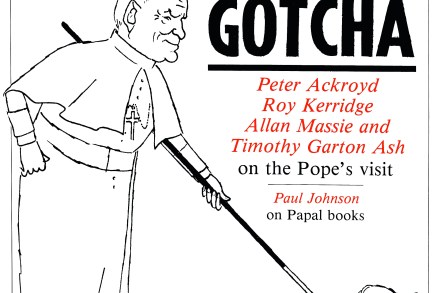
No need to explain why we've disinterred this piece by Peter Ackroyd, on the last papal visit to Britain, from the Spectator archives. And, to the left, the cover image by Garland from that week's issue. As news emerges that five people have been arrested in connection with a terror plot against Benedict XVI, a reminder that papal visits are always replete with global-political significance: The Pope and his princeling, by Peter Ackroyd, The Spectator, 5 June 1982 The pilgrims arrived in Canterbury, carrying their fold-up chairs in plastic Sainsbury bags; strange rumours on the train from London: 'You can't get into town without a permit. They say they've stopped all the cars for three miles … They've taken the door off the cathedral'.

On the Pope’s visit

From our UK edition

The Pope, as I'm sure you know, has touched down in Britain. Here, for CoffeeHousers, is the editorial on his visit from this week's new-look issue of the magazine: Benedict brings hope The arrival of Pope Benedict XVI in Britain has provoked protests that, in the intesity of their anger, far exceed those that greet the state visits of blood-drenched dictators. That is because the Pope is seen to represent — in ascending order of secular distaste — religion, Christianity, the Roman Catholic Church and the conservative wing of Catholicism. Fair enough: Benedict does represent all of these things. He opposes atheism, regarding it as a desperately sad alienation of man from his creator.

Let’s move on from Stephen Fry’s Pope bashing

From our UK edition

Stephen Fry is good at taking himself seriously while pretending not to take himself seriously. But slowly, as he gets older and grander, his self-effacing mask is slipping. He's becoming less and less of a comedian, more and more a sanctimonious bore. Look at the way he has taken it upon himself to denounce, with such gravitas, Pope Benedict XVI's visit to Britain. In his interview with the BBC yesterday – see above – Fry insists that the Pope should be free to come to Britain. "How could I hold my head up if I objected to that?" he says. What Fry cannot not accept, he explains, is that the Pope's time in the UK should be treated as a state visit. Fair enough, I suppose.

Amid the encircling gloom

From our UK edition

Africa is the setting for several of V. S. Naipaul’s finest fictional stories — In a Free State, A Bend in the River, Half a Life. Africa is the setting for several of V. S. Naipaul’s finest fictional stories — In a Free State, A Bend in the River, Half a Life. And there is a pattern to the themes in the African works: fear, post-colonial disintegration, isolation, approaching catastrophe, a sense of being trapped in a way of life that is hovering on the borders of savagery. It is an unforgettable vision, but it remains that of an outsider. In The Masque of Africa, Naipaul goes deeper; this is the account of a journey through five countries with the purpose of ‘investigating the effects of African belief on the progress of civilisation’.

The Hollobone dimension

From our UK edition

As Paul Goodman notes, it is entirely possible that Philip Hollobone’s statements about the burka were taken out of context. As far as I can gather Hollobone has not yet dissociated himself, which is indicative of the contrary.   The French ban on the burkha has English tongues wagging, and Hollobone has looked to stimulate debate. Islamic groups, many of them extreme, will now decamp to Hollobone’s constituency office in Kettering and look to foment a media storm. But so what? This is a debate that must be had.  For example, it must be determined in law whether or not the burka is a religious item, and therefore inviolable under laws of freedom of religious expression. If not, then it would be interesting to hear Muslims, especially women, defend it.

Physical and spiritual decay

From our UK edition

The most striking thing about Piers Paul Read’s early novels was their characters’ susceptibility to physical decay. The most striking thing about Piers Paul Read’s early novels was their characters’ susceptibility to physical decay. The bloom of youth barely had time to settle before it was overrun by maggots. Thus, coolly appraising his mistress’s somewhat faded charms, Hilary Fletcher in The Upstart (1973) notes that marriage and children ‘had loosened her bones and skin and clouded those once fresh eyes with the film of age.’ Harriet, it turns out, is all of 26.

May calls for culture change towards LGB&T groups

From our UK edition

Theresa May has called for ‘culture change’ in wider society to ease the equality and acceptance of lesbian, gay, bi-sexual and transgender minorities. Abstractions are the executive’s favoured metier these days. I’ve read and re-read May’s article in Pink News and nowhere does she define ‘culture change’. The end product of a culture change towards LGB&T groups might be envisaged, but how is it initiated? The government cannot answer that question, beyond suggesting that supporting pride marches is positive. True, but society is more than a pride march. It exists in the daily confusion caused by ill-defined laws, such as who B&B owners let into their homes/businesses.

In defence of Mary Whitehouse

From our UK edition

The first time I interviewed Mary Whitehouse was for the Evening Standard in 1965. She seemed to me a narrow-minded schoolmarm, and after our encounter I wrote a teenagerish attack on her. I was thrilled by the satire boom that had been launched by That Was The Week That Was, and I loved other shows that she opposed, such as Till Death Us Do Part. In the event, Charles Wintour, then the Standard’s editor, spiked my article. ‘You haven’t understood the point about Mrs Whitehouse,’ he said. ‘She’s challenged the system. She has annoyed the hell out of the Director-General of the BBC, [Hugh Carleton Greene]. But she’s got a constituency behind her and she’s making an impact.

Not every aspect pleases

From our UK edition

Half a century ago I read W. G. Hoskins’s book, The Making of the English Landscape, when it first came out. It was for me an eye-opener, as it was for many people. Half a century ago I read W. G. Hoskins’s book, The Making of the English Landscape, when it first came out. It was for me an eye-opener, as it was for many people. It told us of the extent to which our landscape had been made by man, not God, and taught us to look much more observantly at it. Since then, landscape history has become a major subject. So has media and political interest in what we are doing to it. In addition, another subject has come up in the shape of ‘man-made climate change’.